
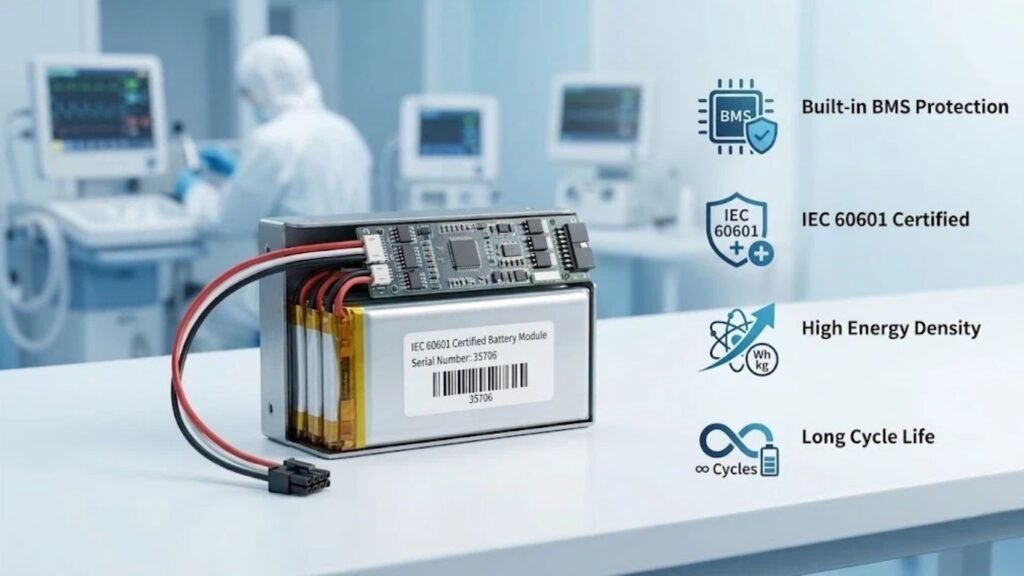
Custom Medical Batteries: OEM Solutions for Healthcare Devices
Published by A&S Power | Medical Battery Technology
Introduction
In medical devices, battery reliability is a patient safety issue—not a convenience feature. A failed battery in a diagnostic device can delay critical care. A dead battery in a drug delivery system can be life-threatening. This is why medical device OEMs cannot afford to source batteries from general consumer electronics suppliers.
At A&S Power, we manufacture custom medical batteries for healthcare OEMs worldwide. Our custom medical device battery packs are designed to meet the specific power, safety, and regulatory requirements of your device—whether it’s a wearable patient monitor, a portable diagnostic tool, or a life-critical drug delivery system. If you’re new to battery specifications and need a primer on voltage, capacity, and discharge rates before diving into medical-specific requirements, read our lithium-ion battery specifications guide for OEM buyers.
This page covers our custom medical battery capabilities, the safety standards we comply with, ISO 13485 quality management, compatible medical battery replacement options, and real examples of medical batteries we’ve produced. If you’re still in the early research stage and comparing different battery chemistries and configurations, read our complete guide to medical device battery selection first.
Medical Device Types & Their Battery Requirements
Different medical devices have vastly different power profiles. A wearable CGM patch needs an ultra-thin, flexible battery that lasts 7-14 days on a single charge. A portable defibrillator needs a high-discharge battery capable of delivering hundreds of amps in milliseconds. Here’s how we approach each category:
| Device Category | Examples | Key Battery Requirements & Our Solution |
|---|---|---|
| Patient Monitors | ECG/EKG, pulse oximeters, blood pressure monitors, bedside monitors | Long runtime (8-24h), low self-discharge, reliable fuel gauge. We use 2000-5000mAh LiPo packs with SMBus communication for accurate remaining capacity reporting. |
| Drug Delivery Systems | Insulin pumps, inhalers, infusion pumps, auto-injectors | Consistent power output, safety-critical reliability, small form factor. Our micro-pouch cells (10-500mAh) with precision PCM ensure stable voltage for motor-driven drug delivery. |
| Portable Diagnostics | Glucose meters, blood analyzers, thermometers, handheld ultrasound | Compact size, long shelf life, low self-discharge. Our 500-2000mAh cells with low self-discharge chemistry hold charge for 12+ months on the shelf. |
| Wearable Medical | CGM patches, smart patches, wearable ECG, hearing aids | Ultra-thin (0.4mm-3mm), lightweight, flexible, patient comfort. Our ultra-thin pouch cells (AS154025 at 1.6mm) are designed for skin-contact wearables. For more on compact battery options, see our small LiPo battery guide. |
| Therapeutic Devices | TENS units, nerve stimulators, CPAP machines, nebulizers | Consistent discharge for motor operation, long cycle life, medium-high capacity. Our 1000-10000mAh packs support continuous motor operation. |
| Emergency & Critical Care | Defibrillators, ventilators, suction devices, AEDs | Uncompromising reliability, high discharge rates (100A+ pulses), long shelf life with self-testing. We design high-discharge packs with redundant protection circuits. For high-capacity needs, explore our high capacity lithium polymer battery solutions. |
Safety Standards & Certifications
Medical device batteries must comply with rigorous safety and regulatory standards before they can be integrated into a certified medical device. We provide full compliance documentation with every order, including test reports, certificates, and material declarations to support your regulatory submissions (FDA 510(k), CE MDR, etc.). For a comprehensive overview of battery safety requirements across all industries, read our lithium battery safety and compliance guide.
| Standard | What It Covers & Why It Matters |
|---|---|
| UL 1642 | Safety testing for individual lithium cells—electrical (overcharge, short circuit, forced discharge), mechanical (crush, nail penetration, shock, vibration), and fire hazards. Required for any lithium cell used in a medical device sold in the US. Our LiPo cells are TÜV SÜD certified to UL 1642 safety standards. |
| UL 2054 | Safety testing for battery packs (multi-cell assemblies with PCM/BMS). Tests the pack as a complete system, including protection circuit response to fault conditions. Required for custom medical battery packs. |
| IEC 62133 | International safety standard for portable lithium cells and batteries. Widely accepted in EU, Asia, and global markets. Often used as the basis for CB Scheme certification, simplifying multi-market regulatory approval. |
| IEC 60601-1 | Medical electrical equipment safety. The battery as a component must meet electrical safety, isolation, and creepage/clearance requirements specified in the device’s IEC 60601-1 compliance documentation. |
| ISO 13485 | Quality management system for medical device manufacturers and suppliers. Ensures consistent production quality, traceability, document control, and CAPA processes. See dedicated section below. |
| ISO 14971 | Risk management for medical devices. Requires identification, analysis, evaluation, and control of all potential battery risks—overcharge, over-discharge, short circuit, thermal runaway, end-of-life degradation. |
| CE / RoHS | CE marking required for EU market. RoHS restricts hazardous substances (lead, mercury, cadmium, etc.). Our batteries are RoHS-compliant with documentation to support your device’s CE marking under MDR. |
| UN38.3 | UN transportation standard for lithium batteries. Required for air and sea shipping. We provide UN38.3 test summaries with every shipment, ensuring global transport without customs delays. |
ISO 13485: Why It Matters When Sourcing Medical Batteries
If you’re searching for an ISO 13485 battery manufacturer, you already know that not all battery suppliers are qualified for medical device production. ISO 13485 is the international quality management standard specifically designed for medical device manufacturers and their suppliers. It goes far beyond general ISO 9001 by requiring:
- Batch-level traceability — every battery can be traced back to the exact production batch, raw material lot, and production date. Critical for post-market surveillance and field safety corrective actions (FSCA).
- Document control and change management — any change to battery design, materials, or production requires formal documentation, risk assessment, and regulatory impact evaluation. No silent substitutions of cells or components.
- Supplier qualification and monitoring — raw material suppliers (cell manufacturers, IC vendors, connector suppliers) are qualified and periodically re-evaluated for consistent quality.
- CAPA (Corrective and Preventive Action) — any quality issue triggers a formal CAPA process with root cause analysis, corrective action, and verification of effectiveness.
- Process validation — critical production processes (spot welding, PCM programming, pack assembly) are validated to ensure consistent output.
- Long-term availability commitment — medical devices have 5-10 year lifecycles. An ISO 13485-certified supplier provides 6-12 months EOL notice with last-time-buy options.
When evaluating a medical device battery manufacturer, always request a copy of their ISO 13485 certificate and verify its scope covers battery assembly and/or cell manufacturing. A supplier with only ISO 9001 may be adequate for consumer electronics but is not sufficient for medical device supply chains.
Compatible Medical Batteries: Replacement vs Custom Design
Many medical device OEMs face a common dilemma: should they source a compatible medical battery (an off-the-shelf or third-party replacement matching the original device’s specifications) or design a fully custom battery pack? The answer depends on your product stage and volume.
When Compatible / Replacement Batteries Make Sense
- Low-volume products or prototypes — fewer than 500 units/year, the tooling and NRE cost of a custom pack may not be justified. A compatible battery based on a standard cell (18650, 14500, standard pouch) gets you to market faster.
- Replacement / aftermarket batteries — supplying replacement batteries for existing medical devices already in the field, a compatible battery matching the original’s form factor, connector, and electrical specs is often most cost-effective.
- Standard power requirements — if your device’s power needs match an existing standard battery format, a compatible battery reduces development time and cost.
When Custom Medical Battery Packs Are Necessary
- Unique form factor requirements — wearables, handheld instruments, and implant-adjacent devices need batteries shaped to fit non-standard enclosures. Custom dimensions, stepped shapes, curved profiles only possible with custom pouch cell design.
- Safety-critical or high-discharge applications — defibrillators, infusion pumps, surgical tools need custom protection circuits, cell matching, and thermal management that off-the-shelf batteries cannot provide.
- Smart battery communication — medical devices often need SMBus, I²C, or CAN for accurate fuel gauging, cycle counting, and authentication. These require custom BMS design and firmware.
- High-volume production — above 5,000-10,000 units/year, per-unit cost savings of a custom-optimized battery typically offset NRE within 6-12 months.
- Regulatory traceability requirements — custom packs from an ISO 13485-certified manufacturer come with full batch traceability, material declarations, and test reports that simplify regulatory submission.
At A&S Power, we produce both compatible medical batteries (standard cells with custom connectors and labeling) and fully custom medical device battery packs (custom cell dimensions, custom BMS, custom form factor). For a broader look at custom pack design across industries, see our complete guide to custom lithium battery packs for OEM buyers. We can help you evaluate which approach is right for your product stage and volume. For a detailed comparison of battery chemistries to inform your selection, see our medical device battery selection guide.
Customization Options for Medical Device Batteries
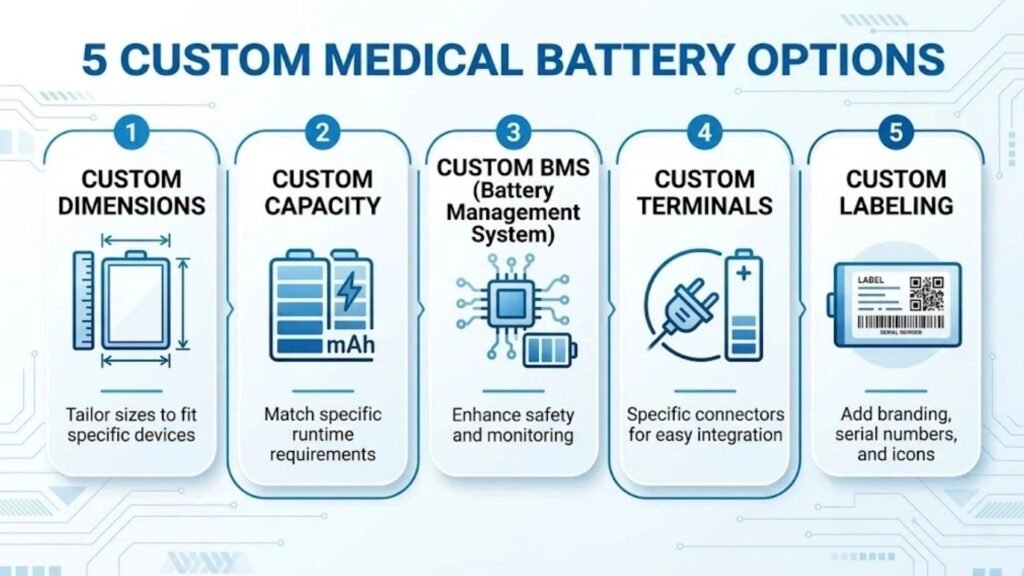
As a custom medical device battery manufacturer, we offer comprehensive customization across every aspect of the battery. If you’re wondering whether a lithium polymer (pouch) cell is right for your device versus a traditional lithium-ion cell, our LiPo vs Li-ion comparison article breaks down the key differences in form factor, safety, and performance.
| Customization Area | Specific Options & Capabilities |
|---|---|
| Dimensions & Shape | Ultra-thin from 0.4mm to standard thickness; any shape—rectangular, stepped, curved, notched, or custom geometry. Pouch cells with tabs on any side for optimal PCB layout. |
| Capacity & Voltage | 10mAh to 10,000mAh+ per cell; multi-cell packs from 3.7V (1S) to 48V+ (13S+). Series-parallel configurations matched to your device’s exact power profile and runtime requirements. |
| PCM / BMS | Overcharge, over-discharge, over-current, short-circuit, temperature protection. NTC thermistor. Communication: I²C, SMBus, CAN, HDQ. Fuel gauge ICs (TI, Maxim, ADI) for accurate remaining capacity reporting. |
| Terminals & Connectors | Wire leads with custom length/gauge (28AWG-16AWG). JST, Molex, Hirose, AMP, or custom connectors. Solder pads for direct PCB mounting. Nickel tabs for spot welding. Custom connector orientation and pinout. |
| Insulation & Packaging | Custom shrink-wrap (PVC, PET) with logo and regulatory markings. Kapton tape for high-temp insulation. Foam padding for shock absorption. Custom plastic enclosures. Medical-grade adhesives for skin-contact applications. |
| Labeling & Traceability | OEM branding with logo, model number, serial numbers. UDI barcodes/QR codes for medical device traceability. Batch codes, date codes, lot numbers. Custom regulatory markings (CE, UL, RoHS, UN38.3, recycling symbols). For OEM-specific packaging and branding requirements, see our custom battery packaging solutions. |
Real Medical Device Battery Examples from A&S Power
These are actual cells from our standard product line commonly used in medical device applications. Custom variants (different capacity, dimensions, connectors, PCM) are available for OEM projects.
| Model | Specs | Dimensions | Typical Medical Applications |
|---|---|---|---|
| AS154025 | 3.7V, 100mAh, 0.37Wh | 40×25×1.6mm (ultra-thin) | Smart patches, wearable ECG, skin-contact sensors, disposable diagnostic patches |
| AS302323 | 3.7V, 110mAh, 0.41Wh | 23×23×3.5mm | Hearing assistance earbuds, smart rings, miniature medical sensors, health trackers |
| AS401230 | 3.7V, 120mAh, 0.44Wh | 30×12×4.0mm | Hearing aids, glucose meters, digital thermometers, pulse oximeter finger probes |
| AS751437 | 3.7V, 350mAh, 1.30Wh | 39×13×7mm | Hearing aid charging cases, portable nebulizers, handheld diagnostic tools, TENS units |
| AS602663 | 3.7V, 1000mAh, 3.7Wh | 63×26×6mm | Portable patient monitors, infusion pumps, handheld ultrasound, medical data loggers |
| AS18650-2600 | 3.7V, 2600mAh, 9.62Wh, 3C discharge | 18×65mm (cylindrical) | Portable oxygen concentrators, CPAP machines, emergency medical equipment, high-drain therapeutic devices |
All of these cells can be customized with PCM protection, custom connectors, wire leads, and OEM labeling for medical device integration. For custom dimensions outside our standard range, we offer fully custom pouch cell design with tooling typically completed in 3-4 weeks. Browse our full product catalog for more standard cell options.
Why Choose A&S Power for Custom Medical Device Batteries
Selecting the right battery partner for a medical device project affects patient safety, regulatory compliance, and product success for years. Here’s what sets A&S Power apart:
- UL, CE, RoHS, and UN38.3 certified products — every cell and pack comes with full certification documentation including UL 1642 cell test reports, UL 2054 pack test reports, IEC 62133 CB certificates, and UN38.3 transportation test summaries. This reduces your regulatory submission timeline by weeks or months.
- ISO 13485-aligned quality management — batch-level traceability, incoming material inspection, in-process quality checks, and final product testing. Every battery is 100% tested for voltage, internal resistance, capacity, and insulation before shipment.
- Full compliance documentation with every order — material declarations (RoHS, REACH), test reports, certificates of conformity, batch traceability records, and UN38.3 test summaries. Supports regulatory submissions and post-market surveillance.
- Batch-level traceability — every battery carries a unique serial number or batch code traceable to production date, raw material lot, cell manufacturer lot, and production line. Essential for field safety corrective actions (FSCA) and recall management.
- Engineering support from concept to production — DFM feedback, thermal analysis, battery sizing calculations, and regulatory guidance throughout the project. From initial concept through prototype development, design validation, and mass production.
- Stable supply chain for 5+ year medical device lifecycles — long-term cell supplier relationships, 6-12 months advance EOL notice, and last-time-buy options to support your service inventory needs over the device’s full lifecycle.
Frequently Asked Questions
1. What certifications do custom medical device batteries need?
Custom medical device batteries typically require UL 1642 (cell safety), UL 2054 (pack safety), IEC 62133 (international portable battery safety), CE marking (EU market), RoHS compliance (hazardous substance restriction), and UN38.3 (transportation safety). For the complete device, IEC 60601-1 and ISO 14971 also apply, and the battery supplier must provide documentation to support these. We provide full documentation for all battery-level certifications to support your device’s regulatory submission. For a broader overview, see our lithium battery safety and compliance guide.
2. Can you customize battery shape and size for medical devices?
Yes. We manufacture custom shapes and sizes to fit your device’s exact enclosure. Our pouch cells range from as thin as 0.4mm to standard thickness, with custom shapes including rectangular, stepped, curved, notched, and irregular geometries. Custom cell tooling typically takes 3-4 weeks, with prototype samples available for testing before mass production. For projects that don’t require custom cell dimensions, we can also build custom packs using standard cells with custom connectors, PCM, and packaging.
3. How long do custom medical device batteries last?
Under normal use, our custom medical device batteries typically provide 500-800+ charge cycles before reaching 80% of rated capacity, depending on cell chemistry, depth of discharge, charge rate, and operating temperature. For low-discharge applications with shallow cycles (20-30% DoD), cycle life can exceed 1000 cycles. Shelf life is typically 2-3 years when stored at 40-60% charge in cool, dry conditions. We provide cycle life test data for each custom cell design during the prototype validation phase. For a detailed breakdown of battery lifespan factors, read our complete guide to battery life expectancy.
4. Do you provide traceability documentation for medical batteries?
Yes. We provide full batch-level traceability documentation with every order, including batch codes, date codes, production records, incoming material inspection reports, in-process quality check records, final test reports (voltage, internal resistance, capacity, insulation), and certificates of conformity. Each battery can carry a unique serial number or UDI barcode for individual unit traceability. This supports post-market surveillance, field safety corrective action (FSCA), and recall management requirements.
5. What is the typical lead time for custom medical battery samples and mass production?
For custom packs using standard cells (no custom cell tooling), prototype samples typically take 2-3 weeks. For fully custom pouch cells requiring new tooling, first prototypes typically take 4-6 weeks including tooling fabrication. Mass production takes 4-6 weeks after sample approval and order confirmation. For repeat orders of existing designs, lead time is typically 3-4 weeks. We can expedite prototype production for urgent projects—contact our engineering team to discuss your timeline.
6. Can you produce compatible replacement batteries for existing medical devices?
Yes. We produce compatible medical batteries for existing medical devices, matching the original battery’s form factor, connector type, pinout, voltage, capacity, and discharge characteristics. Compatible batteries can include custom labeling with your brand, UDI barcodes, and serial numbers for traceability. We can also upgrade the cell chemistry or capacity within the same form factor if the original battery uses older cell technology. All compatible batteries undergo full electrical testing to ensure they meet or exceed the original device’s power requirements.
7. What is the minimum order quantity (MOQ) for custom medical batteries?
The MOQ depends on the battery type and complexity. For custom packs using standard cells with custom connectors and labeling, the MOQ is typically 500-1000 units per order. For fully custom pouch cells requiring new tooling, the MOQ is typically 5000-10000 units per order, with a one-time tooling charge (NRE) for the custom cell design. For prototype and evaluation quantities, we can produce smaller batches (10-50 units) at a higher per-unit cost to support design validation and regulatory testing. Contact us for a custom quote based on your specific requirements and volume.
8. Can you support regulatory submissions for medical devices using your batteries?
Yes. We provide comprehensive documentation to support your regulatory submissions (FDA 510(k), CE MDR, Health Canada, etc.), including cell and pack test reports (UL 1642, UL 2054, IEC 62133), UN38.3 transportation test summaries, material declarations (RoHS, REACH), safety data sheets (SDS), battery datasheets with electrical and mechanical specifications, and quality management documentation. Our engineering team can also participate in design reviews and provide technical support for battery-related sections of your regulatory submission. For high-risk medical devices (Class IIb/III), we can provide additional testing and documentation as required by your notified body or regulatory authority.
Get a Quote for Your Custom Medical Battery Project
Ready to source custom medical batteries for your healthcare device? Contact A&S Power today for a free consultation and custom quote. Our engineering team will review your device’s power requirements, form factor constraints, regulatory needs, and volume projections to recommend the optimal battery solution.
If you’re still evaluating different battery chemistries and configurations, we recommend reading our complete guide to medical device battery selection first, which covers battery type comparisons, safety standards, selection criteria, and supplier evaluation checklists. For broader battery safety and compliance information, see our lithium battery safety and compliance guide.