
Medical Device Battery Selection: Complete Guide for OEM Buyers
Published by A&S Power | Medical Battery Technology
Introduction
Medical devices are only as reliable as their power source. A battery failure in a patient monitor, insulin pump, or diagnostic device isn’t just an inconvenience—it’s a patient safety risk. Yet many medical device OEMs treat battery selection as an afterthought, specifying a battery only after the device’s mechanical and electrical design is largely complete. This approach often leads to compromised runtime, higher costs, regulatory delays, and field failures.
This complete guide to medical device battery selection is designed for OEM engineers, procurement managers, and product development teams who need to make informed battery decisions early in the design process. We cover the battery selection decision framework, battery chemistry comparisons (including medical grade lithium polymer batteries), device-specific power requirements, safety standards and regulatory compliance, medical device battery testing requirements, customization considerations, and a supplier evaluation checklist.
At A&S Power, we manufacture custom lithium polymer batteries for medical device OEMs worldwide. If you already know you need a custom battery and want to review our capabilities, certifications, and real medical battery examples, see our custom medical batteries solutions page. For a complete overview of our custom battery capabilities across all industries, check out our custom lithium polymer battery manufacturer guide.
Why Battery Selection Matters for Medical Devices
Medical devices have unique power requirements that set them apart from consumer electronics. Understanding these differences is the first step in making the right battery selection:
1. Patient Safety is Non-Negotiable
A failed battery in a consumer device means inconvenience. A failed battery in a medical device can mean a missed diagnosis, interrupted treatment, or worse. For life-critical devices (defibrillators, ventilators, infusion pumps), battery reliability is directly tied to patient outcomes. This means the battery must have redundant protection circuits, predictable end-of-life behavior, and zero tolerance for unexpected failure modes.
2. Regulatory Compliance is Mandatory and Complex
Medical devices must meet strict regulatory standards (FDA in the US, CE MDR in the EU, PMDA in Japan, NMPA in China), and the battery is a critical component that falls under regulatory scrutiny. The battery must have the right certifications (UL 1642, UL 2054, IEC 62133), full documentation for regulatory submissions, and traceability for post-market surveillance. Selecting a battery without proper documentation can delay your device’s regulatory approval by months.
3. Reliability is Expected Over a Long Product Lifecycle
Medical devices must operate consistently, often in critical care environments where failure is not an option. Unlike consumer electronics that are replaced every 2-3 years, medical devices have product lifecycles of 5-10 years or more. The battery must be available for the entire lifecycle, with predictable end-of-life characteristics and a clear last-time-buy process. A battery supplier that exits the market or discontinues a cell can leave you scrambling for a replacement mid-lifecycle.
4. Long-Term Availability and Supply Chain Stability
Medical devices have long lifecycles (5-10 years), and batteries must be available for the entire product lifecycle, including service and replacement periods after production ends. This requires a battery supplier with a stable supply chain, long-term cell sourcing agreements, and a formal end-of-life (EOL) notification process with 6-12 months advance notice. Selecting a battery from a supplier with a history of frequent cell discontinuations can create significant supply chain risk for your medical device.
Medical Device Battery Selection Decision Framework
Use this step-by-step framework to systematically evaluate and select the right battery for your medical device. We recommend completing these steps in the early concept phase of device development, before the mechanical enclosure is finalized, because the battery’s dimensions and placement often drive the device’s industrial design.
Step 1: Define Your Device’s Power Profile
Before evaluating any battery, you need a clear understanding of your device’s power consumption profile:
- Operating voltage range — most medical devices use 3.3V, 3.7V, 5V, or 12V rails, determining whether you need 1S (3.7V), 2S (7.4V), or higher cell count. For a detailed voltage reference across 1S through 6S configurations, see our LiPo battery voltage chart and C-rating guide.
- Average current draw — steady-state current during normal operation, in mA or A.
- Peak current draw — maximum instantaneous current during high-power operations (motor activation, wireless transmission, sensor sampling), with duration specified.
- Required runtime — how long must the device operate on a single charge? (e.g., 8h for patient monitor, 14 days for CGM patch)
- Charge time requirement — how quickly must the battery recharge?
- Self-discharge tolerance — how long can the device sit unused before recharging? (critical for emergency equipment)
Step 2: Calculate Required Battery Capacity
Once you have the power profile, calculate the minimum required capacity:
Required Capacity (mAh) = (Average Current Draw (mA) × Required Runtime (hours)) ÷ Depth of Discharge (%)
Add 20-30% margin for battery degradation over cycle life, temperature effects, and peak current derating. For medical devices, we recommend a minimum 30% capacity margin.
Example: A portable patient monitor draws an average of 250mA and requires 8 hours runtime. Minimum capacity = (250mA × 8h) ÷ 0.8 (80% DoD) = 2500mAh. With 30% margin: 2500mAh × 1.3 = 3250mAh. Select a battery with at least 3250mAh rated capacity.
Step 3: Evaluate Battery Chemistry Options
Based on your power profile and capacity requirements, evaluate which chemistry best meets your needs. The most common chemistries for medical devices are lithium polymer (LiPo), lithium-ion (Li-ion cylindrical), lithium iron phosphate (LiFePO4), and primary (non-rechargeable) lithium. See the detailed comparison in the Battery Types section below.
Step 4: Define Form Factor and Mechanical Constraints
Determine the maximum available space for the battery in your device enclosure, including length, width, height, and any irregular shapes or cutouts. Also consider weight limit (critical for wearables and handhelds), connector placement, and thermal management requirements. If your device has unique form factor requirements, a custom pouch cell may be necessary—see our custom medical batteries page for customization options.
Step 5: Verify Regulatory and Certification Requirements
Confirm which certifications are required for your target markets (US: UL 1642/2054, FDA; EU: CE, IEC 62133, MDR; global: UN38.3). Verify that the battery supplier can provide all required documentation, including test reports, certificates, material declarations, and traceability records. See the Safety Standards section below for detailed requirements.
Step 6: Evaluate Suppliers and Request Prototypes
Shortlist 2-3 battery suppliers based on medical device experience, certifications, customization capability, and supply chain stability. Request prototype samples for electrical testing, mechanical fit verification, and regulatory documentation review. Use the supplier evaluation checklist in the Supplier Evaluation section below. Always test prototypes in your actual device under real-world conditions before committing to mass production.
Battery Types for Medical Devices: Chemistry Comparison
The choice of battery chemistry is the most fundamental decision in medical device battery selection. Each chemistry has distinct advantages and limitations. Here’s a detailed comparison of the four most common chemistries used in medical devices:
1. Lithium Polymer (LiPo) — The Preferred Choice for Most Medical Devices
Lithium polymer batteries use a polymer electrolyte instead of a liquid electrolyte, allowing them to be packaged in flexible aluminum-laminate pouches in virtually any shape or thickness. This makes them ideal for medical devices with unique form factor requirements, especially wearables and handheld instruments.
| Characteristic | Value & Implication for Medical Devices |
|---|---|
| Nominal voltage | 3.7V per cell (4.2V full charge). Multi-cell packs in 7.4V (2S), 11.1V (3S), 14.8V (4S), and higher. |
| Energy density | 150-250 Wh/kg. Among the highest of any rechargeable chemistry, enabling long runtime in small, lightweight packages. |
| Cycle life | 300-800 cycles to 80% capacity. Low-discharge medical applications can exceed 1000 cycles. |
| Form factor | Ultra-thin from 0.4mm, any custom shape (rectangular, stepped, curved, notched). Maximum design flexibility. |
| Self-discharge | 2-5% per month. Low enough for devices that may sit unused for weeks or months. |
| Safety | Good with proper PCM/BMS protection. Polymer electrolyte less prone to leakage. Swelling provides visible warning of internal failure. |
| Best for | Wearable medical devices, patient monitors, portable diagnostics, drug delivery systems, handheld instruments, any device requiring custom form factors. |
2. Lithium-Ion (Li-Ion) Cylindrical — Standardized and Cost-Effective
Cylindrical lithium-ion cells (18650, 21700, 26650, 32700) use a liquid electrolyte in a rigid steel can. They are manufactured in standardized sizes by multiple suppliers, making them readily available and cost-effective for high-volume medical devices that don’t require custom form factors. For detailed specifications of the most widely used cylindrical cell, see our 18650 battery complete guide.
| Characteristic | Value & Implication for Medical Devices |
|---|---|
| Nominal voltage | 3.7V per cell (4.2V full charge), same as LiPo. Multi-cell packs in any series-parallel configuration. |
| Energy density | 150-280 Wh/kg. 18650 cells range 2000-3500mAh; 21700 cells up to 5000mAh. |
| Cycle life | 300-1000 cycles. High-quality cells from established manufacturers (Samsung, LG, Panasonic) typically achieve 500+ cycles. |
| Form factor | Standard cylindrical sizes only (18650: 18×65mm, 21700: 21×70mm, 26650: 26×65mm, 32700: 32×70mm). Pack assembly allows custom overall dimensions. |
| Cost | Lower per-Wh cost than custom LiPo pouch cells due to standardized high-volume manufacturing. Most cost-effective for high-volume devices with standard form factors. |
| Best for | Portable oxygen concentrators, CPAP machines, larger patient monitors, emergency medical equipment, e-bikes for medical mobility, high-volume devices with standard form factors. |
3. Lithium Iron Phosphate (LiFePO4) — Long Life and High Safety
LiFePO4 batteries use lithium iron phosphate as the cathode material, offering exceptional cycle life, thermal stability, and safety at the cost of lower energy density and lower nominal voltage. They are increasingly used in medical devices where long service life and high safety are prioritized over maximum energy density. For a detailed look at the 32700 LiFePO4 cell commonly used in medical and industrial applications, see our 32700 LiFePO4 battery specifications and OEM guide.
| Characteristic | Value & Implication for Medical Devices |
|---|---|
| Nominal voltage | 3.2V per cell (3.65V full charge). Lower than LiPo/Li-ion, requiring more cells in series for the same pack voltage. |
| Energy density | 90-140 Wh/kg. Significantly lower than LiPo/Li-ion, meaning larger and heavier battery for the same capacity. Not ideal for space-constrained wearables. |
| Cycle life | 2000-5000+ cycles to 80% capacity. Exceptionally long cycle life ideal for medical devices charged daily needing 5+ years without battery replacement. |
| Safety & thermal stability | Excellent. Thermal runaway temperature 270°C+ (vs 150°C for LiCoO2), does not release oxygen during decomposition. Safest rechargeable lithium chemistry for medical applications. |
| Best for | Stationary or semi-portable medical devices, battery backup systems for critical equipment, home healthcare devices, long-term monitoring equipment, applications where cycle life and safety outweigh minimum size. |
4. Primary (Non-Rechargeable) Lithium — Long Shelf Life for Low-Drain Devices
Primary lithium batteries (lithium thionyl chloride, lithium manganese dioxide, lithium iron disulfide) are non-rechargeable cells designed for long shelf life and stable voltage output. They are used in medical devices that are not recharged during their service life, such as implantable devices, single-use diagnostic tools, and emergency equipment with long standby periods.
| Characteristic | Value & Implication for Medical Devices |
|---|---|
| Nominal voltage | 3.0V (Li-MnO2), 3.6V (Li-SOCl2), 1.5V (Li-FeS2). Higher voltage than alkaline means fewer cells needed. |
| Shelf life | 10-20 years for Li-SOCl2, 5-10 years for Li-MnO2. Self-discharge less than 1% per year. Ideal for emergency equipment and implantable devices. |
| Energy density | Up to 700 Wh/kg for Li-SOCl2, among the highest of any battery chemistry. Enables very long runtime in small packages for low-drain applications. |
| Discharge capability | Li-SOCl2 has high internal resistance, limited to low-drain (microamp to low milliamp). Li-MnO2 supports moderate discharge. Not suitable for high-drain motor-driven devices. |
| Best for | Implantable medical devices (pacemakers, ICDs), single-use diagnostic tools, emergency equipment with long standby, wireless sensor nodes, low-drain devices requiring 5+ years without recharging. |
Side-by-Side Chemistry Comparison
| Characteristic | LiPo (Pouch) | Li-ion (18650) | LiFePO4 | Primary Li |
|---|---|---|---|---|
| Nominal Voltage | 3.7V | 3.7V | 3.2V | 3.0-3.6V |
| Energy Density | 150-250 Wh/kg | 150-280 Wh/kg | 90-140 Wh/kg | Up to 700 Wh/kg |
| Cycle Life | 300-800+ | 300-1000+ | 2000-5000+ | N/A (disposable) |
| Form Factor | Any custom shape | Standard cylinder only | Standard/custom | Standard sizes |
| Safety | Good (with PCM) | Good (with PCM) | Excellent | Good (sealed) |
| Shelf Life | 2-3 years | 2-3 years | 3-5 years | 10-20 years |
| Best Medical Use | Wearables, portable diagnostics, drug delivery | High-volume standard devices, oxygen concentrators | Long-life stationary, backup power | Implants, emergency standby, single-use |
Summary: Most medical device OEMs choose medical grade lithium polymer batteries because they offer the best combination of design flexibility (custom shapes and sizes), high energy density (long runtime in small packages), and good safety — ideal for wearables, patient monitors, portable diagnostics, and drug delivery systems. Cylindrical Li-ion (18650, 21700) is more cost-effective for high-volume devices with standard form factors. LiFePO4 is preferred for long-cycle-life and high-safety applications where size is less constrained. Primary lithium is used only for non-rechargeable, low-drain, long-shelf-life applications. For a deeper technical comparison of LiPo vs Li-ion beyond medical use cases, see our LiPo vs Li-Ion battery comparison guide.
Medical Grade Lithium Polymer Batteries: What Makes Them Different?
The term “medical grade” is often used loosely in the battery industry, but for medical device applications, a medical grade lithium polymer battery must meet specific requirements that go beyond standard consumer-grade LiPo cells. Here’s what distinguishes a medical grade battery from a standard consumer battery:
- Certified to medical-relevant safety standards — medical grade batteries carry UL 1642 (cell safety), UL 2054 (pack safety), and IEC 62133 certifications, with full test reports available for regulatory submission. Consumer-grade batteries may have CE or RoHS marking but lack the comprehensive safety testing and documentation required for medical device regulatory approval.
- Full traceability and batch documentation — every medical grade battery can be traced back to the production batch, raw material lot, and cell manufacturing date. Batch-level test reports (voltage, internal resistance, capacity, insulation) are provided with every shipment. Consumer batteries typically have only a model number and production date, with no batch-level test data.
- Tighter production tolerances and quality control — medical grade batteries undergo 100% final testing (not AQL sampling) for key parameters including voltage, internal resistance, capacity, and insulation resistance. Cell matching for multi-cell packs is tighter (within ±5mV for medical vs ±20mV for consumer), ensuring more consistent pack performance and longer cycle life.
- Enhanced protection circuits (PCM/BMS) — medical grade battery packs include redundant protection features: overcharge, over-discharge, over-current, short-circuit protection, and temperature monitoring with NTC thermistor. Some medical packs include secondary protection (thermal fuse, PTC) for fail-safe operation. Consumer packs may have only basic overcharge and short-circuit protection.
- Long-term availability commitment — medical grade battery suppliers commit to 5-10 year product availability with formal EOL notification (6-12 months advance notice) and last-time-buy options. Consumer battery models are frequently discontinued or revised with no notice, creating supply chain risk for 5-10 year medical device lifecycles.
- Regulatory submission support — medical grade battery suppliers provide documentation to support your device’s regulatory submission (FDA 510(k), CE MDR), including material declarations (RoHS, REACH), safety data sheets (SDS), battery datasheets with full electrical and mechanical specifications, and engineering support for battery-related sections of your submission. Consumer battery suppliers typically provide only a basic datasheet.
When selecting a battery for a medical device, always verify that the supplier can provide these medical-grade capabilities. A battery that meets only consumer-grade standards may be cheaper upfront, but the lack of documentation, traceability, and long-term availability can lead to regulatory delays, field failures, and costly supply chain disruptions over the device’s lifecycle.
Medical Device Types & Their Battery Power Requirements
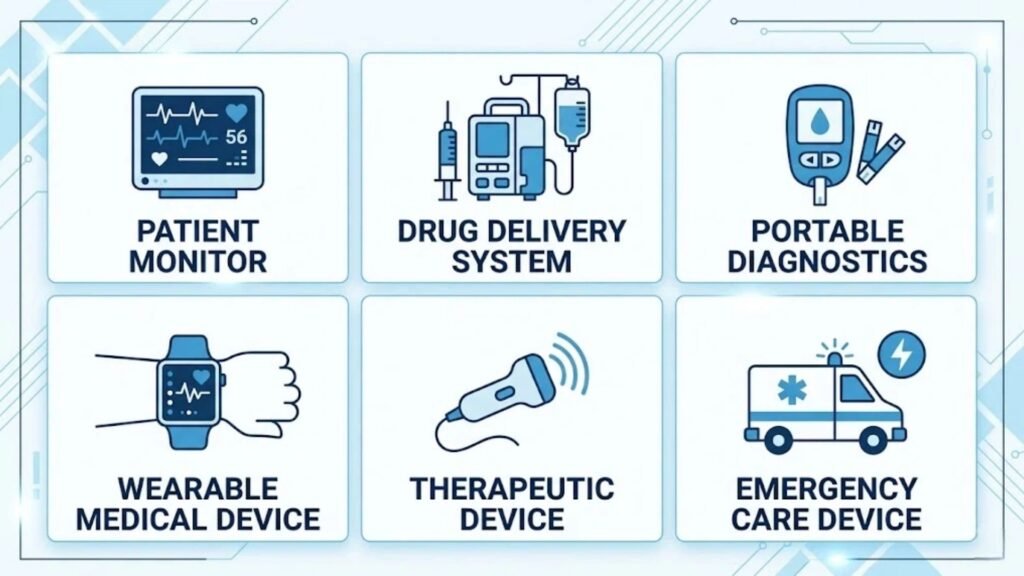
Different medical device categories have vastly different battery requirements. Understanding the specific power profile of your device category is essential for selecting the right battery:
| Device Category | Examples | Typical Battery Specs | Key Selection Criteria |
|---|---|---|---|
| Patient Monitors | ECG/EKG, pulse oximeters, blood pressure monitors, bedside monitors, telemetry | 3.7V-11.1V, 2000-5000mAh, 8-24h runtime, 1C charge | Long runtime, reliable fuel gauge (SMBus), low self-discharge, hot-swap capability |
| Drug Delivery Systems | Insulin pumps, inhalers, infusion pumps, auto-injectors, pain management pumps | 3.7V, 100-1000mAh, 3-14 days runtime, 0.5C charge | Consistent voltage for motor precision, ultra-reliable, small form factor, low self-discharge |
| Portable Diagnostics | Glucose meters, blood analyzers, thermometers, handheld ultrasound, POCT | 3.7V, 200-2000mAh, 1-7 days runtime, 0.5-1C charge | Compact size, long shelf life, low self-discharge, stable voltage for sensor accuracy |
| Wearable Medical | CGM patches, smart patches, wearable ECG, health trackers, hearing aids, smart rings | 3.7V, 10-500mAh, 1-14 days runtime, ultra-thin 0.4-4mm | Ultra-thin form factor, lightweight, flexible, patient comfort, low self-discharge, custom shape. For compact wearable designs, explore our small LiPo battery guide for compact devices. |
| Therapeutic Devices | TENS units, nerve stimulators, CPAP machines, nebulizers, portable oxygen concentrators | 3.7V-14.8V, 1000-10000mAh, 4-24h runtime, 1-2C discharge | Consistent discharge for motor operation, long cycle life (daily charging), medium-high capacity |
| Emergency & Critical Care | Defibrillators, ventilators, suction devices, emergency infusion pumps, AEDs | 12V-24V, 2000-10000mAh, high peak discharge (50-200A), long standby | Uncompromising reliability, high discharge rates, long shelf life with self-test, redundant protection |
Safety Standards & Regulatory Compliance
When selecting a battery for a medical device, you must verify that the battery and its supplier meet all applicable safety standards and regulatory requirements for your target markets:
| Standard / Regulation | What It Requires | What to Verify from Supplier |
|---|---|---|
| UL 1642 | Safety testing for individual lithium cells: electrical (overcharge, short circuit, forced discharge), mechanical (crush, nail penetration, shock, vibration), environmental (temperature cycling, altitude, fire). | Valid UL 1642 certificate for exact cell model. Full test report. Confirm not expired and covers capacity/voltage rating. |
| UL 2054 | Safety testing for battery packs (multi-cell with PCM/BMS). Tests pack as complete system including protection circuit response to fault conditions, thermal performance, enclosure integrity. | Valid UL 2054 certificate for exact pack model. Confirm covers your configuration (cell count, capacity, PCM design). Full test report. |
| IEC 62133 / CB Scheme | International safety standard for portable lithium cells and batteries. Basis for CB Scheme certification simplifying multi-market approval. | Valid IEC 62133 test report and CB certificate from recognized NCB (TÜV, UL, Intertek, SGS). Confirm covers exact cell/pack model. |
| IEC 60601-1 | Medical electrical equipment safety. Battery as component must meet electrical safety, isolation, creepage/clearance, EMC requirements. | Supplier’s ability to provide insulation resistance data, dielectric strength data, creepage/clearance dimensions, EMC test data. |
| ISO 13485 | Quality management system for medical device manufacturers and suppliers. Ensures consistent quality, traceability, document control, CAPA. | Valid ISO 13485 certificate with scope covering battery assembly/cell manufacturing. Issued by accredited body. Not expired. Request copy and scope statement. |
| ISO 14971 | Risk management for medical devices. Requires identification, analysis, evaluation, control of all potential battery risks. | Supplier’s ability to provide battery FMEA, hazard analysis, risk control documentation to support your ISO 14971 file. |
| CE / MDR (EU) | CE marking required for EU market. Under MDR 2017/745, battery as component must meet essential safety and performance requirements. RoHS restricts hazardous substances. | EU Declaration of Conformity (DoC). RoHS material declaration. CE marking on label. Documentation to support your device’s CE MDR technical file. |
| UN38.3 | UN transportation standard for lithium batteries. 8 tests: altitude, thermal, vibration, shock, external short, impact, overcharge, forced discharge. Required for air/sea shipping. | Valid UN38.3 test summary for exact cell/pack model from recognized lab. Available for every shipment. |
We provide full compliance documentation with every order. For a broader overview of lithium battery safety standards and certification requirements across all industries, see our lithium battery safety and compliance guide for OEM buyers.
Medical Device Battery Testing Requirements
Medical device battery testing is a critical step before integrating a battery into a certified medical device. It must undergo a comprehensive testing program to verify safety, performance, and reliability. Medical device battery testing goes far beyond the basic capacity and voltage testing performed on consumer batteries. Here are the key test categories:
1. Electrical Performance Testing
- Capacity verification — discharge at rated current to confirm meets/exceeds rated capacity. Tested at 0.2C, 0.5C, and 1C to verify performance across operating range.
- Internal resistance measurement — DC internal resistance within specified range. Medical grade cells typically ±10% tolerance vs ±20% for consumer.
- Voltage accuracy — verify nominal, full charge, and cut-off voltage match datasheet. Critical for devices with precise voltage regulation.
- Charge/discharge cycle testing — 100-500 cycles during validation, 300-1000+ for full qualification. Capacity fade curves must be documented for predictable end-of-life.
- Self-discharge testing — measure capacity loss over 1/3/6/12 months at various temperatures. Critical for emergency equipment that may sit idle for months.
2. Safety Testing (UL 1642 / UL 2054 / IEC 62133)
- Overcharge test — charge at 1.5x rated voltage or 2x rated current to verify protection circuit activates and no fire/explosion.
- Short circuit test — short terminals with <50mΩ conductor to verify protection activates within specified time and no venting with flame.
- Forced discharge test — force discharge at 1x rated current in reverse polarity to verify cell withstands without safety hazards.
- Crush test — crush between flat plates at 13kN to verify no fire/explosion.
- Nail penetration test — penetrate with 3mm nail to simulate internal short. Verify no explosion/fire (thermal runaway contained).
- Thermal abuse / fire test — expose to 130°C for 10 min or direct flame to verify no violent explosion.
- Vibration and shock testing — vibration 10-55Hz 1.5mm amplitude, shock 150g 6ms half-sine. Verify no internal damage or electrical failure.
3. Environmental and Reliability Testing
- Temperature cycling — cycle between -20°C and +60°C for multiple cycles to verify no performance degradation or safety issues.
- High-temperature storage — store at 45°C or 60°C for 7-30 days at full charge to verify capacity retention and swelling resistance.
- Humidity testing — expose to 85% RH at 40°C for 48-96 hours to verify no corrosion or electrical failure.
- Altitude simulation — store at 11.6 kPa (15,000m) for 6 hours to verify no leakage or swelling during air transport.
- Drop test — drop battery/device from 1-1.5m onto concrete to verify no internal short circuit or safety hazards.
4. Regulatory and Transportation Testing
- UN38.3 transportation tests — 8-test program required before air/sea shipping.
- RoHS / REACH material testing — verify no restricted substances above allowed limits. RoHS restricts lead, mercury, cadmium, hexavalent chromium, PBB, PBDE, 4 phthalates. REACH requires SVHC declaration above 0.1%.
- Biocompatibility testing (skin-contact devices) — for wearable medical devices, outer packaging materials may need ISO 10993 testing (cytotoxicity, sensitization, irritation) to verify no adverse skin reactions.
When evaluating a battery supplier, always ask for a complete list of tests performed on the battery model you’re considering, with full test reports from recognized testing laboratories (TÜV, UL, Intertek, SGS, etc.). A supplier that cannot provide comprehensive test documentation should be eliminated from consideration for medical device applications.
Customization Considerations for Medical Device Batteries
Most medical devices require some level of battery customization, whether it’s a custom connector, custom PCM, or a fully custom cell design. When evaluating customization options, consider these key factors:
- Custom dimensions and shape — unique form factors (wearable patches, handheld instruments with irregular internal space) need custom pouch cells designed to fit exact available space, maximizing capacity and minimizing device size. Custom cell tooling typically $2,000-$8,000 and 3-4 weeks. For projects not justifying custom tooling, standard cells can be assembled into custom pack shapes using holders and spacers.
- Custom PCM/BMS design — medical devices often need custom protection circuits: precise voltage thresholds, configurable current limits, temperature monitoring with specific NTC values, communication protocols (SMBus, I²C, CAN) for smart battery functionality, fuel gauge ICs for accurate remaining capacity, and authentication (SHA-1, SHA-256) to prevent counterfeit batteries. Custom PCM design typically adds $1,000-$5,000 NRE and 2-3 weeks development.
- Custom connectors and wiring — battery connector must match your PCB layout and mechanical design. Options include JST (PH, XH, SH, ZH), Molex, Hirose, AMP, or fully custom connectors. Wire length, gauge (28AWG-16AWG), color coding, and strain relief all customizable. For high-volume production, custom connector orientation and pinout simplify assembly and reduce errors.
- Custom labeling and traceability — medical device batteries require specific labeling including brand logo, model number, serial number, UDI barcode/QR code, batch code, date code, voltage/capacity ratings, regulatory markings (CE, UL, RoHS, UN38.3, recycling symbols), and warning statements. Custom labeling ensures compliance with FDA 21 CFR Part 801, EU MDR Annex I, and enables full traceability for post-market surveillance. For OEM branding and packaging requirements across industries, see our custom battery packaging solutions for brand protection and logistics.
- Custom packaging and insulation — depending on mechanical design, you may need custom shrink-wrap (PVC, PET) with branding, Kapton tape for high-temp insulation, foam padding for shock absorption, or custom plastic enclosures. For skin-contact wearables, medical-grade adhesives and hypoallergenic materials may be required.
For a detailed overview of our custom medical battery capabilities, including specific customization options, real medical battery examples, and compatible replacement battery solutions, see our custom medical batteries solutions page. For custom battery pack assembly across all industries, see our custom lithium polymer battery packs OEM assembly guide.
How to Evaluate a Medical Device Battery Supplier
When evaluating medical device battery manufacturers, selecting the right battery supplier is as important as selecting the right battery chemistry. Use this comprehensive checklist to compare potential suppliers:
| Evaluation Criterion | What to Look For & Questions to Ask |
|---|---|
| ISO 13485 certification | Request copy of certificate. Verify scope covers battery assembly/cell manufacturing. Confirm issued by accredited body (BSI, TÜV, SGS) and not expired. Ask for most recent audit report summary. |
| UL 1642 / 2054 compliance | Request valid UL certificates for exact cell/pack models. Confirm covers your capacity/voltage rating. Ask for full test reports, not just certificates. Verify testing by UL or UL-authorized lab. |
| IEC 62133 / CB Scheme | Request IEC 62133 test report and CB certificate from recognized NCB. Confirm covers exact cell model and capacity. Valid CB certificate simplifies multi-market regulatory approval. |
| Medical device experience | Ask for references from medical device OEMs (without violating NDAs). Ask how many medical device projects supported in last 3 years. Ask which medical device categories (wearables, patient monitors, drug delivery, diagnostics). Proven experience means they understand unique documentation, traceability, and quality requirements. |
| Traceability and documentation | Request sample batch documentation package (CoC, batch test report, material declaration, UN38.3 summary). Verify every battery carries unique serial/batch code. Ask about traceability system — can they trace to cell lot, raw material supplier, production date? |
| Long-term availability | Ask about EOL policy — how much advance notice before discontinuing a cell model? (Minimum 6 months, preferably 12.) Do they offer last-time-buy options? How long have current cell models been in production? Frequent discontinuations = risk for 5-10 year medical lifecycles. |
| Engineering support | Ask about engineering team size and capabilities. Can they provide DFM feedback on battery compartment design? Thermal modeling and battery sizing calculations? Dedicated application engineers for medical projects? Will they participate in design reviews and regulatory submission support? |
| Customization capability | Ask about custom cell design (tooling cost, lead time, MOQ). Custom PCM/BMS design (prototyping, firmware, communication protocols). Custom connector and labeling options. Verify custom samples within 2-4 weeks. |
| Quality control processes | Ask about incoming material inspection (parameters, sampling rate). In-process quality checks. Final product testing — 100% or AQL sampling? Parameters tested (voltage, IR, capacity, insulation, leakage). CAPA process for quality issues. |
| Production capacity and lead time | Ask about monthly production capacity for your model. Standard lead times for prototypes (2-4 weeks), first production (4-6 weeks), repeat orders (3-4 weeks). Capacity to scale if volume increases. Stable supply chain for raw materials (cells, ICs, connectors). |
Frequently Asked Questions
1. What are the key medical device battery requirements I should consider during selection?
The key requirements are: (1) electrical performance — voltage, capacity, discharge rate, runtime must match your device’s power profile; (2) safety — UL 1642/2054 and IEC 62133 certifications with full test reports; (3) form factor — dimensions, weight, shape must fit your enclosure; (4) regulatory compliance — supplier must provide documentation for FDA, CE MDR, or other target markets; (5) traceability — every battery traceable to batch and raw material lot; (6) long-term availability — battery available for your device’s 5-10 year lifecycle; (7) cycle life — battery maintains capacity over expected charge/discharge cycles during service life.
2. What certifications do medical device batteries need?
Medical device batteries typically require UL 1642 (individual cell safety), UL 2054 (battery pack safety), IEC 62133 (international portable battery safety), CE marking (EU market), RoHS compliance (hazardous substance restriction), and UN38.3 (transportation safety). The supplier should also be ISO 13485 certified for quality management. For the complete device, IEC 60601-1 (medical electrical equipment safety) and ISO 14971 (risk management) also apply, and the battery supplier must provide documentation to support these. We provide full documentation for all battery-level certifications to support your device’s regulatory submission.
3. What is a medical grade lithium polymer battery and how is it different from a standard LiPo battery?
A medical grade lithium polymer battery differs from a standard consumer LiPo in several critical ways: it carries medical-relevant safety certifications (UL 1642/2054, IEC 62133) with full test reports; it provides full batch-level traceability and documentation; it undergoes 100% final testing with tighter production tolerances (cell matching within ±5mV vs ±20mV for consumer); it includes enhanced protection circuits with redundant safety features and temperature monitoring; the supplier commits to 5-10 year product availability with formal EOL notification; and the supplier provides regulatory submission support including material declarations, FMEA, and engineering documentation. Standard consumer batteries may be cheaper upfront but lack the documentation, traceability, and long-term availability required for medical device regulatory approval and lifecycle support.
4. What testing is required for medical device batteries?
Medical device battery testing includes four categories: (1) electrical performance testing — capacity verification, internal resistance measurement, voltage accuracy, charge/discharge cycle testing (300-1000+ cycles), self-discharge testing; (2) safety testing per UL 1642/2054 and IEC 62133 — overcharge, short circuit, forced discharge, crush, nail penetration, thermal abuse/fire, vibration, shock; (3) environmental and reliability testing — temperature cycling, high-temperature storage, humidity, altitude simulation, drop testing; (4) regulatory and transportation testing — UN38.3 (8 tests), RoHS/REACH material testing, biocompatibility testing (ISO 10993) for skin-contact wearables. All testing should be performed by recognized laboratories (TÜV, UL, Intertek, SGS) with full test reports available.
5. How do I choose between LiPo, Li-ion, and LiFePO4 for my medical device?
Choose based on your device’s priorities: LiPo (lithium polymer) is best for most medical devices because it offers custom form factors (any shape, ultra-thin from 0.4mm), high energy density (150-250 Wh/kg), and good safety — ideal for wearables, patient monitors, portable diagnostics, drug delivery systems. Cylindrical Li-ion (18650, 21700) is more cost-effective for high-volume devices with standard form factors, such as portable oxygen concentrators, CPAP machines, larger patient monitors. LiFePO4 is preferred for applications where cycle life (2000-5000+ cycles) and high safety are more important than minimum size, such as stationary medical equipment, battery backup systems, home healthcare devices charged daily. Primary lithium (non-rechargeable) is used only for low-drain, long-shelf-life applications like implantable devices and emergency equipment.
6. How long do medical device batteries last?
Medical device battery lifespan depends on chemistry, usage patterns, depth of discharge, charge rate, and operating temperature. LiPo and Li-ion batteries typically provide 300-800 charge cycles to 80% capacity under normal use; low-discharge medical applications with shallow cycles (20-30% DoD) can exceed 1000 cycles. LiFePO4 batteries provide 2000-5000+ cycles. Shelf life is typically 2-3 years for LiPo/Li-ion when stored at 40-60% charge in cool, dry conditions; primary lithium batteries have 10-20 year shelf life. For medical devices, we recommend specifying a minimum 30% capacity margin at end-of-life to ensure reliable performance throughout the battery’s service life. Cycle life test data should be provided by the supplier during the validation phase. For a detailed breakdown of battery lifespan across all chemistries, see our complete guide to battery life expectancy.
7. What should I look for when evaluating a medical device battery supplier?
Key evaluation criteria include: (1) ISO 13485 certification with scope covering battery manufacturing; (2) valid UL 1642/2054 and IEC 62133 certifications for exact cell/pack models with full test reports; (3) proven medical device experience — ask for references and project examples; (4) full batch-level traceability and documentation packages; (5) long-term availability commitment with 6-12 month EOL notification and last-time-buy options; (6) engineering support including DFM feedback, thermal modeling, regulatory submission support; (7) customization capability for custom cells, PCM/BMS, connectors, labeling; (8) 100% final testing with documented quality control processes; (9) adequate production capacity and stable supply chain; (10) competitive pricing with transparent NRE and tooling costs. Use the supplier evaluation checklist in this guide to systematically compare potential suppliers.
8. Can a standard consumer battery be used in a medical device?
While a standard consumer battery may meet the basic electrical requirements of a medical device, it is generally not recommended for several reasons: consumer batteries lack the comprehensive safety testing and documentation (UL 1642/2054 full test reports, IEC 62133 CB certificate) required for medical device regulatory submission; they lack batch-level traceability and 100% quality testing, making it difficult to support post-market surveillance and field safety corrective actions; consumer battery models are frequently discontinued with little or no notice, creating supply chain risk for 5-10 year medical device lifecycles; and consumer batteries typically have basic protection circuits without the redundant safety features and temperature monitoring required for medical applications. For low-risk, non-patient-critical devices (e.g., a non-medical fitness tracker), a consumer battery may be acceptable, but for any device requiring regulatory approval or patient safety assurance, a medical grade battery from an ISO 13485-certified supplier is strongly recommended.
Custom Medical Device Battery Solutions from A&S Power
At A&S Power, we manufacture custom lithium polymer batteries for healthcare OEMs worldwide. From portable diagnostic devices and patient monitors to drug delivery systems and wearable medical devices, we deliver tailored solutions with safety, reliability, and regulatory compliance at the core. Our engineering team works with you from initial concept through prototype development, design validation, and mass production, providing the documentation and support you need for successful regulatory submission.
- Custom dimensions and capacities (0.4mm ultra-thin to 10,000mAh+)
- UL 1642/2054, IEC 62133, CE, RoHS, UN38.3 certified
- ISO 13485-aligned quality management with full batch traceability
- Custom PCM/BMS with SMBus, I²C, CAN communication and fuel gauging
- OEM labeling with UDI barcodes, serial numbers, and regulatory markings
- Engineering support from concept to production, with regulatory submission documentation
If you’ve completed your battery selection evaluation and are ready to review custom battery options, capabilities, and real medical battery examples, see our custom medical batteries solutions page for detailed information on customization options, compatible replacement batteries, and real medical device battery examples.