
⚠️ For OEM Buyers & Procurement Professionals
This article covers lithium battery safety standards, shipping compliance (UN38.3), and quality control protocols that every B2B buyer should verify with their supplier. The following shop-tested procedures are part of our ISO-certified manufacturing and handling process.
For custom battery manufacturing or technical datasheets, visit our Product Page or Contact Our Engineering Team.
At enerbe, we follow strict lithium battery safety protocols across our entire manufacturing and handling process. From UN38.3 shipping compliance to UL/CE safety standards, every step is designed to ensure our cells meet international regulatory requirements. Here’s the exact process we follow in our ISO-certified facility to maintain quality and safety—from incoming raw materials to end-of-life battery handling for our clients.
Understanding Li-Polymer vs. Li-Ion for OEM Procurement
For OEM buyers, understanding battery chemistry is essential for product design. Li-Polymer (LiPo) cells use a gel electrolyte in a soft pouch, enabling custom shapes for wearables, drones, and medical devices. Cylindrical Li-Ion cells (like 18650) are used in power tools, while LiFePO4 (LFP) is common in deep-cycle solar storage. All are lithium-based, but each has distinct safety and handling requirements. At enerbe, we apply rigorous QC protocols across all chemistries—from pouch cells to prismatic packs—to ensure every shipment meets your specifications and international safety standards.
The step-by-step process we actually follow
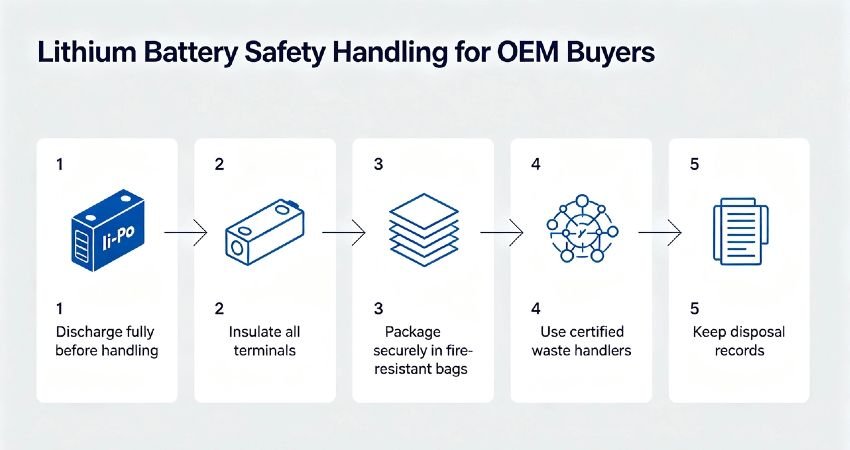
Step 1: Full discharge prior to handling — For OEM buyers, this ensures safe transport of returned or end-of-life cells. We use dedicated dischargers to bring every cell to 0V, eliminating fire risk during logistics.
Step 2: Terminal insulation — Our QC team cleans and tapes every terminal with two layers of heavy-duty vinyl tape. This prevents short circuits during storage and shipping—a critical UN38.3 requirement.
Step 3: Secure packaging — Each cell is placed in individual fire-resistant bags and packed in rigid containers to prevent puncture. This is standard for all our shipments, including returns and samples.
Step 4: Certified handling partners — For end-of-life cells from our OEM clients, we coordinate with licensed universal waste handlers. We provide disposal receipts for your compliance records—no regulatory headaches.
Step 5: Documentation for compliance — We provide full documentation for every batch, including end-of-life handling records and compliance certificates. If your facility is audited, you have everything you need to demonstrate compliance.
Quality Assurance Checklist for OEM Buyers
When evaluating a battery supplier, verify these five points:
-
UN38.3 certification — Required for all lithium battery air/sea shipments. Ask for the test summary.
-
UL/CE/RoHS compliance — Confirm the supplier holds current certifications, not just “compliant with” claims.
-
ISO9001/ISO14001 — Quality management systems matter for consistent production.
-
End-of-life handling policy — Does the supplier offer take-back or certified disposal coordination?
-
Traceability — Can they provide batch-level documentation for every shipment?
Partner with a Certified Lithium Battery Manufacturer
At enerbe, we deliver UN38.3-certified, UL-compliant Li-Polymer and Li-Ion battery solutions for OEM buyers in wearables, medical devices, IoT, and solar storage.
📄 Request a Technical Datasheet
📞 Contact Our Engineering Team
🔗 View Our Custom Battery Solutions
We provide full compliance documentation with every order—so you can focus on your product, not regulatory paperwork.