
LiPo vs Li-Ion Batteries: Which Is Better for Your OEM Project?
Published by A&S Power | Battery Technology | Updated September 2026
Introduction
If you are designing a new electronic device or sourcing batteries for an existing product line, you will eventually face one core decision: lithium polymer (LiPo) vs lithium-ion (Li-Ion) – which technology is right for your project?
Both are rechargeable lithium-based chemistries, but they use different electrolyte forms and packaging, which gives them very different strengths in real products. At A&S Power, we manufacture both LiPo pouch cells and 18650/21700 Li-Ion cells and packs for OEM buyers worldwide. This guide goes beyond the usual “LiPo is thinner, Li-Ion is cheaper” summary and gives you the engineering numbers – energy density, internal resistance, cycle life, failure modes, and true cost – so you can spec the right cell the first time.
For a complete overview of our custom capabilities, see Custom Lithium Polymer Battery – OEM/ODM Solutions for IoT, Wearables & Medical Devices. If you are new to the technology, start with What Is a Lithium Polymer Battery?
TL;DR – The Short Answer
| Feature | LiPo (Pouch) | Li-Ion (18650 / Cylindrical) |
|---|---|---|
| Form factor | Flat, flexible, fully custom | Fixed cylinder or prismatic |
| Minimum thickness | ~3.0mm (down to ~0.4mm) | 18mm (18650) |
| Weight | Lightest (no rigid can) | Heavier (metal casing) |
| Unit cost | Higher for custom sizes | Lower (standardized, high volume) |
| Failure sign | Visible swelling (early warning) | Vents through a pressure valve |
| Best for | Thin, light, custom-shaped products | Standard, cost-driven, high-volume products |
Choose LiPo when thickness, weight, or a custom shape is a hard requirement. Choose Li-Ion when a standard format, the lowest cost per Wh, and high-volume production are the priority.
The Big Misconception: LiPo Is a Lithium-Ion Battery
Here is the point most comparison articles get wrong: “LiPo vs lithium-ion” is not a comparison of two different chemistries. A lithium polymer cell is a type of lithium-ion cell. Both move lithium ions between a graphite anode and a metal-oxide cathode, and both store energy the same way electrochemically. The real differences are:
- Electrolyte form: a LiPo uses a gel-like or polymer electrolyte; a conventional Li-Ion uses a free-flowing liquid electrolyte.
- Packaging: a LiPo uses a soft, laminated aluminum-foil pouch; a conventional Li-Ion uses a rigid steel or aluminum can (cylindrical or prismatic).
What actually determines energy density, cycle life, and safety is the cathode chemistry – NMC, NCA, LCO, or LFP – combined with the packaging. That is why you can find an NMC LiPo, an NMC 18650, an LFP LiPo, and an LFP 18650. Keep this in mind as you read the numbers: many “LiPo vs Li-Ion” differences are really pouch vs can differences, not chemistry differences.
What Is a Lithium Polymer (LiPo) Battery?
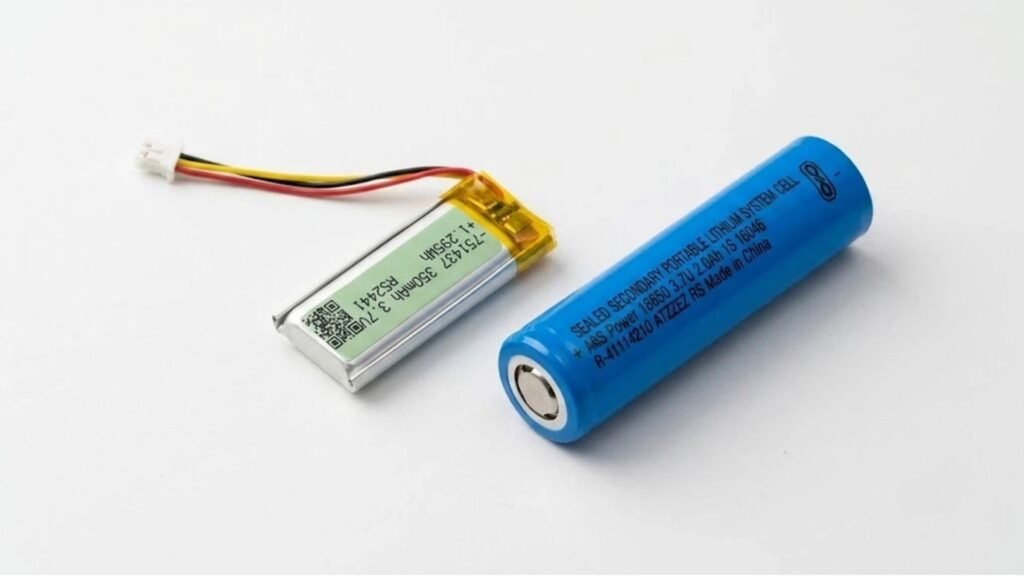
A lithium polymer battery (LiPo / Li-poly) uses a gel-like polymer electrolyte and is sealed inside a flexible aluminum-laminated foil pouch. Because there is no rigid can, the cell can be made very thin or shaped to match a housing.
- Shape: flat, rectangular, curved, stepped, or fully custom
- Thickness: from ~3.0mm standard down to ~0.4mm ultra-thin
- Weight: the lightest lithium format – no metal can
- Safety: tends to swell rather than rupture; very low leakage risk
- Cost: higher per Wh for custom sizes (tooling, lower volume)
Typical uses: wearables, medical patches, TWS earbuds, IoT sensors, smartphones, and compact electronics where space and weight are critical.
What Is a Lithium-Ion (Li-Ion) Battery?
In this comparison, “Li-Ion” usually means a cell with a liquid electrolyte in a rigid cylindrical or prismatic metal can. The workhorse format is the 18650 (18mm diameter × 65mm length), with the larger 21700 (21 × 70mm) and prismatic cells also common.
- Shape: fixed cylinders (18650, 21700) or prismatic blocks
- Dimensions: standardized only – you design around the cell
- Weight: heavier because of the steel/aluminum can
- Safety: built-in CID and pressure vents; can vent if severely abused
- Cost: lowest per Wh thanks to high-volume standardized production
Typical uses: power tools, laptops, flashlights, e-bikes, energy storage, and high-volume consumer electronics.
Side-by-Side Engineering Comparison
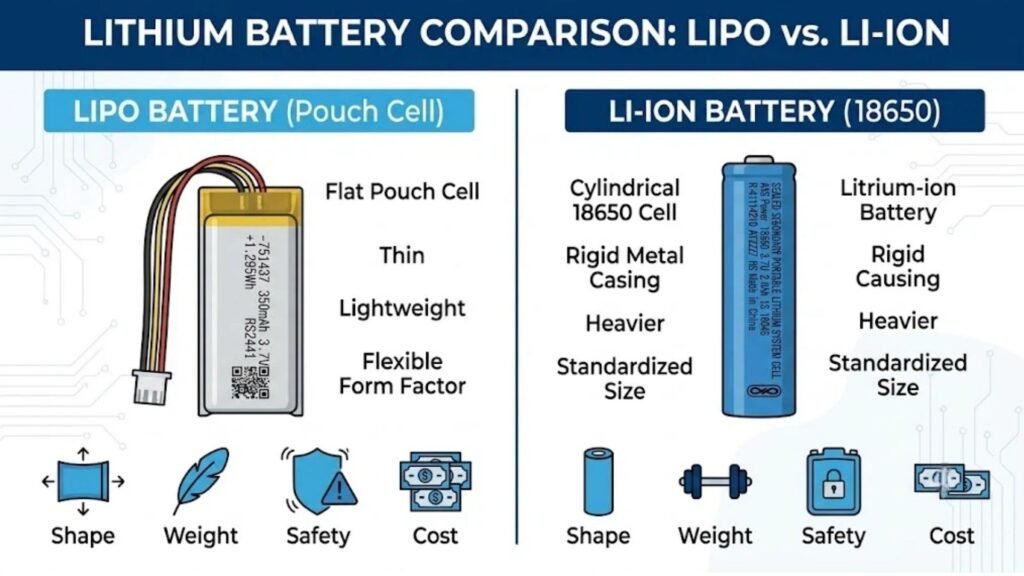
Typical values for consumer/industrial NMC cells. Ranges reflect different grades; exact figures are confirmed on the cell datasheet and by engineering sample.
| Parameter | LiPo (Pouch) | Li-Ion (18650) |
|---|---|---|
| Electrolyte | Gel / polymer | Liquid |
| Casing | Soft laminated foil | Rigid steel / aluminum can |
| Gravimetric energy density | ~150–240 Wh/kg | ~200–260 Wh/kg |
| Volumetric energy density | ~400–650 Wh/L (cell, shape-fit) | ~580–720 Wh/L cell; ~450–500 in a pack |
| Nominal / charge / cutoff voltage | 3.7V / 4.20V / 3.0V | 3.6–3.7V / 4.20V / 3.0V |
| Cycle life (80% retention) | ~300–500 (NMC); up to ~800 | ~300–500 (NMC); up to ~1000 |
| Continuous discharge | ~0.5–3C (up to 10C+ high-drain) | ~1–3C (configurable) |
| Self-discharge | ~2–5% / month | ~2–5% / month |
| Operating temperature | Charge 0–45°C; discharge -20–60°C | Charge 0–45°C; discharge -20–60°C |
| Customization | High – size, shape, capacity, leads | Limited – pack-level only |
Same-Capacity Build: What Fits Inside Your Enclosure
Spec sheets compare cells, but engineers design enclosures. Here is a build-level comparison for a single-cell 3.7V, ~2000mAh requirement. Volumes are calculated from the physical dimensions; note that a round cell inside a square housing leaves dead space that the product still has to accommodate.
| Build parameter | LiPo (model 603450) | 18650 (single cell) |
|---|---|---|
| Capacity / energy | 2000mAh / 7.4Wh | ~2600mAh typical / 9.62Wh |
| Dimensions | 6.0 × 34 × 50mm | Ø18 × 65mm |
| Minimum enclosure thickness | ~6mm | ~18mm |
| Cell volume | 10.2 cm³ | 16.5 cm³ (cylinder) |
| Bounding box in housing | ~10.2 cm³ (shape-fit) | 21.1 cm³ (18×18×65) |
| Typical cell weight | ~40g | ~47g |
| Shape options | Curved / stepped / custom | Round only |
What this means: to deliver ~2000mAh, a LiPo fits in a ~6mm-thick, ~10 cm³ shape-fit space. A single 18650 cannot be thinner than 18mm and, once its round body is boxed into a rectangular housing, occupies a ~21 cm³ bounding box – roughly twice the envelope. The LiPo also weighs ~15% less. That space and thickness saving is the single biggest reason product teams choose a pouch cell, even at a higher unit cost.
Reference engineering comparison; dimensions follow standard model naming (thickness×width×height in 0.1mm). Actual capacity, weight, and swelling allowance are confirmed on the datasheet and sample.
Energy Density: Weight vs Space
Energy density is measured two ways, and the “winner” depends on which one you use:
- Gravimetric (Wh/kg) – energy per unit weight. This is what matters for wearables, handhelds, and drones. The two formats are close; high-power cylindrical cells often edge ahead at the cell level.
- Volumetric (Wh/L) – energy per unit volume. A bare 18650 looks excellent on paper, but cylinders cannot tile a rectangular space – the gaps between round cells and the metal can are dead volume. A pouch fills its enclosure almost completely.
This is why cell-level and system-level numbers can appear to reverse: at the cell level the 18650 posts high Wh/L, but at the pack and enclosure level a shape-fit pouch frequently delivers more usable energy in less space. Rule of thumb: if the constraint is weight, compare Wh/kg; if the constraint is internal volume or thickness, compare system-level Wh/L using the real bounding box, not the cell datasheet.
Safety & Failure Modes
Both formats are safe when designed with proper protection and used within spec. Their hardware handles abuse differently:
- LiPo pouch: the soft foil expands when gas is generated, so swelling is a visible early warning. The pouch directs any release along the seal rather than ejecting material radially. It must still be removed from service immediately when swollen.
- 18650 can: the metal cap integrates a CID (Current Interrupt Device) that disconnects on internal pressure, a pressure-relief vent, and often a PTC that limits current when hot. These are robust, but a severely abused cell can still vent hot gas.
Regardless of format, every pack should run a PCM/BMS with overcharge, over-discharge, overcurrent, and short-circuit protection, and an NTC for temperature where required. Relevant standards include IEC 62133-2 (portable sealed-cell safety), UL 1642 / UL 2054, UN 38.3 (transport), and GB 31241. We provide the corresponding documentation with each order. For a full compliance breakdown, see Lithium Battery Safety & Compliance for OEM Buyers.
Cycle Life & Chemistry
Cycle life is driven mainly by cathode chemistry and operating conditions, not by pouch vs can. Typical figures to 80% capacity retention:
| Chemistry | Nominal cell voltage | Typical cycle life | Strength |
|---|---|---|---|
| NMC / NCA | 3.6–3.7V | ~300–500; up to ~1000 | High energy density |
| LCO | 3.7V | ~300–500 | High volumetric energy, thin cells |
| LFP (LiFePO₄) | 3.2V | ~1000–2000+ | Long life, high safety |
Real-world cycle life is shortened by high depth of discharge, fast charging, high temperatures, and charging above 4.20V. If your product needs a long service life (medical, industrial, always-on IoT), specify an LFP or an optimized NMC grade – available in both pouch and cylindrical packaging. Storage conditions also matter; see Lithium Polymer Battery Storage Guide.
Cost & Total Cost of Ownership
The 18650 usually wins on cell price, but that is only one line of the cost model. Compare total cost of ownership:
| Cost factor | LiPo (Pouch) | 18650 (Cylindrical) |
|---|---|---|
| Price per Wh | Higher (custom, lower volume) | Lower (standardized, high volume) |
| Tooling / NRE | May apply for a new size | None (off-the-shelf) |
| Typical MOQ | Custom size MOQ; samples supported | Lower for standard cells |
| Enclosure / assembly | Simpler – shape-fit, less housing | More holders, spacers, clearance |
| Product value | Enables thin/light premium designs | Best for cost-led products |
A LiPo is often the more economical choice when its space and weight saving lets you ship a thinner, higher-value product or avoid a larger enclosure. When the product is cost-led and a standard cell fits, the 18650 is hard to beat. Tell us your target annual volume and envelope and we will model both options.
How to Choose: A 5-Step Decision Tree
- Is thickness or internal volume a hard constraint (< ~6mm, curved, or irregular)? → LiPo. A cylinder cannot be made thinner than 18mm.
- Is weight critical (wearable, medical, handheld, drone)? → LiPo for the lightest pack.
- Do you need the lowest cost per Wh at high volume with a standard format? → 18650 / 21700.
- Do you need very long cycle life or maximum safety in a fixed space? → specify LFP, then choose pouch or can by shape.
- Check discharge rate and environment. For high-drain or rugged/industrial use, match the C-rate and temperature range; both formats offer high-drain grades. For voltage and C-rate selection, see the LiPo Battery Voltage Chart & C-Rating Guide.
Common Applications by Device Type
| Device / application | Recommended | Key reason |
|---|---|---|
| Smartwatches & fitness trackers | LiPo | Thin, light, custom shape |
| TWS earbuds & charging cases | LiPo | Tiny footprint |
| Medical wearables & patches | LiPo | Ultra-thin, body-conforming |
| IoT sensors & smart home | LiPo | Small, light, shape-fit |
| Smartphones & tablets | LiPo | Thin, space-optimized |
| Power tools | Li-Ion | Rugged, high discharge, low cost |
| Laptops | Li-Ion | Standard format, high capacity |
| Flashlights & portable lighting | Li-Ion | Standard 18650, widely available |
| E-bikes & light EVs | Li-Ion | High capacity, durable, low cost |
Frequently Asked Questions
1. Which battery lasts longer – LiPo or Li-Ion?
Cycle life is similar for the same chemistry – typically ~300–500 cycles to 80% capacity for NMC in either format. Longevity is set mainly by chemistry (LFP lasts far longer) and by how the cell is charged and treated, not by the pouch or can.
2. Are LiPo batteries safer than Li-Ion?
Each has robust safety features. A pouch gives visible swelling as an early warning and low leakage risk; an 18650 has a CID, vent, and PTC. Both are safe with a proper PCM/BMS and within-spec operation. The chemistry and protection design matter more than the label.
3. Which is cheaper – LiPo or Li-Ion?
The 18650 generally has the lower cost per Wh because it is standardized and made in very high volume with no custom tooling. A custom LiPo carries a higher cell price but can reduce enclosure size and assembly and enable premium thin products.
4. Can I replace a Li-Ion battery with a LiPo battery?
Only if the nominal voltage, capacity, and charge profile match and the enclosure fits the different shape. Because both are lithium-ion, the voltage window (3.0–4.20V, CC-CV) is compatible, but have a battery engineer confirm the substitution and protection before you do it.
5. Which is better for wearable devices?
LiPo is the standard choice for wearables: it can be made a few millimeters thin, curved to the body, and is the lightest option. For very long-life wearables, an LFP pouch is available where the slightly lower voltage and energy density fit.
6. Can both battery types be customized?
LiPo offers full customization of dimensions, shape, capacity, and terminals at the cell level. A cylindrical Li-Ion is a fixed standard cell; customization is limited to the pack – series/parallel configuration, BMS, connectors, and housing.
7. Do LiPo and 18650 charge the same way?
Yes – both use constant-current/constant-voltage (CC-CV) charging to 4.20V (standard NMC) with a 3.0V cutoff, and the same charge-current limits apply relative to capacity. Follow the cell datasheet and use a charger matched to the chemistry. See our How to Charge LiPo Batteries guide.
8. Which is better for drones and high-drain devices?
LiPo pouches are most common in drones because of their light weight and high C-rate (high-drain grades deliver 10C+). For high-drain industrial products, high-rate cylindrical cells are also used where the fixed format and ruggedness are preferred.
9. What if my device runs in a cold or hot environment?
Both formats cover roughly -20–60°C on discharge and 0–45°C on charge. Cold reduces usable capacity and charging must not be attempted below 0°C without a grade rated for it. Specify the real temperature range up front so the correct cell and protection are selected.
Custom Battery Solutions from A&S Power
We manufacture both LiPo pouch cells and 18650/21700 Li-Ion cells and packs for OEM buyers worldwide. Send us your enclosure dimensions, target capacity and voltage, discharge rate, certification needs, and annual volume – our engineers will model the best option, build samples, and support you through to mass production.
- Custom pouch dimensions and shapes, or standard cylindrical cells
- Integrated PCM/BMS with I²C, SMBus, CAN, or HDQ communication
- UL, CE, RoHS, UN 38.3, IEC 62133 documentation included
- OEM labeling, packaging, and prototype-to-mass-production support