
How Long Do Lithium Batteries Last? Shelf Life, Cycle Life & Expiration Guide
Published by A&S Power | Battery Technology | Updated August 2026
Introduction
How long do batteries last? It is the first question every product designer and procurement manager asks when specifying a battery. The answer is not a single number – it depends on whether you mean shelf life (sitting unused), service life (powering a device), or cycle life (charge-discharge repetitions).
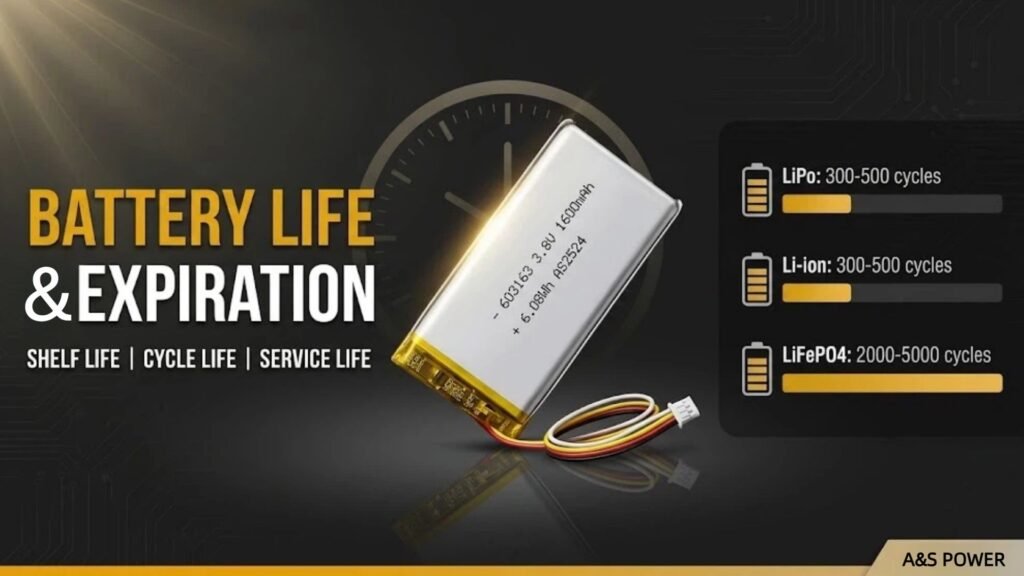
For lithium batteries – the chemistry powering most modern electronics – the typical range is 300–500 charge cycles for LiPo and Li-ion, and 2,000–5,000 cycles for LiFePO4. But those numbers assume ideal conditions. Heat, overcharging, deep discharges, and improper storage can cut battery life in half or worse.
This guide covers battery lifespan from every angle: shelf life, service life, cycle life, expiration, self-discharge, degradation factors, and how to test remaining health. If you are new to lithium battery technology, start with our What is a Lithium Polymer Battery? guide for the fundamentals.
Shelf Life vs Service Life vs Cycle Life
Battery “life” is not one number. It is three different measurements, and confusing them leads to wrong product specifications.
| Term | Definition | How It Is Measured |
|---|---|---|
| Shelf Life | How long a battery can sit unused before its performance degrades below usable levels | Time (years) at specified storage conditions |
| Service Life | How long a battery lasts while actually powering a device in real-world use | Time (hours) per charge, or total years in service |
| Cycle Life | Number of complete charge-discharge cycles before capacity drops to 80% of original (industry standard end-of-life threshold) | Number of cycles (count) |
Key point for OEMs: A battery can have a 10-year shelf life but only 2 hours of service life in a high-drain device. Always specify all three numbers when sourcing batteries for a product.
How Long Do Lithium Batteries Last?
Lithium-based batteries are not a single chemistry. The three main types used in OEM products have very different lifespans:
LiPo (Lithium Polymer) – 300–500 Cycles
LiPo batteries use a gel-like polymer electrolyte in a soft pouch. They offer high energy density and custom shapes but have the shortest cycle life of the three. Typical lifespan is 300–500 cycles to 80% capacity, or about 2–3 years in regular use. Shelf life is 2–3 years when stored properly.
Best for: wearables, medical devices, IoT sensors, TWS earbuds, smartphones – where thin profile and custom shape matter more than maximum cycle count.
Li-ion (Lithium-Ion, 18650/21700) – 300–500 Cycles
Standard Li-ion cells in rigid cylindrical or prismatic casings have similar cycle life to LiPo (300–500 cycles) but often better calendar life due to more stable packaging. The 18650 cell is the most common format. Shelf life is 2–5 years.
Best for: laptops, power tools, e-bikes, flashlights, Bluetooth speakers – where standard formats and cost efficiency matter.
LiFePO4 (Lithium Iron Phosphate) – 2,000–5,000 Cycles
LiFePO4 is the longest-lasting lithium chemistry. It delivers 2,000–5,000 cycles to 80% capacity – 4 to 10 times more than LiPo or standard Li-ion. It also has better thermal stability and a wider operating temperature range. The trade-off is lower energy density and lower nominal voltage (3.2V vs 3.7V).
A&S Power’s AS32700 LiFePO4 cell is a real-world example: 3.2V, 6000mAh, with 5C continuous discharge (30A) and ultra-low internal resistance (≤3mΩ), designed for power tools, e-bikes, and solar storage where long cycle life is critical.
Battery Lifespan Comparison by Type
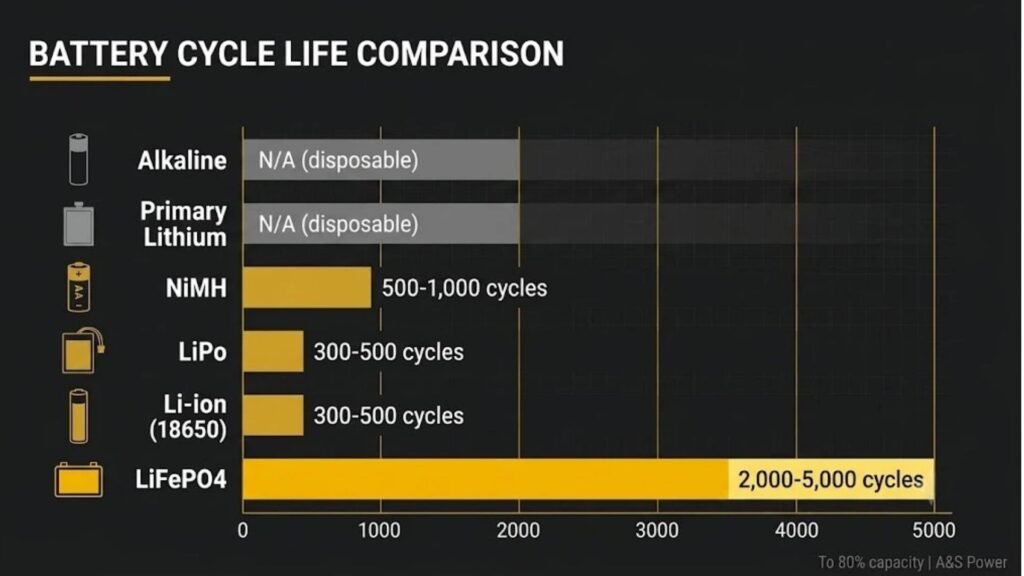
The table below compares all common battery chemistries across shelf life, service life, and cycle life.
| Battery Type | Shelf Life | Service Life (Typical) | Cycle Life | Rechargeable? |
|---|---|---|---|---|
| Alkaline (Primary) | 5–10 years | 1–5 hrs (high-drain) / 10–50 hrs (low-drain) | N/A | No |
| Lithium (Primary, CR/DL) | 10–15 years | 2–10 hrs (high-drain) / 20–100 hrs (low-drain) | N/A | No |
| NiMH (Rechargeable) | 3–5 years | 2–8 hours | 500–1,000 cycles | Yes |
| LiPo (Lithium Polymer) | 2–3 years | 2–10 hours (depends on device) | 300–500 cycles | Yes |
| Li-ion (18650/21700) | 2–5 years | 2–10 hours (depends on device) | 300–500 cycles | Yes |
| LiFePO4 (Lithium Iron Phosphate) | 3–5 years | 3–12 hours (depends on device) | 2,000–5,000 cycles | Yes |
Note: Cycle life is measured to 80% of original capacity, the industry standard end-of-life threshold. Actual lifespan varies based on usage patterns, temperature, depth of discharge, and charging practices.
Do Batteries Expire?
Yes. All batteries expire over time due to chemical degradation inside the cell – even when they are sitting unused on a shelf. This is called calendar aging, and it happens independently of charge-discharge cycling.
What Happens When a Battery Expires?
- Capacity loss – the battery holds less charge than its rated capacity
- Higher internal resistance – the battery cannot deliver current as efficiently, causing voltage sag under load
- Increased self-discharge – the battery loses charge faster when sitting idle
- Leakage risk – primary batteries may leak corrosive electrolyte as seals degrade
- Swelling – lithium batteries may swell as gas builds up from degraded electrolyte (stop using immediately)
Expiration by Battery Type
| Battery Type | Typical Shelf Expiration | Date Marking |
|---|---|---|
| Alkaline | 5–10 years from manufacture | Usually printed on packaging (“best before” or manufacture date) |
| Primary Lithium (CR/DL) | 10–15 years from manufacture | Often printed on cell casing |
| LiPo / Li-ion | 2–5 years from manufacture (proper storage) | Rarely printed; check manufacture date code or test voltage |
| LiFePO4 | 3–5 years from manufacture (proper storage) | Rarely printed; check manufacture date code |
Can You Use Expired Batteries?
It depends on the battery type and the application:
- Low-drain devices (remote controls, clocks): expired alkaline batteries may still work, though with shorter runtime
- High-drain devices (flashlights, cameras): expired batteries will sag under load and may shut down the device
- Critical / medical devices: never use expired batteries – test voltage first and replace if below rated capacity
- Rechargeable lithium packs: if swollen, leaking, or below 3.0V per cell, do not charge or use – dispose of properly
Safety rule: If a battery is swollen, leaking, corroded, or physically damaged, do not use it – regardless of expiration date. Dispose of it at a battery recycling center.
Self-Discharge Rates: How Fast Batteries Lose Charge When Idle
Even when not in use, batteries slowly lose charge through internal chemical reactions. This is called self-discharge, and it is a key factor in shelf life.
| Battery Type | Monthly Self-Discharge (Room Temp) | Time to 50% Charge (Idle) |
|---|---|---|
| Alkaline (Primary) | ~0.5% per year | ~100 years (theoretical) |
| Primary Lithium (CR/DL) | ~1% per year | ~50–70 years (theoretical) |
| NiMH | 20–30% per month (standard) / ~5% per month (low-self-discharge) | 2–4 months (standard) / ~1 year (LSD) |
| LiPo / Li-ion | 2–5% per month | 1–2 years |
| LiFePO4 | 2–3% per month | 1.5–2.5 years |
OEM tip: For products that may sit in warehouses or on retail shelves for months before first use, specify low-self-discharge cells and require batteries to be shipped at 40-60% charge. This prevents customers from receiving a dead battery on day one.
Factors That Degrade Battery Life
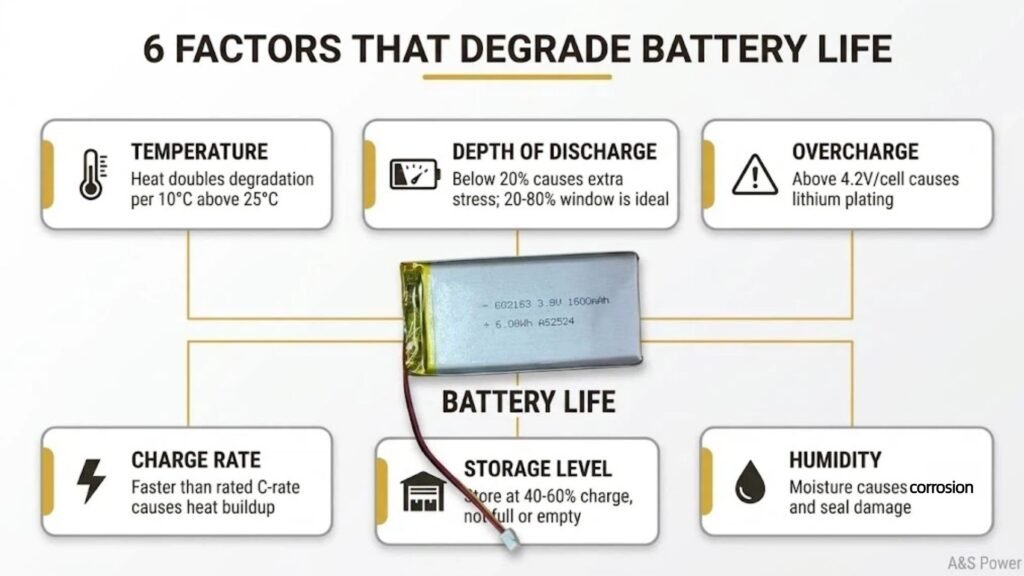
Six factors have the biggest impact on how long a battery lasts. Understanding them lets you design products and storage practices that maximize lifespan.
| Factor | Impact | Recommended Range |
|---|---|---|
| Temperature | The single biggest factor. Heat accelerates chemical degradation. Every 10°C above 25°C roughly doubles degradation rate. Cold reduces capacity temporarily but does not permanently damage unless frozen. | 15–25°C (storage) 0–40°C (operation) |
| Depth of Discharge (DoD) | Discharging below 20% causes extra stress on the anode. A battery cycled at 100% DoD may last 300 cycles; the same battery cycled at 50% DoD may last 1,000+ cycles. | 20–80% operating window (ideal) Never below 3.0V/cell (LiPo) |
| Charge Voltage | Charging above 4.2V/cell causes lithium plating and electrolyte oxidation. Even small overvoltage (4.25V) significantly shortens life. | ≤4.2V/cell (LiPo standard) Use a proper CC-CV charger |
| Charge Rate (C-rate) | Charging faster than the rated C-rate causes heat buildup and lithium plating. Standard LiPo cells are typically rated at 0.5C–1C charge. | 0.5C–1C (standard LiPo) Check cell datasheet for max charge rate |
| Storage Charge Level | Storing at 100% or 0% charge accelerates degradation. Full-charge storage causes electrolyte oxidation; empty storage causes copper dissolution on the anode. | 40–60% charge (~3.8V/cell for LiPo) |
| Humidity / Moisture | Moisture causes corrosion on terminals and can penetrate damaged pouch seals, reacting with lithium inside the cell. | < 65% relative humidity Dry storage environment |
How to Extend Battery Life
Storage Best Practices
- Store in a cool, dry place at 15–25°C (59–77°F)
- Store rechargeable lithium batteries at 40–60% charge (~3.8V per cell), not fully charged or empty
- Keep batteries in original packaging or individual non-conductive containers to prevent short circuits
- Remove batteries from devices that will not be used for more than 2 weeks
- Check voltage every 1–2 months during long-term storage and top up if below 3.6V/cell
Usage Best Practices
- Avoid deep discharges – recharge before the battery drops below 20% capacity
- Use a compatible charger with the correct voltage and cell count setting
- Do not mix old and new batteries or different brands in the same device
- Allow batteries to cool to room temperature before recharging after heavy use
- Keep battery contacts clean – dirty contacts increase resistance and reduce efficiency
For OEM Product Designers
- Design the device’s operating voltage window to stay within 20–80% DoD for maximum cycle life
- Include a BMS (Battery Management System) with overcharge, over-discharge, over-current, and temperature protection
- Ensure adequate thermal management – batteries should not exceed 45°C during operation or charging
- For products with long shelf life before first use, specify low-self-discharge cells and ship at 40–60% charge
For detailed charging procedures, see our How to Charge LiPo Batteries Safely guide. For storage-specific guidance, see our LiPo Battery Storage Best Practices guide.
How to Test Battery Health (SOH)
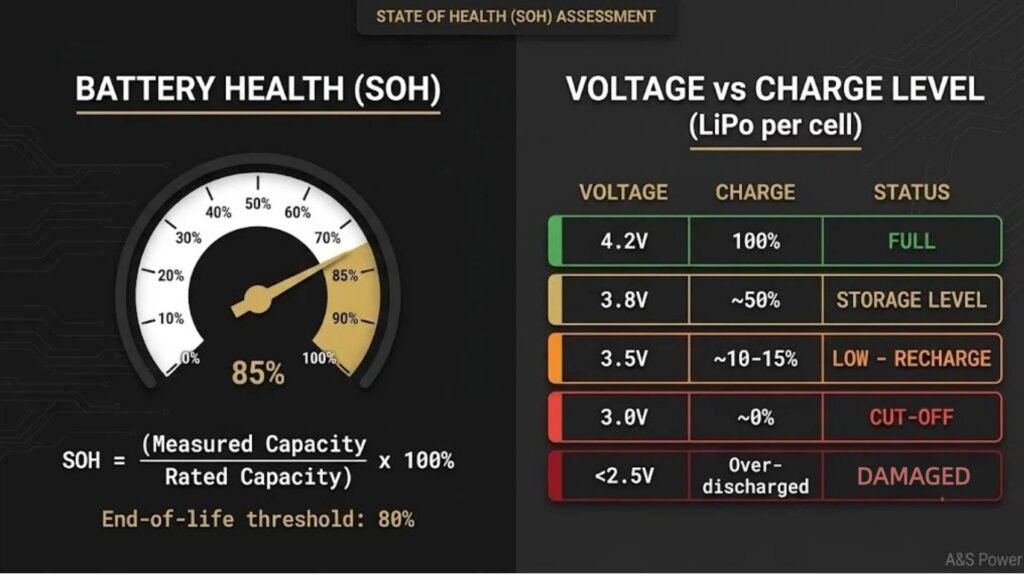
State of Health (SOH) is a percentage measure of a battery’s current capacity compared to its original rated capacity. A new battery has 100% SOH; at 80% SOH, the battery is considered end-of-life for most applications.
Method 1: Voltage Check (Quick Screening)
Use a multimeter to measure open-circuit voltage. This is a quick screening test but does not measure capacity directly.
| Voltage per Cell (LiPo) | Approximate Charge Level | Status |
|---|---|---|
| 4.2V | 100% | Full |
| 3.8V | ~50% | Storage level |
| 3.5V | ~10–15% | Low – recharge soon |
| 3.0V | ~0% | Cut-off – do not discharge further |
| Below 2.5V | Over-discharged | Damaged – may not recover |
Method 2: Capacity Test (Accurate SOH)
To measure actual SOH, perform a full charge-discharge cycle and compare the measured capacity to the rated capacity:
- Fully charge the battery at its rated charge rate to 4.2V/cell
- Rest for 30 minutes
- Discharge at a standard rate (typically 0.2C or 1C) to the cut-off voltage (3.0V/cell)
- Record the discharged capacity in mAh or Ah
- Calculate SOH = (Measured Capacity / Rated Capacity) × 100%
Example: A battery rated at 2600mAh measures 2210mAh after a full discharge cycle. SOH = (2210 / 2600) × 100 = 85%. The battery is still usable but approaching the 80% end-of-life threshold.
Method 3: Internal Resistance Check
As batteries degrade, internal resistance increases. Use a battery analyzer with IR measurement capability. A significant increase (e.g., doubling from the rated value) indicates advanced degradation. For reference, A&S Power’s AS18650-2600 cell has a rated internal resistance of ≤40mΩ when new.
Signs Your Batteries Need Replacing
Physical Signs
- Swelling or bulging – gas buildup from degraded electrolyte; stop using immediately
- Leakage – white or crusty residue around terminals (primary batteries)
- Corrosion – rust or green/white powder on metal contacts
- Cracked or damaged casing – compromised seal allows moisture ingress
Performance Signs
- Shorter runtime – the battery does not last as long as it used to (SOH below 80%)
- Voltage sag under load – device shuts down or dims when drawing high current
- Device will not turn on – even after a full charge, the battery cannot deliver enough voltage
- Overheating – battery gets unusually hot during use or charging
- Slow charging – the battery takes much longer to reach full charge than when new
If you notice swelling, leakage, or corrosion, stop using the battery immediately and dispose of it at a certified battery recycling center. Do not throw lithium batteries in the trash.
Frequently Asked Questions
How long do lithium batteries last?
Lithium-ion and LiPo batteries typically last 2–3 years or 300–500 charge cycles to 80% capacity, whichever comes first. LiFePO4 batteries last significantly longer at 2,000–5,000 cycles. Shelf life for unused lithium batteries is 2–5 years when stored properly at 40–60% charge and 15–25°C.
Do batteries expire?
Yes. All batteries expire over time due to chemical degradation, even when unused. Primary batteries like alkaline have a shelf life of 5–10 years, while rechargeable lithium batteries degrade in 2–5 years. Expired batteries show reduced capacity, higher internal resistance, and may leak or swell. Always check the manufacture date and test voltage before use.
How long do unused batteries last?
Unused alkaline batteries last 5–10 years in original packaging. Primary lithium batteries last 10–15 years. Rechargeable lithium batteries (Li-ion/LiPo) last 2–5 years on the shelf if stored at 40–60% charge in cool, dry conditions. Storing at full charge or high temperatures cuts shelf life in half.
Can you use expired batteries?
Expired batteries may still work but with reduced capacity and higher risk of leakage. For low-drain devices like remote controls, an expired alkaline battery may still function. For critical devices, medical equipment, or rechargeable lithium packs, do not use expired batteries – test voltage first and replace if below rated capacity. Never use swollen, leaking, or damaged batteries.
Do lithium batteries expire if not used?
Yes. Lithium batteries undergo calendar aging even when unused. Internal chemical reactions slowly degrade the electrolyte and electrodes over time. A LiPo battery sitting on a shelf at full charge and room temperature may lose 20–30% of its capacity in 2–3 years without a single charge cycle. Proper storage at 40–60% charge and 15–25°C slows this significantly.
What is the difference between shelf life, service life, and cycle life?
Shelf life is how long a battery sits unused before degrading. Service life is how long it lasts while powering a device. Cycle life is the number of charge-discharge cycles a rechargeable battery can complete before dropping to 80% of original capacity. A battery can have a long shelf life but short service life in a high-drain device.
How long do LiFePO4 batteries last compared to Li-ion?
LiFePO4 batteries last 2,000–5,000 charge cycles, compared to 300–500 cycles for standard Li-ion/LiPo batteries. This makes LiFePO4 ideal for solar storage, e-bikes, and power tools where long cycle life is critical. LiFePO4 also has better thermal stability and longer calendar life, but lower energy density and lower nominal voltage (3.2V vs 3.7V).
Need a Battery with the Right Lifespan for Your Product?
A&S Power manufactures custom lithium polymer, lithium-ion, and LiFePO4 batteries with precise cycle life and shelf life specifications. Our engineering team helps OEM buyers select the right chemistry, capacity, and BMS configuration to meet product lifespan requirements. All batteries include UN38.3 transport certification and full compliance documentation.
Compare chemistries for your project: see our LiPo vs Li-Ion Battery Comparison and Lithium Battery Safety & Compliance Guide.