
Introduction
For engineering and procurement teams building small-form-factor electronics, battery selection rarely gets the attention it deserves — until it causes problems. We’ve seen it hundreds of times at A&S Power: a design team picks a generic off-the-shelf cell based on advertised specs, only to find out after tooling that batch-to-batch dimensional drift makes assembly a nightmare, that capacity runs 15% below label, or that missing certification paperwork holds an entire shipment at the port.
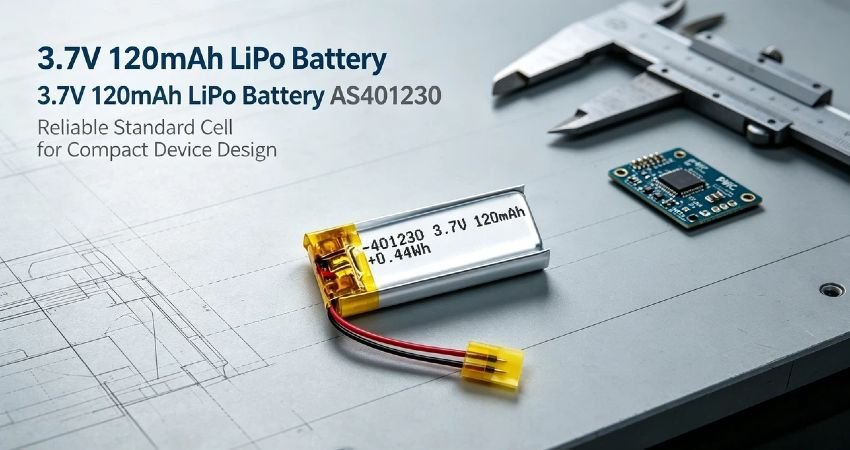
These are not minor inconveniences. For wearable, audio and IoT product lines, they translate to rework costs, delayed launch dates and avoidable compliance risk. That’s why we developed the AS401230, our 3.7V 120mAh lithium-ion polymer battery built as a production-ready standard cell for space-constrained devices.
After 17 years in lithium polymer li po manufacturing, we know what B2B clients actually need from a small cell: consistent dimensions, guaranteed capacity, full certification traceability, and enough design flexibility to work across multiple product SKUs. In this article, we break down this cell’s real-world value, answer the question we hear every week — what is lithium ion polymer battery technology, and how does it differ from standard lithium-ion? — and walk through exactly which applications this cell is built for.
Li Po Battery vs Lithium Ion: What Actually Matters for Product Design
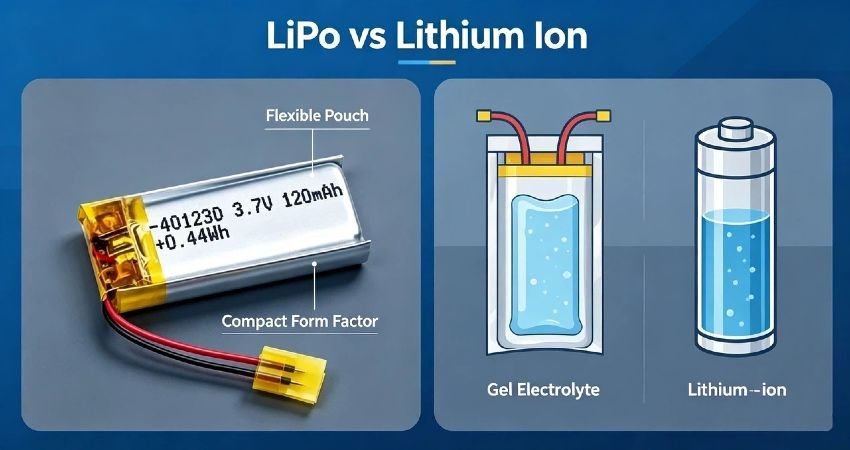
One of the most common questions from new clients is: is a lithium polymer battery the same as lithium ion? The short answer is yes — LiPo is a subset of lithium-ion technology — but the structural differences matter enormously for compact product design.
All rechargeable lithium-based cells work on the same core principle: lithium ions move between anode and cathode during charge and discharge. Where they differ is packaging and electrolyte format. Traditional lithium-ion batteries use a liquid electrolyte inside a rigid metal casing, most often in cylindrical 18650 or prismatic form factors. A li-po battery uses a gel polymer electrolyte sealed inside a thin, flexible foil pouch.
For product teams, this creates three practical advantages that make battery li po the default choice for small devices:
- Thinner, more adaptable form factors. Without a thick metal shell, LiPo cells can be made as thin as a few millimeters, and shaped to fit irregular enclosure space. Rigid cylindrical cells simply cannot do this.
- Better energy density per unit volume. The soft pouch structure wastes less space on housing, so you get more usable capacity inside the same battery bay. For wearables and earbuds, every cubic millimeter counts.
- Lower rupture risk. Gel electrolyte and flexible packaging are far less likely to burst or leak under damage than hard-cased liquid-electrolyte cells, which is a critical safety factor for skin-contact wearables and portable medical gear.
For low-voltage portable products, the 3.7 v li po chemistry has become the global industry standard. It aligns with nearly all common low-power PMIC and charging IC designs, requires no custom power management hardware, and delivers a stable discharge plateau across the full state of charge. When evaluating li po battery vs lithium ion options for compact builds, LiPo is almost always the more practical choice for design flexibility and production consistency.
AS401230 Cell Specifications & Design Intent
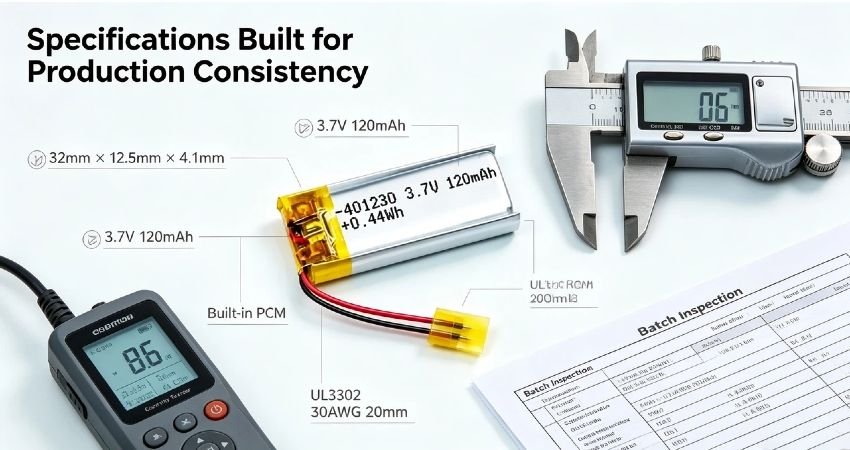
The AS401230 is not a niche custom cell. It is a field-validated standard model that we have refined over years of high-volume production, tuned specifically for reliability in low-power compact devices. Below are its core specifications, with the practical engineering context that matters for your design:
| Parameter | Specification |
| Battery Type | Lithium-ion Polymer Battery |
| Part Number | AS401230 |
| Voltage & Capacity | 3.7V @ 120mAh (0.37Wh) |
| Protection Circuit | Yes (built-in PCM) |
| Thermistor (NTC) | Standard configuration without NTC; custom integration available |
| Wires | UL3302 30AWG, 20mm length |
| Connector | No pre-installed connector; custom options available |
| Dimensions (L×W×T) | 32mm × 12.5mm × 4.1mm |
| Charge Current | 0.2C to 0.5C (standard) |
| Discharge Current | 0.5C to 1.0C (standard) |
| Storage Temperature | 15°C to +35°C (recommended) |
What the spec sheet alone doesn’t tell you is the production control behind each value.
We do this because we’ve had clients come to us after costly rework: their previous supplier’s cells varied just enough from batch to batch that batteries wouldn’t seat properly in pre-tooled enclosures. With the AS401230, what you see on the datasheet is what you get across every order.
The built-in protection circuit is another deliberate choice. It provides overcharge, over-discharge, over-current and short-circuit protection directly on the cell, removing the need for your design team to add extra protection components on the main PCB. This reduces BOM complexity and speeds up your compliance testing process.
We also use UL-certified 30AWG wire as standard, cut to a consistent 20mm length. For high-volume assembly lines, consistent wire length means less manual trimming, fewer process variables, and lower defect rates on the production floor. Capacity is tested 100% before shipment, with a guaranteed ±3% maximum deviation from rated value — no underrated cells that cause premature device shutdown in the field.
Where the AS401230 Delivers the Most Value
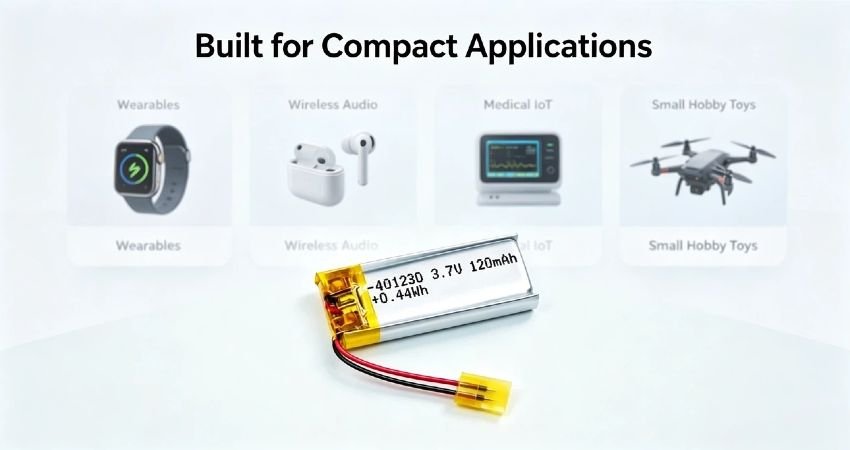
This cell is optimized for four core application segments where small size, consistent performance and compliance are non-negotiable. We supply it to clients across all four categories, and it has been validated in real production environments:
Wearable Devices
Smart watches, fitness bands and lightweight wearable gadgets demand cells that are thin, light and safe for prolonged skin contact. The 4.1mm slim profile of the AS401230 fits easily into narrow band enclosures and compact watch bodies, while its stable 3.7V discharge curve supports continuous Bluetooth connectivity, heart rate sensing and motion tracking without unexpected voltage drops. For clients with custom enclosure designs, this cell also serves as a baseline platform for fully customized dimensions and capacities.
Wireless Audio
TWS earbuds and mini Bluetooth headsets run on extremely tight internal space budgets. The AS401230’s compact footprint maximizes use of available earbud or charging case internal volume, while its low self-discharge rate ensures products retain charge through shipping and shelf storage. We regularly hear from audio brands that one of their biggest return drivers is dead batteries on arrival; our final testing and low self-discharge chemistry directly reduce that risk.
Medical & IoT Gear
Portable medical monitors and smart home sensor nodes require above-average reliability and long service life. For medical accessories, consistent power delivery directly affects measurement accuracy. For IoT sensors deployed in hard-to-reach locations, short battery life means high maintenance costs. The AS401230’s strict quality control and full international safety certifications make it suitable for low-power medical peripherals and always-on sensor fleets, where unplanned failure is not an acceptable outcome.
Small Hobby Toys
Mini drones, remote control toys and compact hobby electronics need cells that can handle peak current loads and repeated charge cycles. The AS401230’s 1.0C maximum discharge rating supports the short burst demands of small motors, while its durable pouch construction holds up to regular handling. For toy brands selling globally, our UN38.3-certified cells streamline shipping and customs clearance across all major markets.
Why A&S Power as Your LiPo Battery Supplier
Selecting the right cell is only half the decision; the supplier behind it determines whether your production runs stay on schedule and within spec.
Founded in 2009, A&S Power has focused exclusively on lithium polymer battery R&D and manufacturing for nearly 20 years. We operate our own production facilities with a 230+ member professional team, and we supply clients across 50+ countries. We are an approved vendor for global brands including LEGO, Philips and Best Buy, and we maintain all major global certifications — CE, UL, SGS, IEC CB and UN38.3 — across our standard product line.
What this means for you as a B2B partner:
- Full traceability on every cell, with test reports and certification files available for audit and compliance purposes
- Tight process control that delivers consistent electrical and dimensional performance across repeat orders
- In-house engineering support for design adjustments and custom modifications
- Stable lead times for both standard cells and custom projects
We don’t compete on the absolute lowest price with unbranded generic cells. We compete on consistency, compliance and technical support — the factors that actually prevent costly production and logistics problems down the line.
ODM/OEM Customization & Full Specification Support
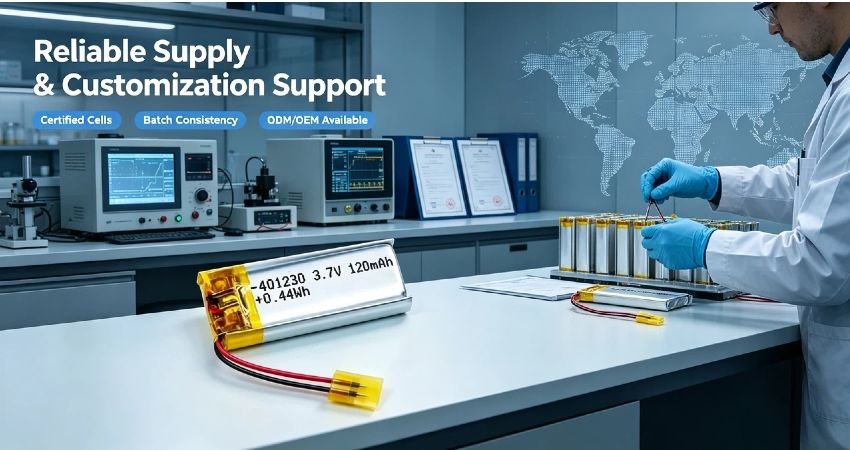
The AS401230 is a proven standard form factor, but we recognize that many projects require tailored power solutions. We offer full ODM and OEM customization services for lithium polymer batteries, including custom dimensions, adjusted capacities, specialized protection circuits, custom wire lengths and connectors, NTC thermistor integration, and branded packaging. Whether you need a modified version of this standard cell or a fully custom design built to your exact enclosure and performance requirements, our engineering team will work directly with you to finalize the specification.
If you require complete datasheets, detailed performance curves, certification documentation, sample pricing or a formal quotation for volume production, our team is ready to provide the information you need.
Contact us for detailed product parameters and custom project support:
- Tel: +86 137 1383 1631
- Email: info@enerbe.net