
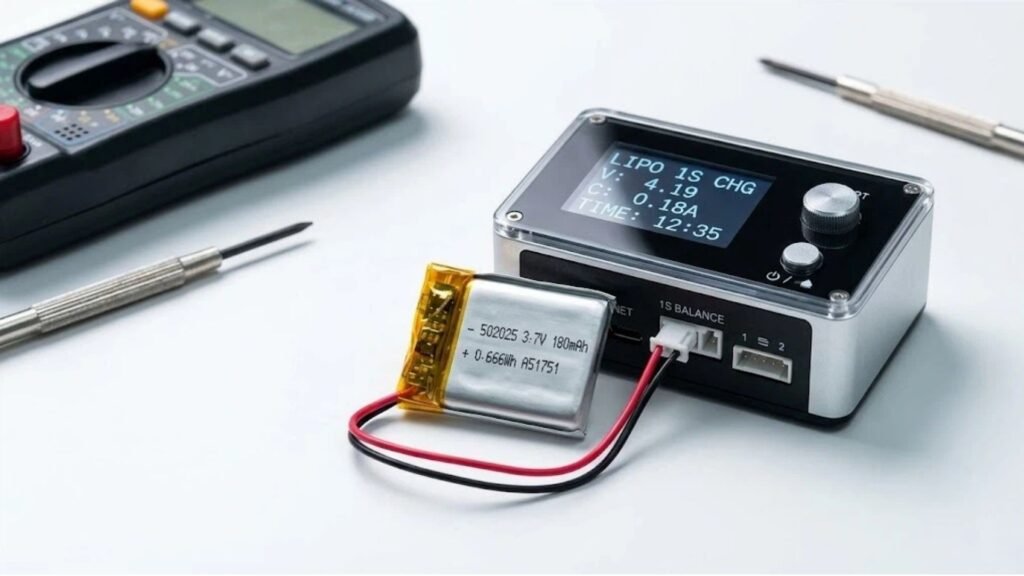
How to Charge LiPo Batteries: Step-by-Step, Voltage & First-Time Guide
Published by A&S Power | Battery Technology | Updated September 2026
Introduction
Charging a lithium polymer (LiPo) battery correctly is the single biggest factor in how long the cell lasts and how safely it performs. Charge it within spec and a quality LiPo delivers 300–500 cycles before it reaches 80% capacity. Charge it too fast, too cold, or a fraction of a volt too high, and the same cell can swell, lose capacity permanently, or in the worst case enter thermal runaway.
Most charging guides stop at a list of steps. This one starts with how the charge actually works – the constant-current/constant-voltage (CC/CV) profile, the taper current, the voltage limits for each chemistry, and a charge-time model you can calculate – then gives you the step-by-step procedure, balance-charging engineering, and the rules for 1S through 6S packs.
At A&S Power, we manufacture custom LiPo cells and packs for OEM buyers in medical, IoT, wearable, drone, and industrial markets. Every cell ships with a datasheet stating its exact charge voltage, maximum charge current, and balance requirements. If you are new to the technology, start with What Is a Lithium Polymer Battery?; for a full capability overview, see our Custom LiPo OEM/ODM guide.
The CC/CV Charging Profile
A standard LiPo is not simply “filled” at a fixed current the whole way. A lithium charger runs a controlled sequence of phases so the cell reaches 4.20V without ever being over-driven. Understanding these phases makes every other setting on your charger make sense.
| Phase | Voltage | Current | Capacity added |
|---|---|---|---|
| Pre-charge (only if a cell is below ~3.0V) | < 3.0V | ~0.1C, limited | Recovery only |
| Constant current (CC) | Rises 3.0 → 4.20V | Held at the set rate (e.g. 1C) | ~70–80% |
| Constant voltage (CV) | Held at 4.20V | Tapers 1C → cutoff | ~20–30% |
| Termination | 4.20V | ≤ 0.02–0.05C | 100% (charger stops) |
- CC phase: the charger delivers its full set current while the cell voltage climbs. This is the fast part – most of the energy goes in here.
- CV phase: at exactly 4.20V the charger holds voltage and lets the current taper. This tops up the last 20–30% without overshooting 4.20V. Skipping CV leaves the pack partly charged; forcing more voltage to speed it up damages the cell.
- Termination (taper) current: the charge ends when the CV current falls to roughly 0.02–0.05C – for example 20–50mA on a 1000mAh cell. There is no trickle or float charge for LiPo; once complete, disconnect it.
LiPo Voltage Reference by Cell Count
Every LiPo cell has a nominal voltage of 3.7V, a full-charge voltage of 4.20V, and a discharge cut-off of 3.0V. Multi-cell packs multiply these by the number of cells in series. Setting the wrong cell count on the charger is the fastest way to destroy a pack.
| Configuration | Nominal | Full charge | Storage (50%) | Cut-off |
|---|---|---|---|---|
| 1S | 3.7V | 4.20V | 3.80–3.85V | 3.0V |
| 2S | 7.4V | 8.40V | 7.60–7.70V | 6.0V |
| 3S | 11.1V | 12.60V | 11.40–11.55V | 9.0V |
| 4S | 14.8V | 16.80V | 15.20–15.40V | 12.0V |
| 6S | 22.2V | 25.20V | 22.80–23.10V | 18.0V |
Critical rule: verify the cell count on the battery label before charging. Charging a 3S pack on a 4S setting applies 16.8V to an 11.1V pack – overcharging every cell by 1.4V and causing immediate swelling or fire. For the complete reference, see our LiPo Voltage Chart & C-Rating Guide.
Charge Parameters by Chemistry
The 4.20V figure applies to the common LCO and NMC chemistries – not to every lithium cell. The charger must match the chemistry, or it will stop at the wrong voltage. This is the table to check before you select a charge setting.
| Chemistry | Nominal | Charge voltage | Discharge cut-off | Notes |
|---|---|---|---|---|
| LCO | 3.7V | 4.20V | 3.0V | Thin consumer cells |
| NMC / NCA | 3.6–3.7V | 4.20V | 2.75–3.0V | High energy density |
| LiHV | 3.7–3.85V | 4.35–4.40V | 3.0V | More capacity, shorter life |
| LFP (LiFePO₄) | 3.2–3.3V | 3.65V | 2.5V | Long life, high safety |
| LTO | 2.3–2.4V | 2.85V | 1.5–1.8V | Extreme power / cold |
Charge Time Formula & Model
The most common question we hear is “how long does a LiPo take to charge?” It depends on capacity, charge current, and how deeply the pack was discharged.
Real CC/CV time is longer because the CV taper adds roughly 20–40%. As a planning figure, use ~1.3 × theoretical.
| Charge rate | Theoretical CC time | Typical total (CC/CV) |
|---|---|---|
| 0.5C | 120 min | ~150–160 min |
| 1C | 60 min | ~75–85 min |
| 2C | 30 min | ~38–42 min |
| 3C | 20 min | ~25–28 min |
| 5C | 12 min | ~15–17 min |
Real-world examples (charge from a typical 20–30% remaining state; a pack from 0% takes longer and may run a pre-charge phase):
| Battery | Capacity | Rate / current | Typical time |
|---|---|---|---|
| Small wearable | 120mAh | 0.5C / 60mA | ~2.5 h |
| Bluetooth speaker | 1000mAh | 1C / 1.0A | ~1.3 h |
| 18650 cell | 2600mAh | 0.5C / 1.3A | ~2.2 h |
| Drone 4S pack | 4000mAh | 1C / 4.0A | ~1.3 h |
| Drone pack (fast) | 5000mAh | 2C / 10A | ~40 min |
Step-by-Step Charging Process
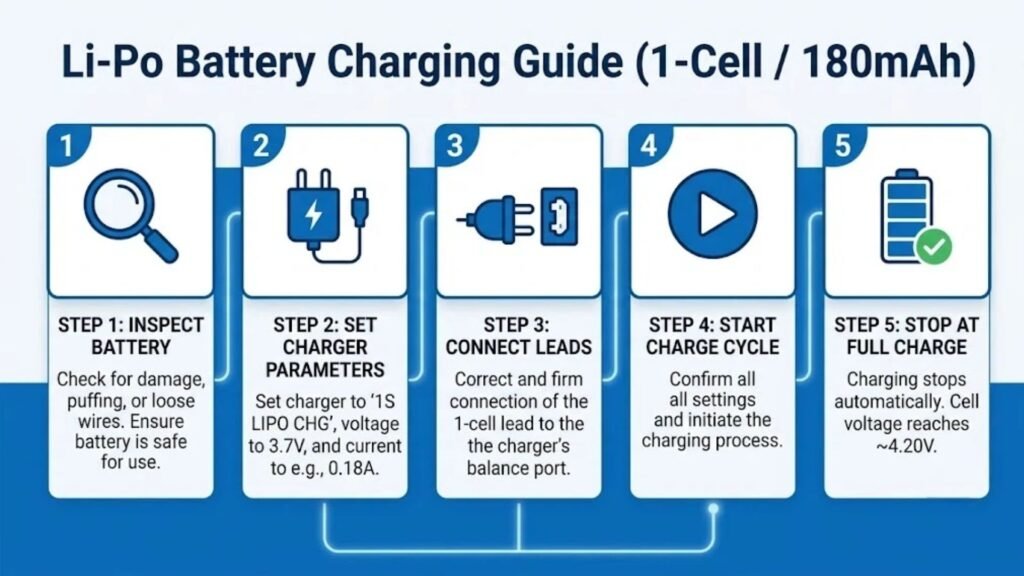
- Inspect the battery. Check for swelling, punctures, exposed wires, corroded terminals, or damage. Gently squeeze a soft pack to feel for gas. If anything is wrong, do not charge – quarantine and recycle it.
- Set the correct cell count, chemistry, and current. Match the S-rating and chemistry, and set current to 1C unless the datasheet says otherwise (1000mAh → 1A, 2600mAh → 2.6A, 5000mAh → 5A). Never exceed the maximum charge current on the label.
- Connect the leads. Connect the main power lead and – for every pack 2S and up – the balance lead to the balance port. A 1S cell needs no balance lead.
- Start in a fire-safe location. Place the pack in a charging bag or on a non-flammable surface, then start. The charger runs CC, then switches to CV at 4.20V. Do not leave it fully unattended.
- Monitor, especially at the start and end. Watch the first ~15 minutes and the final CV taper. Stop if you see swelling, unusual heat, or a chemical smell.
- Stop at full charge and verify. The charge ends when the CV current falls to ~0.02–0.05C and each cell reads 4.15–4.20V. Disconnect immediately. If cells differ by more than ~0.10V, run a balance cycle.
First-Time Charging
A new LiPo is normally shipped at 30–40% charge (~3.7–3.8V/cell) to limit degradation in transport. The first few cycles condition the chemistry. Follow these points:
- Inspect the pack and confirm each cell reads roughly 3.6–3.9V. A cell below 3.0V may be transit-damaged – pre-charge at ~0.1C with close supervision or replace it.
- Charge the first 2–3 cycles at 0.5C (for a 2000mAh pack, 1A rather than 2A) and avoid deep discharges.
- Do not fast-charge a new cell. A 2C+ charge before the pack is conditioned can cause lithium plating, permanently cutting capacity and raising internal resistance. Use full-rate charging only after the first ~3 cycles.
Balance Charging: How It Works
In a series pack, cells are never perfectly identical. Small differences in capacity, internal resistance, and temperature mean they take charge and age at slightly different rates. Over cycles, the gap compounds: the strongest cell reaches 4.20V first, the charger stops, and the weaker cells are left under-charged – so the pack’s usable capacity is set by its weakest cell. Balance charging corrects this by monitoring every cell individually.
| Method | How it works | Typical balance current |
|---|---|---|
| Passive balancing | Drains energy from the higher cells through small resistors until all cells match; simple and low cost | ~30–100mA |
| Active balancing | Transfers energy from higher to lower cells rather than wasting it as heat; faster, more complex and costly | Higher (design-dependent) |
- The balance lead (usually JST-XH) has one more wire than the number of cells – a 3S pack has a 4-pin balance plug. Always connect it for 2S and above.
- If cells differ by more than roughly 0.05–0.10V, run a dedicated balance charge. Packs that see very high discharge (drones) drift fastest and benefit from balancing before every use.
Charging 1S–6S: Quick Reference
| Pack | Charger setting / full voltage | Balance lead | Common uses & notes |
|---|---|---|---|
| 1S | 1S / 4.20V | None | Wearables, TWS, small IoT; use a charger that goes low enough for <200mAh cells |
| 2S | 2S / 8.40V | Yes | Small RC, speakers, medical; most prone to imbalance |
| 3S | 3S / 12.60V | Yes | RC cars/boats, entry drones; see the 3S guide |
| 4S | 4S / 16.80V | Yes | High-performance drones, RC, e-bikes; more heat – ventilate; see the 4S guide |
| 6S | 6S / 25.20V | Yes | Large drones, high-end RC; needs a 25V-capable charger; see the 6S guide |
Cold Charging & Lithium Plating
Temperature is as important as current. The safe charging range is roughly 0–45°C, with ~15–35°C ideal. Discharging works far colder (down to ~-20°C), but charging below ~0°C must be avoided on a standard graphite-anode cell.
What happens in the cold: low temperature slows lithium-ion diffusion in the electrolyte and anode. If the charge current pushes ions in faster than they can intercalate into graphite, the excess ions deposit as metallic lithium on the anode surface instead of entering it – lithium plating. The consequences are cumulative and serious:
- Permanent capacity loss, because plated lithium is removed from the working cycle and continues to consume electrolyte.
- Higher internal resistance and, if lithium grows into dendrites, a possible internal short-circuit.
- The same mechanism is triggered, to a lesser degree, by charging at too high a rate or by poor CV control.
How Charging Affects Cycle Life
Charging choices are the main lever you have over cycle life. The trends below are typical for a graphite-anode lithium cell; the exact trade-off is confirmed on the cell datasheet.
| Factor | Setting | Effect on cycle life |
|---|---|---|
| Charge current | 0.5C vs 1C vs 2C+ | Slower charging runs cooler and plates less; high rates add heat and shorten life |
| Charge voltage | 4.10V / 4.20V / 4.35V+ | Lowering the limit (e.g. to 4.10V) can extend life notably; LiHV’s 4.35–4.40V trades life for capacity |
| Temperature | Cold charge / high heat | Cold charging plates lithium; sustained heat accelerates aging |
| Depth of cycle | Shallow vs full 0–100% | Recharging at 20–30% rather than running to cut-off reduces stress and extends life |
For always-on medical, industrial, or long-service products, the common combination is a 0.5C charge, a slightly reduced voltage limit, and LFP chemistry – which can reach 1000–2000+ cycles. For the chemistry-level comparison, see our LiPo vs Li-Ion comparison.
Drone & RC Charging Tips
Drone and RC packs see very high discharge and are often charged in batches, so a few extra rules apply:
- Let the pack cool after a run/flight before charging (~20–30 minutes); charging a warm pack accelerates aging and can trip the temperature cutoff.
- Balance before every flight. Packs discharged at 20–100C in use drift fast; balancing prevents the sudden mid-flight “weak cell” voltage sag.
- Storage-charge between sessions. If you will not fly/run for more than ~48 hours, set the pack to storage voltage (3.80–3.85V/cell). A pack left fully charged for several days loses capacity.
- Parallel-charge only matched packs – same cell count, capacity within ~20%, and starting voltage within ~0.1V/cell. Never parallel a depleted pack with a full one.
RC car/boat packs are usually 2S or 3S with Deans/EC3 connectors; the procedure is identical – just match the connector and cell count.
LiPo vs Li-Ion Charging
A common question is whether the same charger works for LiPo pouch cells and Li-ion cylindrical cells (such as 18650). For standard 4.20V cells, yes – they use the same CC/CV profile and full-charge voltage.
| Parameter | LiPo (pouch) | Li-Ion (18650) |
|---|---|---|
| Profile / full voltage | CC/CV to 4.20V | CC/CV to 4.20V (standard) |
| Typical max charge rate | 0.5–1C (up to ~5C high-drain RC) | 0.5–1C (up to 2–4C some cells) |
| Balance sensitivity | Higher – pouch cells need careful balancing | Lower – more robust, but still benefit |
| Overcharge sign | Visible swelling | Vents through a pressure valve |
If you charge high-voltage cells (4.35/4.40V), make sure the charger supports those settings – a standard 4.20V charger does not. For the full chemistry and packaging comparison, see our LiPo vs Li-Ion guide.
Safety Rules & Common Mistakes
| Mistake | Risk / consequence |
|---|---|
| Using a non-LiPo (NiMH/lead-acid) charger | No 4.20V cutoff or CC/CV profile – overcharge, thermal runaway, fire |
| Wrong cell-count / chemistry setting | Overcharges every cell (3S on 4S = +1.4V/cell) – immediate swelling or fire |
| Skipping the balance lead | Cells drift apart; strong cell hits 4.20V first and weak cells stay under-charged – capacity falls over cycles |
| Charging too fast / too cold | Heat and lithium plating – can cut cycle life sharply and raise internal resistance |
| Charging a swollen/damaged pack | Internal gas and damage – high risk of venting or fire; recycle it, never puncture it |
| Charging unattended / overnight on a flammable surface | A faulty cell or charger can overcharge while you sleep; always use a fire-safe bag or concrete surface and set a timer |
Charge in a fire-safe area away from liquids and combustibles; use a LiPo bag for packs above ~1000mAh or 2S; and never charge a frozen pack or use a damaged charger or frayed leads. For the standards behind these rules, see Lithium Battery Safety & Compliance for OEM Buyers; for end-of-life handling, see How to Dispose of Lithium-Ion Batteries.
Charging Glossary
| CC (Constant Current) | The first charge phase, where a fixed current is applied while voltage rises; most capacity is added here. |
| CV (Constant Voltage) | The second phase, holding 4.20V while current tapers; tops up the cell safely. |
| C-rate | Current relative to capacity; 1C charges a full pack in a theoretical one hour (1000mAh → 1A). |
| Termination / taper current | The current at which the CV phase ends, typically 0.02–0.05C. |
| Balance charging | Charging that monitors and equalizes every cell in a series pack via a balance lead. |
| PCM / BMS | Protection Circuit Module / Battery Management System; provide overcharge, over-discharge, overcurrent, short and temperature protection. |
| NTC | A thermistor that reports cell temperature to the charger/BMS. |
| LiHV | High-voltage lithium cells charged to 4.35–4.40V for extra capacity. |
| Lithium plating | Deposition of metallic lithium on the anode from cold or fast charging; causes capacity loss and possible shorts. |
Frequently Asked Questions
1. How long does it take to charge a LiPo battery?
At 1C, a pack from a typical 20–30% remaining state takes roughly 60–90 minutes to full. Estimate with Capacity ÷ Current, then add ~30% for the CV taper; 0.5C takes about twice as long and 2C about half. A pack from 0% takes longer and may run a pre-charge phase.
2. How do I charge a LiPo battery for the first time?
Inspect the pack, set the correct cell count and chemistry, charge the first 2–3 cycles at 0.5C, connect the balance lead for multi-cell packs, and charge in a fire-safe bag. New packs ship at 30–40% charge; avoid fast charging until the pack is conditioned.
3. Can I charge a LiPo with a regular (NiMH or lead-acid) charger?
No. LiPo needs a CC/CV profile with a precise 4.20V per-cell limit and a taper cutoff. NiMH/lead-acid chargers lack this and will overcharge the cell, risking thermal runaway and fire. Always use a lithium-specific balance charger.
4. What does 1C or 0.5C mean, and how do I set the current?
1C is a current in amps equal to the capacity in Ah: 1000mAh → 1A, 2000mAh → 2A, 5000mAh → 5A. 0.5C is half that. Set the charger current to 1C unless the datasheet specifies a lower or higher limit, and never exceed the maximum on the label.
5. How do I charge a 2S, 3S or 4S LiPo pack?
Select the matching S-rating (2S/8.40V, 3S/12.60V, 4S/16.80V), set current to 1C, connect the main lead and the balance lead, and charge until each cell reaches 4.20V. Never charge a pack on a neighbouring cell-count setting – that is the most common cause of pack failure.
6. What happens if I skip the balance lead?
The charger can only see pack voltage, so the strongest cell reaches 4.20V first and the charger stops while weaker cells are under-charged. Over repeated cycles the imbalance and capacity loss worsen. Always connect the balance lead for 2S and above.
7. Can I charge LiPo and Li-ion (18650) with the same charger?
For standard 4.20V cells, yes – both use the same CC/CV profile and full-charge voltage. Match the chemistry setting, check the cell’s maximum charge rate, and note that LiHV (4.35/4.40V) and LFP (3.65V) need their own settings.
8. Can I charge a LiPo in the cold (below 0°C)?
Not on a standard cell. Charging below ~0°C causes lithium plating, permanent capacity loss, and possible shorts. Let the pack warm to room temperature first, and for cold-climate products specify a BMS low-temperature charge inhibit or a cold-rated chemistry.
9. When is a LiPo fully charged – what is the taper current?
The charge ends at 4.20V when the CV current falls to roughly 0.02–0.05C (20–50mA for a 1000mAh cell), with each cell reading 4.15–4.20V. There is no trickle charge – disconnect at that point.
10. Why is my LiPo swelling?
Swelling is gas from electrolyte breakdown, usually caused by overcharging, charging a damaged or deeply discharged cell, excessive heat, or a defect. A swollen pack is compromised – stop using it and recycle it; a severely puffy pack (large deformation) must be removed immediately. Never puncture it.
Custom LiPo Charging Solutions from A&S Power
Every custom cell and pack we build ships with a datasheet that defines its charge voltage, maximum charge current, taper current, and balance requirements – so your device charges it correctly from the first unit. We can integrate a PCM/BMS with cell balancing, temperature monitoring, a low-temperature charge inhibit, and the communication protocol your product needs.
- Custom voltage, capacity, form factor and connectors (1S to 16S+)
- PCM/BMS with balancing, NTC, and I²C, SMBus, CAN or HDQ communication
- UL, CE, RoHS, UN 38.3, IEC 62133 documentation included
- OEM labeling and engineering support from prototype to mass production