
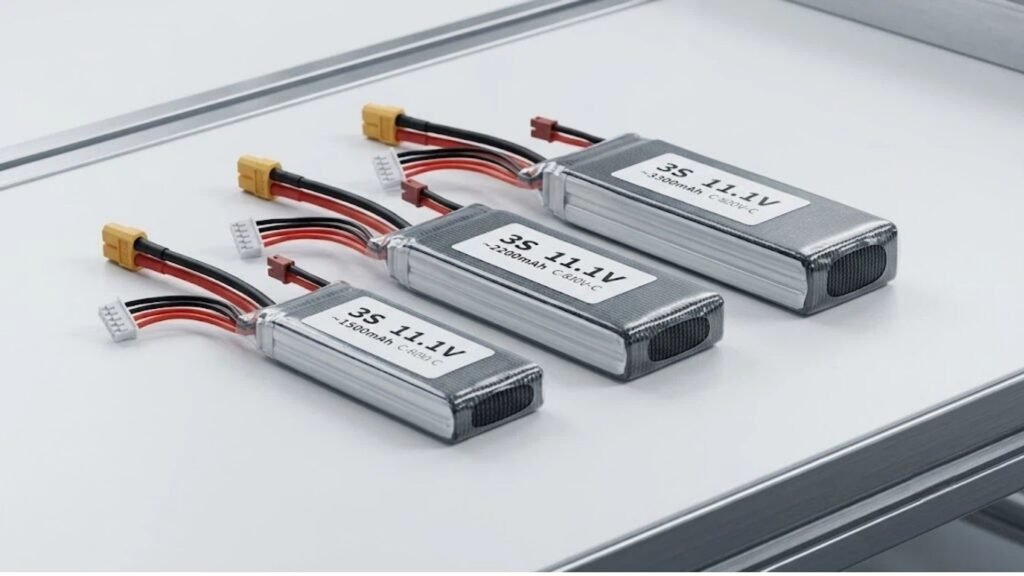
3S Lipo Battery: 11.1V Specs, Applications, Charging & OEM Guide
Published by A&S Power | Battery Technology
Introduction
If you’re into RC cars, drones, or DIY electronics, you’ve probably come across the term 3S lipo battery. But what exactly does “3S” mean, and why does it matter? This guide covers everything you need to know — from voltage specs and capacity to applications, charging procedures, and safety considerations.
At A&S Power, we manufacture custom lithium polymer batteries for OEM buyers worldwide. Our 3S LiPo packs are used in RC vehicles, drones, airsoft, portable electronics, and industrial equipment. This guide breaks down 3S technology from the ground up.
For a complete voltage reference covering all LiPo configurations, see our LiPo Battery Voltage Chart & C-Rating Guide. If you’re new to lipo batteries, start with our Lipo Battery 101 guide.
What is a 3S Lipo Battery?
A 3S lipo battery is a lithium polymer battery pack that contains three cells connected in series. The “S” stands for “series,” meaning the cells are wired end-to-end to increase voltage. Each LiPo cell has a nominal voltage of 3.7V, so three cells in series produce 11.1V nominal — the defining characteristic of a 3S pack.
The “S” notation works across all configurations: 1S = 3.7V, 2S = 7.4V, 3S = 11.1V, 4S = 14.8V, 6S = 22.2V. The number before S tells you how many cells are in series; multiply by 3.7V to get nominal voltage.
3S is one of the most popular configurations because 11.1V is a sweet spot for many applications — enough power for performance RC and drones, but lighter and more manageable than 4S or 6S systems. It’s also the most common voltage for airsoft guns and many portable electronic devices.
Key Specifications
| Specification | Value |
|---|---|
| Number of cells | 3 cells (3S) |
| Nominal voltage | 11.1V (3 × 3.7V) |
| Full charge voltage | 12.6V (3 × 4.2V) |
| Storage voltage | 11.4V (3 × 3.8V) |
| Cutoff voltage | 9.0V (3 × 3.0V) |
| Minimum safe under load | 9.6V (3.2V per cell) |
| Common capacities | 800mAh – 5,000mAh |
| Configurations | 3S1P, 3S2P, 3S3P |
| Typical C-rating | 25C – 100C+ |
| Energy range (typical) | 8.9Wh – 55.5Wh |
In simple terms: A 3S lipo delivers higher voltage than 2S (7.4V) or 1S (3.7V), making it suitable for moderate-to-high performance applications without the weight and complexity of 4S+ systems.
Common Uses of 3S Lipo Batteries
3S lipo batteries are widely used in applications requiring moderate to high power. The 11.1V nominal voltage balances performance with weight and cost:
| Application | Why 3S Lipo Battery | Typical Capacity |
|---|---|---|
| RC cars and trucks | Provides speed and torque for 1/10 and 1/12 scale off-road and on-road models | 2,000–5,000mAh |
| Drones and quadcopters | Powers 3-5 inch drones for 8-15 minute flights; popular for cinematic and cruising | 1,000–2,200mAh |
| FPV racing drones | Delivers burst power for acceleration; common in 3-inch and micro class | 450–1,500mAh |
| Airsoft guns | 11.1V is the standard for high-rate-of-fire AEGs; lightweight and high discharge | 1,000–2,500mAh |
| Portable electronics | Powers devices requiring 11.1V input — speakers, monitors, field equipment | 2,000–10,000mAh |
| Industrial equipment | Test instruments, portable scanners, and field devices use 3S for stable 12V-class output | 2,000–5,000mAh |
| DIY projects and robots | Used in custom electronics, robotics, and Arduino/Raspberry Pi projects | 1,000–3,000mAh |
3S Lipo Battery vs 2S vs 4S – What’s the Difference?
Choosing the right cell count is critical. Here’s how 3S compares to the two most common alternatives:
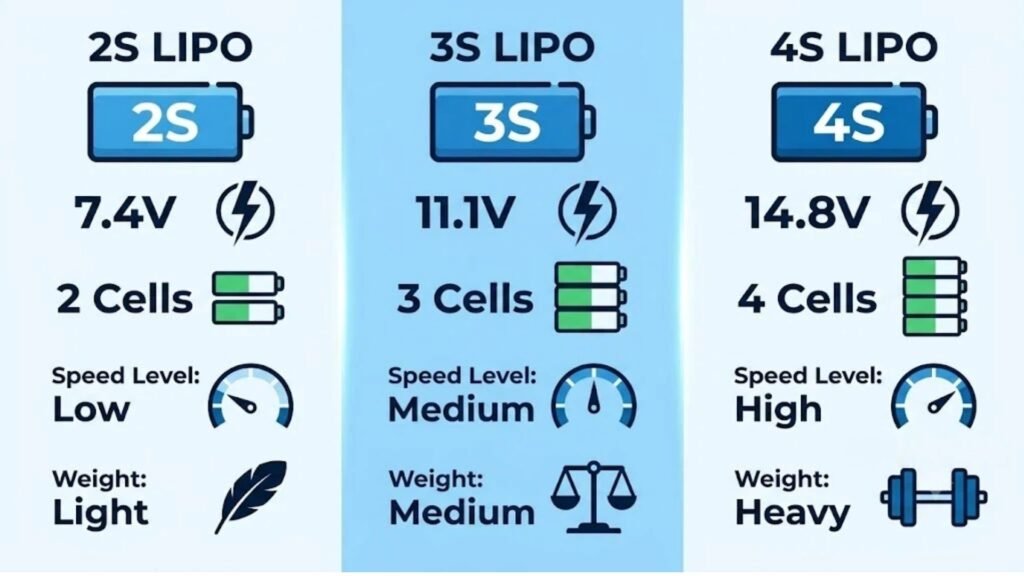
| Feature | 2S Lipo (7.4V) | 3S Lipo (11.1V) | 4S Lipo (14.8V) |
|---|---|---|---|
| Nominal voltage | 7.4V | 11.1V | 14.8V |
| Full charge | 8.4V | 12.6V | 16.8V |
| Cutoff voltage | 6.0V | 9.0V | 12.0V |
| Speed/Power | Moderate | Higher | Very high |
| Current draw (same power) | Higher (~68A at 500W) | Medium (~45A at 500W) | Lower (~34A at 500W) |
| Weight | Lighter | Medium | Heavier |
| ESC/charger cost | Lower | Medium | Higher |
| Best for | Small drones, micro RC, beginners | RC cars, mid-sized drones, airsoft | Racing drones, large RC vehicles |
For higher voltage options, see our 4S Lipo Battery guide and 6S Lipo Battery guide.
How to Choose the Right 3S Lipo Battery
Selecting the right 3S pack involves matching five key parameters to your application:
1. Capacity (mAh)
Higher capacity = longer runtime, but more weight. For RC cars, 2,000–5,000mAh is common. For drones, 1,000–2,200mAh balances weight and flight time. Calculate: Capacity (mAh) = (Average current in mA × Runtime in hours) / DOD factor. Use 0.8 DOD for long cycle life.
2. Discharge Rate (C-rating)
Max current = Capacity (Ah) × C-rating. A 2200mAh 50C pack delivers 110A continuously. For RC cars, 30C–50C is sufficient. For racing drones, 70C–100C is common. Always verify with actual load testing — advertised C-ratings vary between manufacturers.
3. Connector Type
Most 3S packs use XT60 (up to ~60A), Deans/T-plug, EC3, or JST. Airsoft commonly uses mini Tamiya or XT30. Check your device compatibility before purchasing.
4. Balance Connector
All 3S packs have a 4-pin JST-XH balance lead. Never charge without connecting the balance lead — it allows the charger to monitor and balance each individual cell.
5. Physical Dimensions and Internal Resistance
Ensure the battery fits your compartment. Quality 3S packs have per-cell internal resistance below 10–15mΩ. A&S Power uses grade-A cells with consistent IR matching across all three cells for balanced discharge and long life.
How to Charge a 3S Lipo Battery Safely
Charging a 3S LiPo correctly is essential for safety and longevity. You need a balance charger that supports at least 3 cells.
What You Need
- Lipo balance charger (supports 3S / 11.1V)
- 3S balance lead (4-pin JST-XH connector)
- Fire-safe charging bag or ceramic container
- Appropriate main power connector (XT60, Deans, etc.)
Step-by-Step Charging Procedure
- Inspect the battery — Check for swelling, damage, or abnormal temperature. Do not charge a damaged or puffy pack.
- Connect the balance lead — Plug the 4-pin JST-XH into the charger’s 3S balance port. Critical for monitoring each cell.
- Connect the main power leads — Plug the XT60/Deans main connector into the charger.
- Set charger to 3S (11.1V) — Do not select 2S or 4S. Most chargers auto-detect, but always verify.
- Set charging current to 1C — e.g., 2.2A for a 2,200mAh battery, 5.0A for 5,000mAh.
- Start charging and monitor — Never leave a charging LiPo unattended.
- Wait for completion — Charger shows “Complete” when all cells reach 4.20V.
- Disconnect — Unplug main lead first, then balance lead. Store at storage voltage if not using immediately.
⚠️ Never charge a 3S lipo without balance charging. Uneven cell charging creates fire hazards. Without balancing, a cell can be overcharged to 4.3V+, causing thermal runaway.
3S Lipo Battery Voltage Chart
Monitoring voltage at different states of charge helps you avoid over-discharge and maintain battery health:
| State of Charge | Per Cell | 3S Total | Action |
|---|---|---|---|
| 100% (Full) | 4.20V | 12.60V | Ready to use; don’t store long-term |
| 75% | 3.95V | 11.85V | Good operating range |
| 50% (Storage) | 3.80V | 11.40V | Ideal for long-term storage |
| 25% | 3.65V | 10.95V | Consider recharging soon |
| Low warning | 3.40V | 10.20V | Land/stop using immediately |
| Critical (cutoff) | 3.00V | 9.00V | Do not discharge below this |
| Damaged | Below 3.00V | Below 9.00V | Permanently damaged; dispose safely |
Voltage under load reads lower than at rest. Set your ESC cutoff to 9.6–10.2V (3.2–3.4V/cell) to account for voltage sag under acceleration.
Storage and Maintenance Best Practices
Proper storage significantly extends the life of your 3S LiPo batteries:
- Store at storage voltage (3.8V/cell = 11.4V total) — Never store fully charged (12.6V) for more than 3 days.
- Store in a cool, dry place — Ideal temperature is 15–25°C (59–77°F). Avoid above 35°C or below 0°C.
- Use a fire-safe storage bag — LiPo-safe bags or metal containers contain fires if a battery fails.
- Check voltage monthly — Verify stays above 3.6V/cell (10.8V total). Recharge to storage voltage if it drops.
- Cycle every 3 months — For long-term storage, do a partial charge/discharge cycle every 90 days.
- Never discharge below 3.0V/cell — Over-discharge causes irreversible lithium plating and capacity loss.
- Inspect before each use — Look for swelling, punctures, damaged wires, or connector corrosion.
Safety Considerations
3S LiPo batteries store significant energy (up to 55+ Wh in larger packs) and require careful handling:
- Always use a balance charger — Never charge with a non-balancing charger.
- Never leave charging unattended — Most LiPo fires occur during charging.
- Set correct cell count — Charging a 3S pack as 2S overcharges cells to 6.3V — catastrophic.
- Avoid physical damage — Punctures or crushing can cause internal short circuits.
- Don’t charge damaged or puffy batteries — Swollen cells are at higher risk of thermal runaway.
- Keep away from flammable materials — Charge on a non-flammable surface.
- Follow shipping regulations — Packs over 100Wh require special handling for air transport.
For comprehensive safety information, read our Lithium Battery Safety & Compliance Guide.
Frequently Asked Questions
1. How long does a 3S lipo battery last?
Under normal use and proper care, a 3S lipo lasts 300–500 charge cycles (approximately 2–5 years). Runtime per charge is typically 8–30 minutes depending on the device and capacity.
2. What does 3S1P mean?
3S1P means 3 cells in Series, 1 in Parallel — three cells wired end-to-end for 11.1V with single-cell capacity. 3S2P doubles the capacity at the same 11.1V.
3. Can I use a 3S lipo battery in a 2S device?
No. 3S delivers 11.1V vs 7.4V and will damage 2S-compatible devices, including burning out ESCs and motors. Always match battery voltage to your device’s input range.
4. What is the voltage of a fully charged 3S lipo battery?
A fully charged 3S lipo reads 12.6V (4.2V per cell × 3). This is the maximum safe voltage — charging beyond 4.2V/cell can cause thermal runaway.
5. Can I store a 3S lipo battery fully charged?
No. For long-term storage, store at 40–60% charge (approximately 3.8V per cell = 11.4V total) in a cool, dry place. Fully charged storage causes permanent capacity loss and swelling.
6. What is the lowest voltage for a 3S lipo battery?
The minimum safe voltage is 9.0V (3.0V per cell). Set your device cutoff to 9.6–10.2V (3.2–3.4V/cell) to account for voltage sag under load.
7. Can I charge a 3S battery on a 2S charger?
No. A 2S charger only supplies up to 8.4V and cannot fully charge a 3S pack (requires 12.6V). Always use a charger rated for at least 3S. Most modern LiPo chargers support 1S–6S.
8. How do I know if my 3S battery is balanced?
Check each cell with a LiPo checker or multimeter. A healthy pack has all three cells within 0.05V of each other. Persistent imbalance may indicate a failing cell.
9. Is 3S or 4S better for drones?
For 3-inch and cinematic 5-inch drones, 3S is lighter and more efficient. For freestyle and racing 5-inch drones, 4S provides more power. Match the battery to your ESC and motor KV rating.
10. How should I dispose of a damaged 3S LiPo?
Discharge to 0V using a LiPo discharger or small load, then take to a battery recycling center. Never throw LiPo batteries in the trash. See our disposal guide.
Custom 3S Lipo Battery Solutions from A&S Power
We manufacture custom 3S lithium polymer batteries for OEM buyers across RC, drones, airsoft, medical, industrial, and portable power industries. Every pack is built with grade-A cells and full safety certifications.
- Custom dimensions and capacities (800mAh–10,000mAh+)
- 3S1P / 3S2P / 3S3P / 3S4P configurations
- Integrated PCM/BMS with over-charge, over-discharge, over-current & short-circuit protection
- Custom connectors (XT60, Deans, JST, Tamiya, custom harnesses)
- NTC thermistor for temperature monitoring; SMBus/I2C for smart batteries
- UL 1642, IEC 62133, CE, RoHS, REACH, UN38.3 certified