
What is a Lithium Polymer (LiPo) Battery? Specs, Types & Applications
By A&S Power Engineering Team | Battery Technology
Introduction
If you’ve ever used a smartphone, drone, or wireless earbuds, you’ve used a lithium polymer battery – often called a Li-Po or Li-poly battery. But what exactly is a lithium polymer battery, how is it constructed, and how is it different from other rechargeable lithium batteries?
At A&S Power, we manufacture custom lithium polymer pouch cells and packs at our Dongguan facility for OEM buyers worldwide. This guide goes beyond generic definitions: it explains the internal construction of a pouch cell, the 10-step production process, and an engineering decision framework for choosing between LiPo and cylindrical Li-ion in your product.
For custom pack design and BMS integration, see our dedicated guide: Custom LiPo Battery Packs: OEM Assembly with Built-in BMS. For a comparison of all three physical formats, see Battery Cell Types: Cylindrical, Pouch & Prismatic.
What Is a Lithium Polymer Battery?
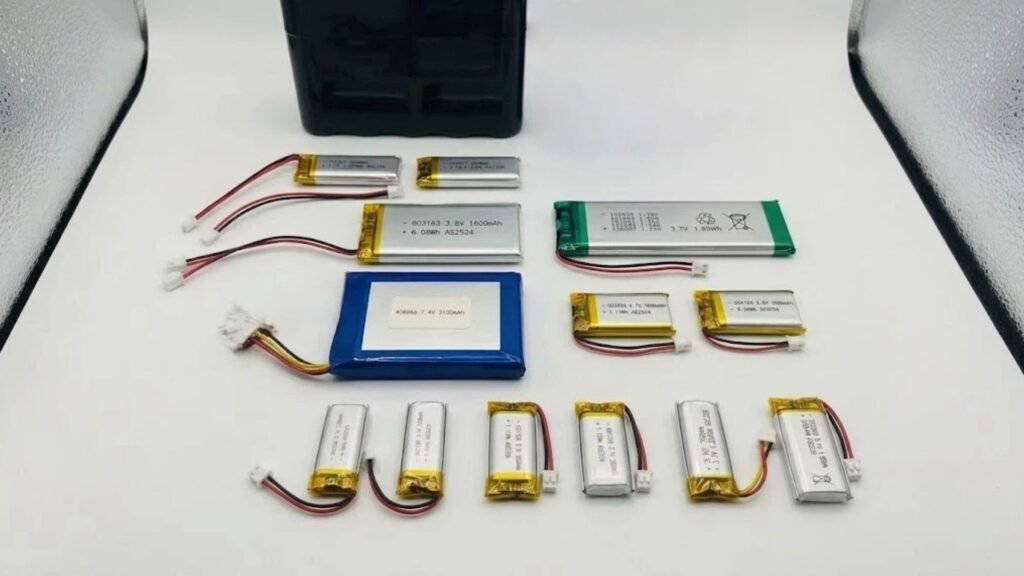
A lithium polymer battery (LiPo / Li-poly) is a rechargeable lithium battery that uses a solid or gel-like polymer electrolyte instead of the liquid electrolyte found in traditional cylindrical lithium-ion cells. It is packaged in a flexible aluminum-laminated foil pouch – hence the name “pouch cell” – rather than a rigid metal can.
This construction is what gives LiPo cells their signature shape flexibility. Unlike standard 18650 or 21700 cylindrical cells that only come in fixed sizes, LiPo cells can be manufactured in almost any dimension, thickness, and capacity – including curved, stepped, and ultra-thin profiles below 1mm.
Clarifying a common confusion: LiPo is a subtype of lithium-ion battery – the term describes the packaging and electrolyte form, not a different chemistry family. A modern pouch cell and an 18650 cell can use the exact same cathode chemistry (NMC, for example). The difference is physical construction, not electrochemical principle.
Inside a LiPo Pouch Cell: Layer-by-Layer Construction
As a manufacturer, we start every custom cell design from the internal stack. A LiPo pouch cell contains these layers, repeated many times inside the foil envelope:
| Layer / Component | Material (Typical) | Function |
|---|---|---|
| Cathode (positive electrode) | LiCoO₂, NMC, or LFP coated on aluminum foil | Hosts lithium ions at full charge; determines voltage and energy |
| Anode (negative electrode) | Graphite coated on copper foil | Stores lithium ions during charging |
| Separator | PE/PP microporous membrane, often ceramic-coated | Physically separates electrodes while allowing ion flow; melts shut at ~130°C as a safety feature |
| Electrolyte | Lithium salt (LiPF₆) in gel/polymer matrix | Conducts lithium ions between electrodes |
| Pouch casing | Aluminum-laminated film (PET/Al/PP) | Moisture barrier and flexible enclosure; heat-sealed on 3 sides |
| Tabs (terminals) | Aluminum (+), nickel or nickel-coated copper (−) | External electrical connection, sealed through the pouch with polymer tape |
Engineering note: The number of electrode layers stacked inside the pouch directly determines capacity. For example, our AS503759 (5.0 × 37 × 59mm, 1000mAh) uses roughly 14–16 double-sided electrode layers; doubling the thickness to 10mm approximately doubles capacity in the same footprint.
How LiPo Cells Are Made: The Production Process
Understanding production helps OEM buyers evaluate suppliers. A LiPo cell passes through these main stages in our factory – moisture control is critical throughout, which is why electrode handling and electrolyte filling happen in dry rooms at <1% relative humidity:
| Stage | What Happens | Quality Checkpoint |
|---|---|---|
| 1. Slurry mixing | Active material, binder, and solvent mixed into uniform slurry | Viscosity and solids content |
| 2. Coating | Slurry coated onto Al/Cu foil at controlled thickness | Coating weight consistency per m² |
| 3. Calendaring | Rollers compress coating to target density | Electrode density and thickness tolerance |
| 4. Slitting | Electrodes cut to cell-specific widths | Burr inspection (burrs cause internal shorts) |
| 5. Stacking / winding | Anode/separator/cathode stacked (pouch cells typically Z-stacked) | Layer alignment |
| 6. Tab welding & pouch sealing | Tabs ultrasonic-welded; stack sealed inside aluminum-laminate pouch | Seal strength and leak test |
| 7. Electrolyte filling | Gel electrolyte injected in dry room; final seal | Fill weight precision |
| 8. Formation | First controlled charge creates the SEI layer | Charge curve logging per cell |
| 9. Aging | Cells rest 7–14 days to stabilize | OCV decay screening (rejects micro-shorts) |
| 10. Grading (binning) | Capacity, internal resistance, and voltage measured; cells sorted into bins | 100% OCV/ACIR/capacity test |
This is why custom-shape cells carry tooling cost and lead time: stages 2–6 require cell-specific coating widths, stacking fixtures, and pouch forming dies.
Key Specifications & Characteristics
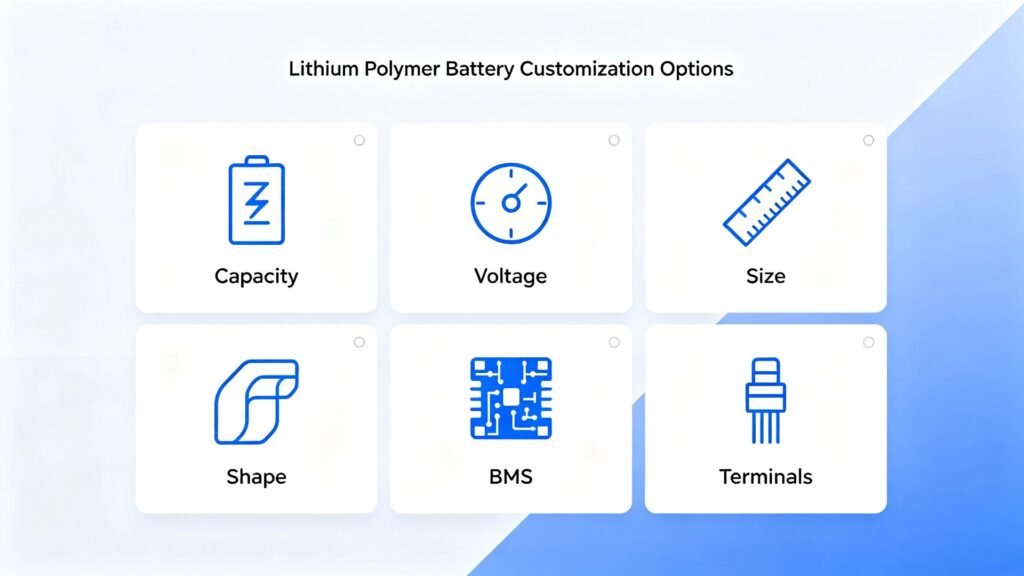
These are the parameters we define with OEM customers during custom cell design. Ranges below reflect our actual production capability:
| Specification | Typical Range | Why It Matters |
|---|---|---|
| Nominal voltage | 3.7V per cell (3.8V high-voltage variants) | Determines compatibility with device electronics |
| Charge / cutoff voltage | 4.2V full / 3.0V cutoff (4.35V for HV cells) | Exceeding either permanently degrades the cell |
| Capacity | 20mAh – 10,000mAh+ per cell | Directly impacts runtime per charge |
| Thickness | From ~0.8mm (ultra-thin line) to 13mm+ | Critical for slim wearables and card-style devices |
| Discharge rate | 0.5C–3C standard; high-rate designs to 10C+ | Determines peak power for motors and transmitters |
| Cycle life | 300–500 cycles typical; 700+ optimized designs (to 80% capacity) | Affects warranty cost and replacement rate |
| Operating temperature | Charge 0–45°C; discharge −20 to 60°C | Must match the real operating environment |
| Self-discharge | ~1–2% per month at 50% SOC, 25°C | Determines shelf behavior and recharge intervals |
For the full per-cell voltage reference across 1S–6S packs, see our LiPo Battery Voltage Chart & C-Rating Guide. Storage conditions are covered in our LiPo Battery Storage Guide, including 12-month factory degradation data.
Cell & Pack Configurations
LiPo batteries ship as single cells or assembled into multi-cell packs. Cells in series (S) add voltage; cells in parallel (P) add capacity:
| Configuration | Nominal Voltage | Typical Application |
|---|---|---|
| 1S | 3.7V | Wearables, TWS earbuds, IoT sensors, medical patches |
| 2S | 7.4V | Portable audio, small power tools, heated apparel |
| 3S | 11.1V | Mid-size RC models, portable monitors, drones |
| 4S | 14.8V | High-performance drones, RC cars, industrial equipment |
| 6S | 22.2V | Professional racing drones, heavy-duty equipment |
| S-P combinations | Custom | e.g. 4S2P doubles capacity at 14.8V; requires matched cells + BMS |
Multi-cell packs require a PCM or BMS for cell balancing and protection. See our Custom Battery Pack Assembly & BMS Integration guide for I²C, SMBus, and CAN communication options.
LiPo vs. Traditional Li-Ion Batteries
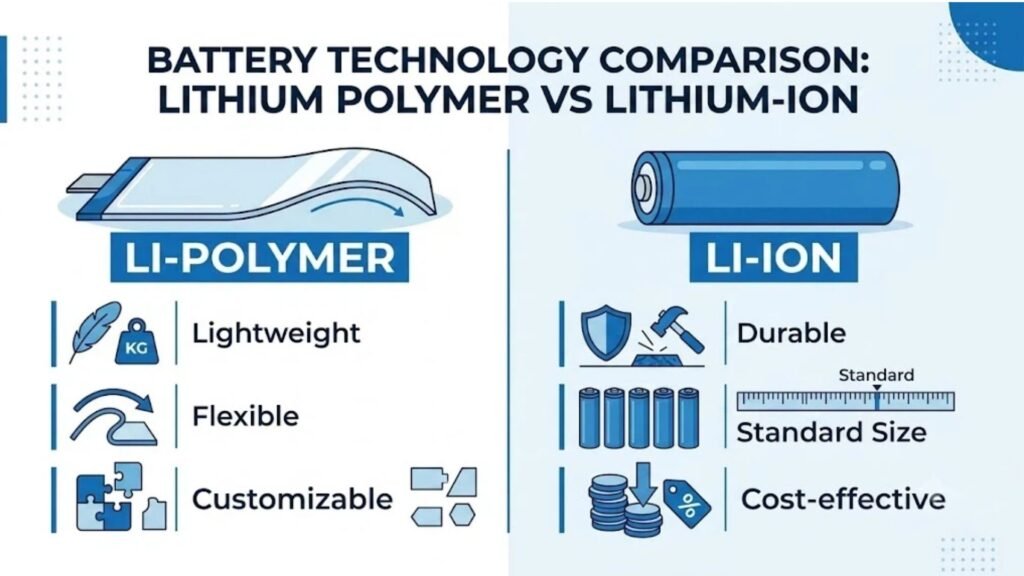
| Feature | Li-Polymer (Pouch) | Li-Ion (Cylindrical) |
|---|---|---|
| Electrolyte | Gel / polymer matrix | Liquid |
| Casing | Flexible aluminum-laminate pouch | Rigid steel/aluminum cylinder |
| Shape | Custom: thin, curved, stepped | Fixed (18650, 21700, 26650…) |
| Weight | 10–20% lighter for equivalent energy | Heavier (metal can + safety vent) |
| Vent behavior in failure | Pouch swells and vents gas (soft failure) | Pressure relief vent / can rupture (hard failure) |
| Cost | Higher per Wh for custom sizes (tooling) | Lower per Wh at high volume (standardized) |
| MOQ | Custom sizes typically 1,000–3,000 pcs | Standard cells often available off the shelf |
| Best for | Compact, custom-designed, weight-sensitive devices | Standard high-volume, cost-driven applications |
For the full comparison including chemistry and pack-level trade-offs, see LiPo vs Li-Ion Batteries: Which Is Better for Your OEM Project?
Engineer’s Selection Framework: When to Specify LiPo
After hundreds of custom projects, our engineers use this decision sequence. Specify a custom LiPo pouch cell when two or more of these conditions apply:
| Your Product Constraint | LiPo Pouch | Cylindrical Li-Ion |
|---|---|---|
| Enclosure thinner than 10mm | Required (18650 is 18mm diameter) | Not feasible |
| Irregular / curved / wearable form factor | Required | Not feasible |
| Dead space must be minimized | Preferred (pouch fills rectangular space ~90%) | Cylinders waste ~20–25% packing space |
| Weight is a selling point (wearables, drones) | Preferred | Heavier |
| Standard rectangular enclosure, >50K units/year, cost-critical | Acceptable | Preferred (lower $/Wh) |
| High impact / rough handling environment | Needs rigid housing design | More tolerant (metal can) |
Real OEM Selection Case: Medical Wearable Patch
A medical customer designing a continuous-monitoring skin patch initially specified a small cylindrical cell. During our design review we identified three problems and switched the design to a custom LiPo pouch:
| Issue | Cylindrical Design | Custom LiPo Solution |
|---|---|---|
| Patch thickness | 18mm minimum (cell diameter) – visibly bulky on skin | 3.0mm curved pouch – conforms to body contour |
| Space utilization | Round cell in rectangular patch wasted ~25% space | Pouch filled the full footprint |
| Capacity in same envelope | 180mAh | 260mAh (+44% runtime) |
Trade-off: the custom cell required tooling and 3,000-piece MOQ, with a 3-week sample lead time – acceptable because the product’s form factor was its core selling point. For high-volume, cost-driven products without space constraints, standard cylindrical cells remain the better choice.
Industry Applications
| Industry | Common Applications |
|---|---|
| Wearables | Smartwatches, fitness bands, smart rings, AR/VR glasses, health-monitoring patches |
| Medical devices | Portable monitors, infusion pumps, CGMs, diagnostic tools, hearing aids |
| IoT & sensors | Environmental sensors, asset/GPS trackers, smart home devices |
| Consumer electronics | TWS earbuds, Bluetooth speakers, power banks, wireless peripherals |
| Drones & RC | High-rate packs for FPV racing, aerial photography, RC cars and boats |
| Industrial & robotics | Handheld scanners, test instruments, portable tools, service robots |
For single-cell selection details, see our 3.7V LiPo Battery Guide for Engineers and Procurement.
Safety, Standards & Best Practices
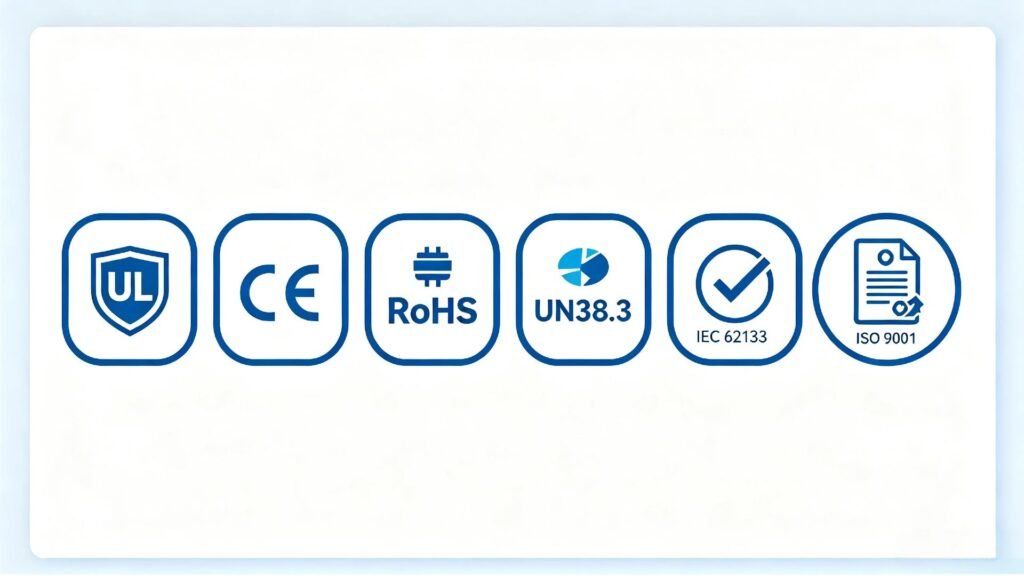
LiPo cells are safe when correctly designed, protected, and used. Every cell we ship includes protection at the cell level (separator shutdown, PTC where specified) and pack level (PCM/BMS for overcharge, over-discharge, overcurrent, and short-circuit protection). Relevant standards for OEM products:
| Standard | Scope |
|---|---|
| IEC 62133-2 | Safety requirements for portable sealed secondary lithium cells (including storage and abuse tests) |
| UL 1642 / UL 2054 | Cell and battery pack safety for the North American market |
| UN38.3 | Transport testing – mandatory for air/sea shipment (cells shipped at ≤30% SOC by air) |
| CE / RoHS | EU market conformity and restricted substances |
Handling rules: never puncture or crush a pouch cell; never charge above 4.2V or discharge below 3.0V; charge at 0–45°C only; store at 40–50% SOC in a cool, dry place; and quarantine any swollen cell for proper recycling. A swollen pouch is a failed cell – do not charge it.
Full requirements are in our Lithium Battery Safety & Compliance Guide for OEM Buyers. End-of-life handling is covered in How to Dispose of Lithium-Ion Batteries.
Frequently Asked Questions
1. Is a lithium polymer battery the same as a lithium-ion battery?
LiPo is a subtype of lithium-ion. Both move lithium ions between graphite anodes and metal-oxide cathodes. The difference is construction: LiPo uses a gel electrolyte in a flexible foil pouch, while conventional Li-ion uses liquid electrolyte in a rigid cylindrical or prismatic can. Same chemistry family, different packaging.
2. How long do LiPo batteries last?
Typically 300–500 full charge cycles to 80% capacity (roughly 2–4 years of normal use); optimized designs and conservative charge rates can reach 700+ cycles. Calendar aging also occurs even without use – see our storage guide for factory test data.
3. Can I charge a LiPo battery with a regular charger?
No. Use a LiPo-specific CC/CV charger set to the correct cell count (1S = 4.2V cutoff) and current (0.5C–1C standard). Multi-cell packs must be balance-charged through the balance lead. A mismatched charger can overcharge cells and cause swelling or fire.
4. What causes a LiPo battery to swell?
Gas generation from electrolyte decomposition, triggered by overcharging, overheating, deep discharge, physical damage, or manufacturing defects. The pouch expands because it has no rigid can. A swollen cell is permanently compromised – stop using it, do not charge it, and recycle it.
5. Can LiPo batteries be made in custom shapes and sizes?
Yes – this is their defining advantage. We manufacture rectangular, curved, stepped, and ultra-thin (from ~0.8mm) profiles, with custom tab positions, connectors, and labeling. Custom tooling typically requires 1,000–3,000-piece MOQ and 2–3 week sample lead time.
6. What do 1S, 2S, 3S, 4S mean?
“S” = cells in series, which add voltage: 1S = 3.7V, 2S = 7.4V, 3S = 11.1V, 4S = 14.8V, 6S = 22.2V nominal. “P” = parallel groups, which add capacity. A 4S2P pack uses 8 cells and delivers 14.8V with double the capacity of one cell group.
7. Are LiPo batteries more dangerous than cylindrical Li-ion?
Not inherently. Pouch cells vent gas by swelling (a visible early warning) rather than building pressure like a sealed can, but the soft casing is more vulnerable to puncture. With proper PCM/BMS, correct charging, and mechanical protection in the product enclosure, both formats are safe and certified to the same IEC 62133 standard.
8. What is the minimum order quantity for custom LiPo cells?
Standard-size pouch cells typically start at 1,000 pcs; fully custom dimensions generally require 1,000–3,000 pcs due to tooling and fixture setup. We support lower quantities for engineering prototypes before mass production.
9. How long does custom cell development take?
Typical timeline: specification review (3–5 days) → engineering samples (2–3 weeks, including tooling for custom shapes) → testing and validation (1–2 weeks) → mass production (4–6 weeks after sample approval).
10. Can lithium polymer batteries be recycled?
Yes. They contain recoverable lithium, cobalt/nickel, copper, and aluminum, but must be processed at a certified lithium battery recycling facility – never in regular trash. Discharge and insulate terminals before sending for recycling.
Custom LiPo Battery Solutions from A&S Power
Whether you need a standard 3.7V pouch cell or a fully custom multi-cell pack with integrated BMS and communication protocols, our engineering team supports you from specification review through mass production.
- Custom dimensions from ultra-thin profiles to large-format packs
- Built-in PCM / BMS with I²C, SMBus, and CAN communication
- UL 1642, CE, RoHS, UN38.3, and IEC 62133 documentation
- OEM labeling, retail or industrial packaging
- 100% OCV/ACIR/capacity testing with batch-level traceability