

Battery Cell Types: Cylindrical, Pouch & Prismatic Explained for OEM Buyers
Published by A&S Power | Battery Technology
Introduction
When you source lithium batteries for an OEM product, one of the first decisions you make is the battery cell type. Cylindrical, pouch, prismatic, or coin — each form factor has distinct strengths, and the wrong choice can increase cost, reduce runtime, or create safety problems down the line.
At A&S Power, we manufacture both cylindrical lithium-ion cells (18650, 26650, 32700) and custom pouch LiPo cells for OEM buyers worldwide. This guide breaks down every major battery cell type — by form factor and by chemistry — so you can match the right cell to your device.
If you are comparing battery technologies at a higher level, see our LiPo vs Li-Ion comparison. For the basics of lithium polymer technology, start with our What is a Lithium Polymer Battery guide.
What Is a Battery Cell?
A battery cell is the single electrochemical unit that stores and releases energy. It consists of four core components:
- Cathode (+): The positive electrode, typically a lithium metal oxide (LiCoO₂, LiFePO₄, NMC).
- Anode (−): The negative electrode, usually graphite.
- Separator: A porous membrane that prevents direct contact between cathode and anode while allowing lithium ions to pass.
- Electrolyte: The lithium salt solution (liquid, gel, or solid) that carries ions between electrodes.
A battery pack is one or more cells combined with a protection circuit (BMS), connectors, and packaging. The cell type determines the pack’s shape, weight, voltage, and performance ceiling.
Battery Cell Types by Form Factor
The most common way to classify lithium battery cells is by their physical shape. There are four main form factors in commercial use today:

| Cell Type | Typical Sizes | Key Advantage | Best For |
|---|---|---|---|
| Cylindrical | 18650, 21700, 26650, 32700 | Low cost, standardized, high consistency | Power tools, e-bikes, UPS, solar storage |
| Pouch (LiPo) | Custom, 0.4mm–10mm thick | Ultra-thin, any shape, lightweight | Wearables, medical, IoT, slim devices |
| Prismatic | Rectangular, various sizes | Space-efficient stacking, high capacity | Smartphones, laptops, EV battery packs |
| Coin (Button) | CR2032, CR2025, LIR series | Ultra-compact, low cost | Watches, remote controls, RTC backup |
Cylindrical Cells
Cylindrical cells are the most widely produced lithium battery format. The cell is wound into a jelly roll and sealed inside a steel or aluminum can. The metal casing provides structural rigidity and good thermal stability.
Common cylindrical cell sizes:
| Model | Dimensions (D×L) | Typical Capacity | Common Use |
|---|---|---|---|
| 18650 | 18mm × 65mm | 1500–3500mAh (3.7V) | Power tools, e-bikes, flashlights, UPS |
| 21700 | 21mm × 70mm | 3000–5000mAh (3.7V) | EVs, e-bikes, high-drain devices |
| 26650 | 26mm × 65mm | 3000–5000mAh (3.2V LiFePO₄) | Solar storage, UPS, flashlights |
| 32700 | 32mm × 70mm | 5000–6000mAh (3.2V LiFePO₄) | Solar energy storage, UPS, e-mobility |
Pros: Highly standardized manufacturing keeps costs low; consistent quality across production runs; metal casing provides good abuse tolerance; easy to assemble into packs with holders or spot welding.
Cons: Fixed dimensions limit design flexibility; heavier than pouch cells for the same capacity; wasted space when packing cylinders into rectangular enclosures. Explore our full cylindrical battery range, including 32700 LiFePO4 cells and 18650 battery guide.
Pouch Cells (LiPo)
Pouch cells, commonly called LiPo batteries, use a flexible laminated aluminum foil pouch instead of a rigid metal can. This allows the cell to be made in virtually any shape and thickness — from ultra-thin 0.4mm cells for wearables to large multi-amp-hour packs for industrial equipment.
Key characteristics:
- Fully customizable dimensions: Any length, width, and thickness from 0.4mm up.
- Lightweight: No metal casing, typically 10–20% lighter than equivalent cylindrical cells.
- Stackable: Multiple pouch cells can be stacked to build high-capacity packs with minimal wasted space.
- Swelling on failure: Unlike cylindrical cells that vent, pouch cells swell when abused — a visible warning sign but requires design clearance.
Best for: Wearable medical devices, smart rings, hearing aids, IoT sensors, Bluetooth speakers, and any device where space and weight are critical. See our small LiPo battery guide for compact applications, or our ultra-thin battery guide for sub-0.4mm designs.
Prismatic Cells
Prismatic cells use a rectangular aluminum or steel case with stacked or wound electrodes inside. The flat rectangular shape allows efficient stacking in battery packs — no wasted space between round cells.
Pros: Space-efficient packing; high energy density per volume; rigid case provides protection; commonly used in smartphones and laptops.
Cons: Higher manufacturing cost than cylindrical; fewer standard sizes (mostly custom); can be more susceptible to swelling under abuse.
Best for: Smartphones, tablets, laptops, and EV battery modules where volumetric energy density is the top priority. A&S Power offers custom prismatic-style pouch cells that deliver the same space efficiency with the flexibility of LiPo packaging.
Coin Cells (Button Cells)
Coin cells are small, round, flat batteries used for low-drain applications. Rechargeable lithium coin cells (LIR series) are available, but most coin cells are primary (non-rechargeable) lithium manganese dioxide (CR series).
Common sizes: CR2032 (20mm × 3.2mm, 220mAh), CR2025 (20mm × 2.5mm, 150mAh), CR2016 (20mm × 1.6mm, 90mAh).
Best for: Watches, car key fobs, remote controls, real-time clock (RTC) backup, and small sensors. For rechargeable applications requiring more than a few mAh, a small pouch cell is typically a better choice.
Battery Cell Types by Chemistry
Beyond form factor, lithium battery cells are classified by their cathode chemistry. The chemistry determines voltage, energy density, cycle life, safety, and cost.
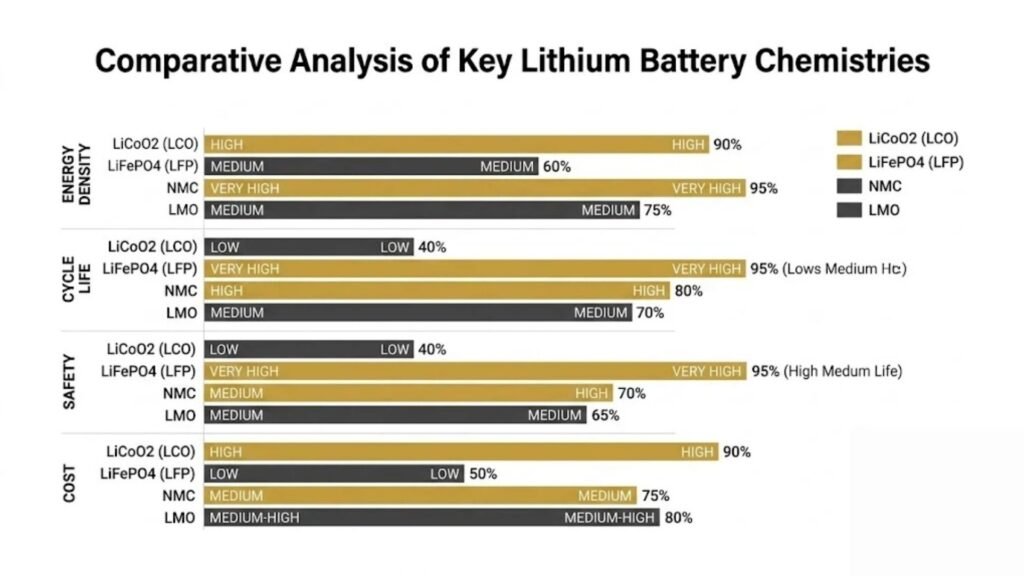
| Chemistry | Nominal Voltage | Energy Density | Cycle Life | Best For |
|---|---|---|---|---|
| LiCoO₂ (LCO) | 3.7V | High (150–200 Wh/kg) | 500–1000 cycles | Consumer electronics, wearables, medical |
| LiFePO₄ (LFP) | 3.2V | Medium (90–120 Wh/kg) | 2000–6000+ cycles | Solar storage, UPS, e-bikes, industrial |
| NMC / NCA | 3.6–3.7V | Very High (200–300 Wh/kg) | 1000–2000 cycles | EVs, power tools, high-drain devices |
| LiMn₂O₄ (LMO) | 3.8V | Medium (100–150 Wh/kg) | 300–700 cycles | Power tools, medical devices |
At A&S Power, our standard LiPo cells use LiCoO₂ chemistry for high energy density in compact designs, while our cylindrical 32700 and 26650 cells use LiFePO₄ for long cycle life and thermal stability. For a deeper comparison, see our 32700 LiFePO4 battery guide.
How to Choose the Right Battery Cell Type
Use this decision framework to select the right cell for your OEM product:
- Is space or weight the top constraint? If yes, choose a pouch LiPo cell. Custom dimensions and ultra-thin profiles (down to 0.4mm) make pouch cells the only option for wearables, hearing aids, and slim IoT devices.
- Is cost per watt-hour the top priority? If yes, choose cylindrical cells. Standardized sizes like 18650 and 32700 benefit from economies of scale and are the most cost-effective for high-volume production.
- Do you need 2000+ cycles? If yes, choose LiFePO₄ chemistry in cylindrical (32700, 26650) or custom prismatic format. LFP cells deliver 2000–6000 cycles vs. 500–1000 for LCO.
- Is the device thin and rectangular? If yes, a pouch or prismatic cell fills the enclosure better than cylindrical cells, which leave gaps between round cans.
- Do you need a standard, replaceable cell? If yes, choose 18650 cylindrical. It is the most widely available and replaceable cell format in the world.
Still unsure? Our engineering team can review your device specifications and recommend the optimal cell type, chemistry, and BMS configuration. Contact us for a free design review.
Frequently Asked Questions
1. What are the 4 types of battery cells?
The four main lithium battery cell types by form factor are cylindrical (18650, 32700), pouch (LiPo), prismatic (rectangular), and coin (button). Each is suited to different applications based on size, weight, cost, and performance requirements.
2. Which battery cell type is best for wearable devices?
Pouch LiPo cells are the best choice for wearables. They can be made as thin as 0.4mm, customized to any shape, and are significantly lighter than cylindrical or prismatic cells. Smart rings, hearing aids, and fitness trackers almost universally use pouch cells.
3. What is the difference between a cell and a battery?
A cell is a single electrochemical unit (one cathode, one anode, one separator, one electrolyte). A battery is one or more cells combined with a protection circuit, connectors, and packaging. For example, a 7.4V battery pack contains two 3.7V cells wired in series.
4. Are cylindrical cells safer than pouch cells?
Both cell types are safe when designed and used correctly. Cylindrical cells have a metal case that can vent gas under extreme abuse, while pouch cells swell visibly — which is actually an early warning sign. Safety depends more on the protection circuit (BMS), cell quality, and proper usage than on the form factor alone.
5. Which chemistry lasts the longest?
LiFePO₄ (LFP) chemistry has the longest cycle life, typically 2000–6000+ charge cycles. LiCoO₂ (LCO), used in most consumer LiPo cells, delivers 500–1000 cycles. NMC falls in between at 1000–2000 cycles.
6. Can I get a custom-shaped battery cell?
Yes. Pouch LiPo cells can be manufactured in custom dimensions, shapes (rectangular, stepped, curved), and capacities from 10mAh to 10,000mAh+. Cylindrical cells are limited to standard sizes (18650, 26650, 32700). A&S Power specializes in custom pouch cell design for OEM applications.
7. What does 18650 mean?
18650 is a cylindrical cell size code: 18mm diameter × 65mm length, with the trailing 0 indicating a round cell. Similarly, 32700 means 32mm × 70mm, and 26650 means 26mm × 65mm.
8. Which cell type does A&S Power manufacture?
A&S Power manufactures both custom pouch LiPo cells (any shape, 0.4mm thin, 10mAh–10,000mAh) and cylindrical lithium-ion/LiFePO4 cells (18650, 26650, 32700). We also build custom battery packs with BMS, custom connectors, and OEM branding. All cells are UL, CE, RoHS, and UN38.3 certified.
Custom Battery Cell Solutions from A&S Power
Whether you need a standard 18650 cylindrical cell, a 32700 LiFePO4 cell for solar storage, or a fully custom pouch LiPo cell for a wearable medical device, A&S Power delivers OEM-grade battery solutions with safety and reliability built in.
- Custom pouch LiPo cells — any shape, 0.4mm thin, 10mAh–10,000mAh
- Cylindrical cells — 18650, 26650, 32700 (Li-ion & LiFePO4)
- Custom battery packs with BMS, NTC, and custom connectors
- UL, CE, RoHS, UN38.3, IEC 62133 certified
- OEM branding, custom packaging, engineering support