
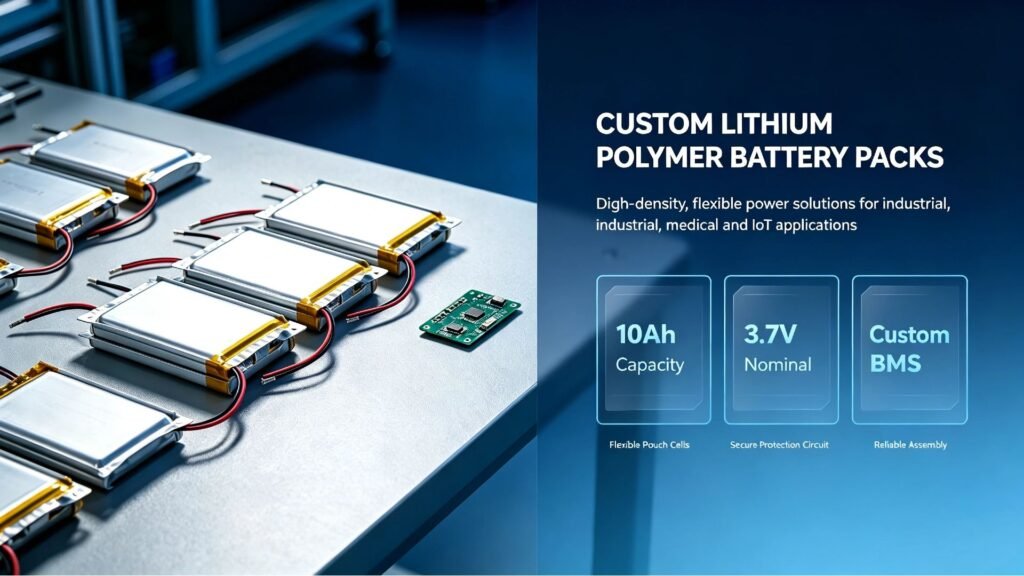
Custom Lithium Polymer Battery Pack: OEM Design, BMS Integration & Manufacturing Guide
Published by A&S Power | Battery Technology
Introduction
When your product requires more than a single cell, a custom lithium polymer battery pack is the solution. Whether you need a multi-cell configuration for higher voltage, an integrated BMS for smart communication, or a compact assembly for a wearable device, A&S Power delivers fully customized battery packs tailored to your OEM specifications.
As a dedicated custom lithium polymer battery manufacturer, we provide end-to-end pack assembly services — from cell selection and BMS design to final encapsulation and labeling. Our engineering team works closely with you to ensure your battery pack integrates seamlessly into your product, meets safety certifications, and performs reliably over thousands of cycles.
For a complete overview of our custom polymer battery capabilities, see our Custom Lithium Polymer Battery – OEM/ODM Solutions guide. For safety and compliance details, read our Lithium Battery Safety & Compliance Guide.
What Is a Custom Lithium Polymer Battery Pack?
A lithium polymer battery pack is an assembly of one or more LiPo cells connected in series, parallel, or series-parallel configurations to achieve the desired voltage and capacity. Unlike off-the-shelf cells, a custom pack is designed around your product’s exact mechanical, electrical, and thermal requirements.
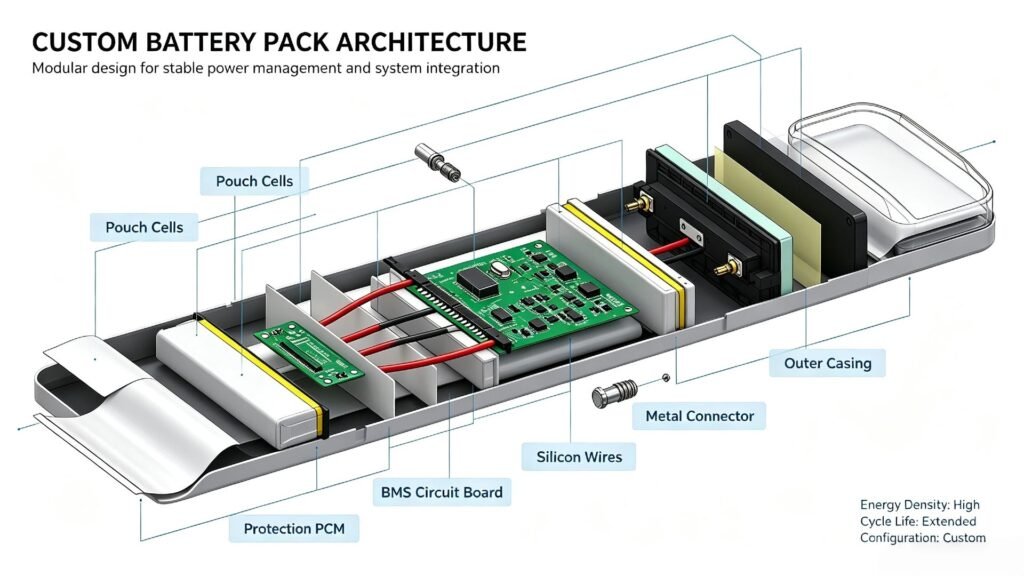
A complete pack typically includes five core subsystems:
| Subsystem | Function |
|---|---|
| Cells | Energy storage element; LiPo pouch cells in custom capacities and dimensions |
| PCM | Protection Circuit Module — overcharge, over-discharge, short-circuit, overcurrent protection |
| BMS | Battery Management System — cell balancing, SoC/SoH monitoring, communication (I²C/SMBus/CAN) |
| Encapsulation | Heat-sealed pouches, plastic housings, or custom-molded enclosures |
| Terminals & Labeling | Wire leads, connectors (JST, Molex, Anderson), solder pads; OEM branding |
Custom lithium polymer battery packs are used in medical devices, IoT sensors, portable electronics, drones, and industrial equipment where standard off-the-shelf batteries cannot meet the space, performance, or communication requirements.
Key Components of a Custom Battery Pack
1. Cell Selection
The foundation of every pack is the cell. We offer a wide range of lithium polymer pouch cells with varying capacities (50mAh–10,000mAh+), dimensions, and discharge rates (1C–100C+). Based on your product’s power requirements and physical constraints, we recommend the optimal cell for your application. All cells are grade-A with matched internal resistance (±5mΩ) for balanced performance.
2. Protection Circuit Module (PCM)
Every pack includes a PCM that provides essential safety functions:
- Overcharge protection — cuts off charging when any cell reaches 4.25V–4.35V (configurable)
- Over-discharge protection — disconnects load when any cell drops below 2.4V–3.0V
- Short-circuit protection — immediate disconnect (≤10ms) in fault conditions
- Overcurrent protection — limits excessive current draw (threshold configurable by application)
3. Battery Management System (BMS)
For advanced applications, we integrate a smart BMS that offers:
- Cell balancing — passive or active balancing ensures all cells in a multi-cell pack maintain equal voltage
- State monitoring — tracks State of Charge (SoC), State of Health (SoH), temperature, and current in real time
- Communication — supports I²C, SMBus, CAN bus, and HDQ protocols for smart device integration
- Fault diagnostics — reports abnormal conditions (over-temp, cell imbalance, communication failure) to the host device
4. Encapsulation & Packaging
Depending on your product’s environment, we offer:
- Heat-sealed pouch wrapping — lightweight and compact for wearables and IoT
- Plastic housing (ABS/PC) — rigid protection for industrial and medical applications
- Custom-molded enclosures — full mechanical integration into your product chassis
- Conformal coating (acrylic/silicone) — moisture and dust resistance for outdoor and harsh environments
5. Termination Options
We support all standard and custom termination types: wire leads with custom length and gauge (AWG 16–32), JST/Molex/Hirose/Anderson connectors, solder pads for direct PCB mounting, and custom wiring harnesses with multiple output leads.
Series & Parallel Configurations Explained
Cell configuration determines your pack’s voltage and capacity. Understanding the three basic configurations is essential for specifying your custom pack:
| Configuration | Voltage | Capacity | Typical Use |
|---|---|---|---|
| 1S1P (single cell) | 3.7V nominal | Single cell capacity | TWS earbuds, wearables, small IoT |
| 2S (series) | 7.4V nominal | Single cell capacity | Small drones, portable speakers |
| 3S (series) | 11.1V nominal | Single cell capacity | RC cars, mid-sized drones, medical devices |
| 4S (series) | 14.8V nominal | Single cell capacity | Racing drones, large RC, industrial tools |
| 2P (parallel) | 3.7V nominal | 2× cell capacity | High-capacity power banks, IoT gateways |
| 3S2P (series-parallel) | 11.1V nominal | 2× cell capacity | Medical equipment, portable industrial devices |
The notation XsYp means X cells in series (multiplies voltage) and Y cells in parallel (multiplies capacity). For example, a 3S2P pack using 2,000mAh cells delivers 11.1V and 4,000mAh (44.4Wh). For a complete voltage reference, see our LiPo Battery Voltage Chart & C-Rating Guide.
Why OEM Buyers Choose A&S Power for Custom Battery Packs
Engineering Support from Concept to Production
Our in-house engineers provide design reviews, thermal modeling, and electrical simulation to ensure your pack performs as expected. We support you from initial specification through prototyping, testing, and mass production — with a dedicated project manager at every stage.
Full Compliance Documentation
Every battery pack includes comprehensive compliance documentation:
- UN38.3 test summary for safe air and sea transport
- UL 1642 / IEC 62133 test reports
- CE, RoHS, REACH certificates for EU market access
- Material Safety Data Sheets (MSDS / SDS)
- Batch-level traceability records (cell lot, PCM lot, test data)
Rigorous Quality Control
We test every pack before shipment. Our QC process includes:
- 100% visual inspection (welding, encapsulation, labeling)
- Open-circuit voltage (OCV) and internal resistance (ACIR) testing
- Functionality and communication protocol testing (for BMS packs)
- Insulation resistance and high-voltage withstand testing
- Thermal cycling and aging tests (for sample and pilot batches)
Flexible Volumes & Factory-Direct Pricing
From prototype quantities (50–500 pcs) to high-volume production (10,000+ pcs/month), we scale with your project. As a factory-direct custom lithium polymer battery manufacturer, we eliminate middlemen and pass the savings to you — without compromising on quality or support.
Applications for Custom Lithium Polymer Battery Packs
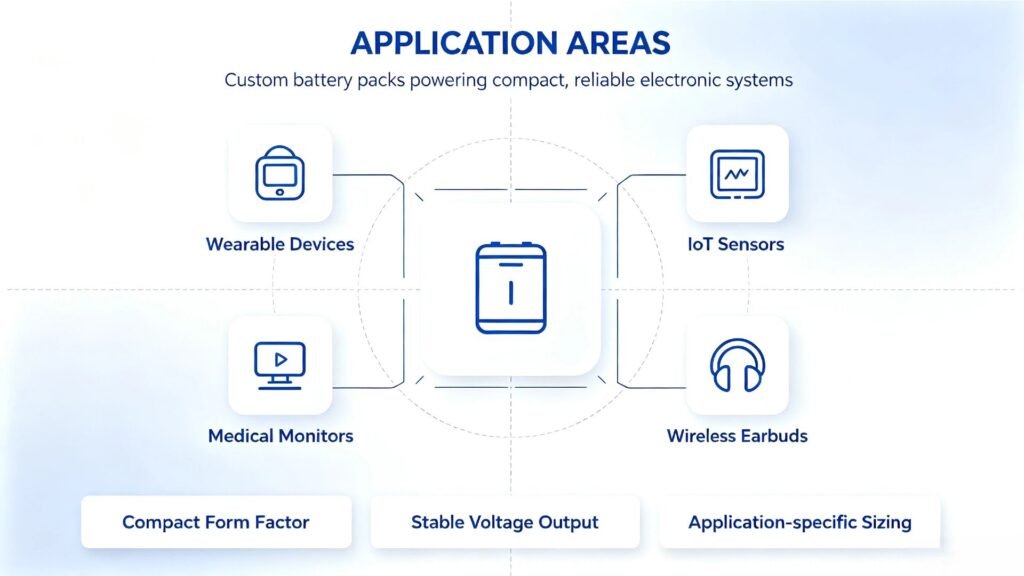
Our custom battery packs power products across multiple industries:
| Industry | Applications | Typical Spec |
|---|---|---|
| Medical | Portable monitors, infusion pumps, surgical tools, patient tracking devices | ISO 13485, IEC 60601, smart BMS |
| IoT | Environmental sensors, asset trackers, smart home devices | Low self-discharge, compact form factor |
| Wearables | Smartwatches, fitness bands, smart clothing, hearing aids | Ultra-thin (0.8mm+), flexible, lightweight |
| Portable Electronics | TWS earbuds, Bluetooth speakers, wireless keyboards | Fast charge, high cycle life |
| Industrial | Handheld scanners, test equipment, robotics | Wide temp range, rugged enclosure |
| Drones & UAVs | High-discharge packs for flight and FPV systems | 70C–150C discharge, lightweight |
For medical-specific requirements, see our Custom Battery Solutions for Medical Devices page.
Custom Pack Development Process & Timeline
A typical custom battery pack project follows five phases. Exact timelines depend on complexity, certification requirements, and component availability.
| Phase | Activities | Timeline |
|---|---|---|
| 1. Specification Review | Requirements gathering, cell selection, PCM/BMS architecture, mechanical design review | 3–5 business days |
| 2. Engineering Sample | Prototype build (5–20 pcs), electrical testing, dimensional verification, initial functional test | 2–3 weeks |
| 3. Testing & Validation | Cycle life test, thermal test, vibration/drop test, UN38.3 pre-test, certification submission | 1–4 weeks (certification: 4–8 weeks) |
| 4. Pilot Production | Small-batch run (100–500 pcs), process validation, quality system setup, full documentation package | 2–3 weeks |
| 5. Mass Production | Volume manufacturing, 100% QC, batch traceability, scheduled shipments | 4–6 weeks per batch (after sample approval) |
For simple single-cell packs with standard PCM, the process can be compressed to 4–6 weeks total. Complex multi-cell BMS-integrated packs with medical certification typically require 12–16 weeks including certification.
Quality Assurance Checklist for OEM Buyers
When evaluating a battery pack supplier, verify these five critical points:
| Check Point | Why It Matters |
|---|---|
| UN38.3 Certification | Mandatory for air and sea transport — without it, freight forwarders will reject your shipment |
| UL / CE / RoHS Compliance | Required for North American and European market access; UL 1642 for cells, IEC 62133 for packs |
| ISO 9001 / ISO 14001 | Ensures consistent quality management and environmental responsibility across production runs |
| Traceability | Batch-level documentation for every order — essential for audits, field issues, and recalls |
| End-of-Life Handling Policy | Demonstrates the supplier’s commitment to regulatory compliance and sustainability |
A&S Power meets all five checkpoints and provides full documentation with every order. For disposal and recycling guidance, see our How to Dispose of Lithium-Ion Batteries guide.
Frequently Asked Questions
1. What is the MOQ for custom lithium polymer battery packs?
MOQ depends on pack complexity. For standard single-cell packs, MOQ starts at 1,000 units. For complex multi-cell BMS-integrated packs, we can accommodate lower volumes (50–500 pcs) for prototyping and pilot runs.
2. How long does the custom pack development process take?
Typical timeline: specification review (3–5 days) → engineering sample (2–3 weeks) → testing and validation (1–2 weeks) → mass production (4–6 weeks after sample approval). Certification (UN38.3, UL, IEC 62133) adds 4–8 weeks and can run in parallel with pilot production.
3. Can you integrate a custom BMS with specific communication protocols?
Yes. We support I²C, SMBus, CAN bus, HDQ, and custom protocol development. Our BMS team can implement custom SoC algorithms, fuel gauging, and host-device communication per your specification.
4. Do you provide design assistance for integrating the battery pack into my product?
Yes. Our engineering team offers mechanical and electrical integration support, including 3D CAD modeling (STEP files), thermal analysis, connector placement guidance, and charging circuit design recommendations.
5. What certifications do you provide with each order?
We provide UN38.3 test summary, UL 1642 / IEC 62133 certificates (where applicable), CE / RoHS / REACH declarations, MSDS/SDS, batch test reports, and full traceability documentation.
6. Can you use cells from a specific brand or must I use your cells?
We can use customer-specified cells (e.g., LG, Samsung, Murata) if required, or recommend our own grade-A cells for cost optimization. Cell brand choice affects lead time and pricing — we advise on the best balance for your project.
7. What is the typical cycle life of a custom LiPo pack?
Standard LiPo packs achieve 300–500 cycles to 80% capacity. With optimized cell selection, conservative depth of discharge (80%), and proper BMS management, we can design packs for 500–1,000+ cycles. LiFePO4 packs are available for 2,000–6,000 cycle applications.
8. Do you offer OEM branding and custom packaging?
Yes. Every pack can carry your logo, product name, voltage/capacity ratings, warning labels, and serial numbers. We also offer custom retail packaging, blister packs, and bulk carton labeling per your brand guidelines.
Get a Quote for Your Custom Lithium Polymer Battery Pack
Ready to discuss your project? Contact A&S Power today for a free engineering review and quotation. We provide full compliance documentation and technical support with every order — so you can focus on your product, not regulatory paperwork.