
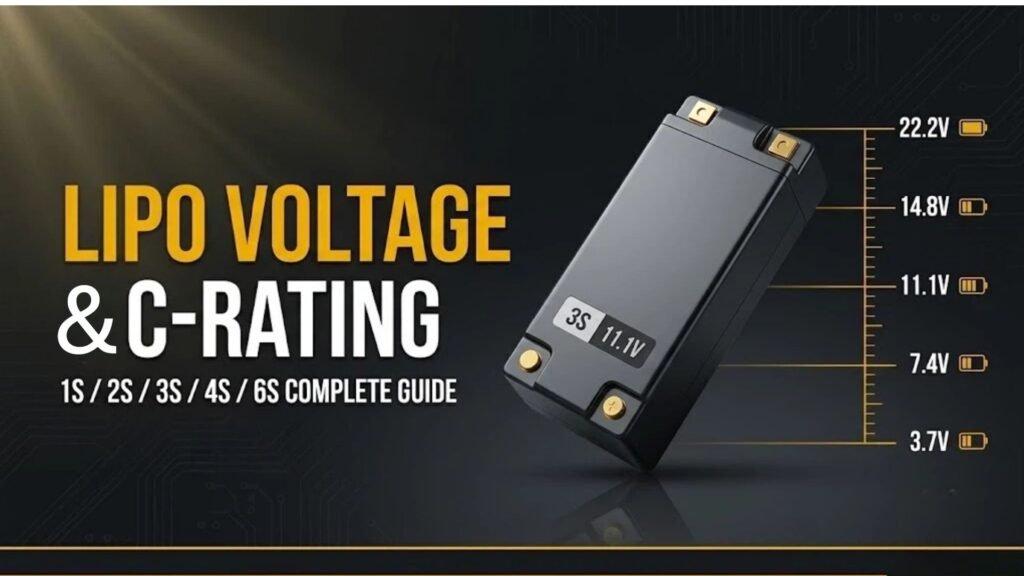
LiPo Battery Voltage Chart & C-Rating Guide: 1S/2S/3S/4S/6S for OEM Projects
Published by A&S Power | Battery Technology | August 2026
Introduction
When sourcing lithium polymer batteries for an OEM project, two parameters determine whether the battery will work in your device: voltage (the S number) and discharge rate (the C-rating). Get either one wrong and your product will underperform, shut down unexpectedly, or become a safety hazard.
This guide covers the complete voltage range for 1S through 6S LiPo configurations, explains how C-rating translates to real discharge current, and provides application-specific selection guidance. All voltage figures use standard NMC (Nickel-Manganese-Cobalt) LiPo chemistry with 4.2V full charge per cell.
If you are new to LiPo technology, start with our What is a Lithium Polymer Battery? guide for the fundamentals. For charging procedures, see our How to Charge LiPo Batteries guide.
LiPo Voltage Basics: Understanding a Single Cell
A single LiPo cell (1S) has four key voltage values that every engineer should memorize:
| Voltage Type | Value (per cell) | What It Means |
|---|---|---|
| Nominal Voltage | 3.7V | The average voltage during discharge. Used for labeling and capacity calculations (Wh = Ah × V). |
| Full Charge Voltage | 4.2V | Maximum safe voltage. Charging beyond 4.2V causes swelling and fire risk. |
| Cut-off Voltage | 3.0V | Minimum safe discharge voltage. Going below 3.0V causes permanent capacity loss and cell damage. |
| Storage Voltage | 3.8V | Optimal long-term storage voltage (approximately 40-60% charge). Minimizes degradation. |
Key rule: Multiply the per-cell value by the number of cells in series (the S number) to get the pack voltage. A 4S pack = 4 cells in series = 4 × 3.7V = 14.8V nominal.
Complete LiPo Voltage Chart: 1S to 6S
The table below lists all critical voltage values for common LiPo pack configurations. Use this as a quick reference for charger settings, BMS thresholds, and system design.
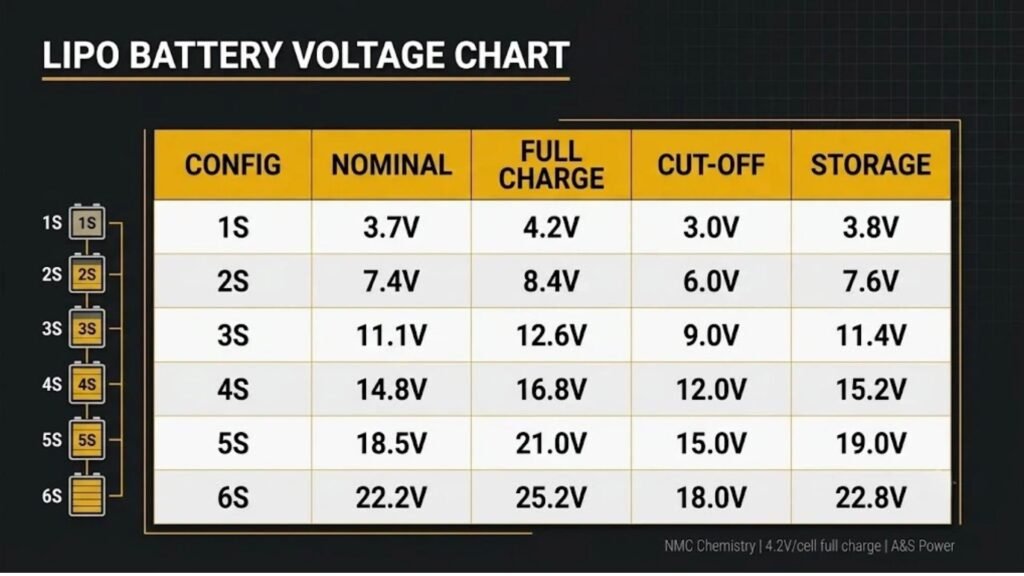
| Configuration | Nominal | Full Charge | Cut-off (Min) | Storage | Common Uses |
|---|---|---|---|---|---|
| 1S | 3.7V | 4.2V | 3.0V | 3.8V | Wearables, TWS earbuds, IoT sensors, Bluetooth headsets |
| 2S | 7.4V | 8.4V | 6.0V | 7.6V | Portable speakers, small drones, handheld devices |
| 3S (11.1V) | 11.1V | 12.6V | 9.0V | 11.4V | RC cars, industrial equipment, high-power speakers, 18650 packs |
| 4S (14.8V) | 14.8V | 16.8V | 12.0V | 15.2V | RC helicopters, drones, power tools, e-bikes, laptop replacements |
| 5S | 18.5V | 21.0V | 15.0V | 19.0V | Less common; some industrial and medical equipment |
| 6S (22.2V) | 22.2V | 25.2V | 18.0V | 22.8V | High-performance RC, drones, e-bikes, electric skateboards, power tools |
Note: Values are for standard NMC LiPo chemistry. High-voltage LiPo cells (4.35V/4.4V full charge) are used in some smartphone and wearable applications. LiFePO4 chemistry uses different values (3.2V nominal, 3.65V full charge).
For deep dives on specific configurations, see our individual guides: 2S LiPo Battery, 3S LiPo Battery (11.1V), 4S LiPo Battery (14.8V), and 6S LiPo Battery (22.2V).
How to Calculate Battery Pack Voltage and Capacity
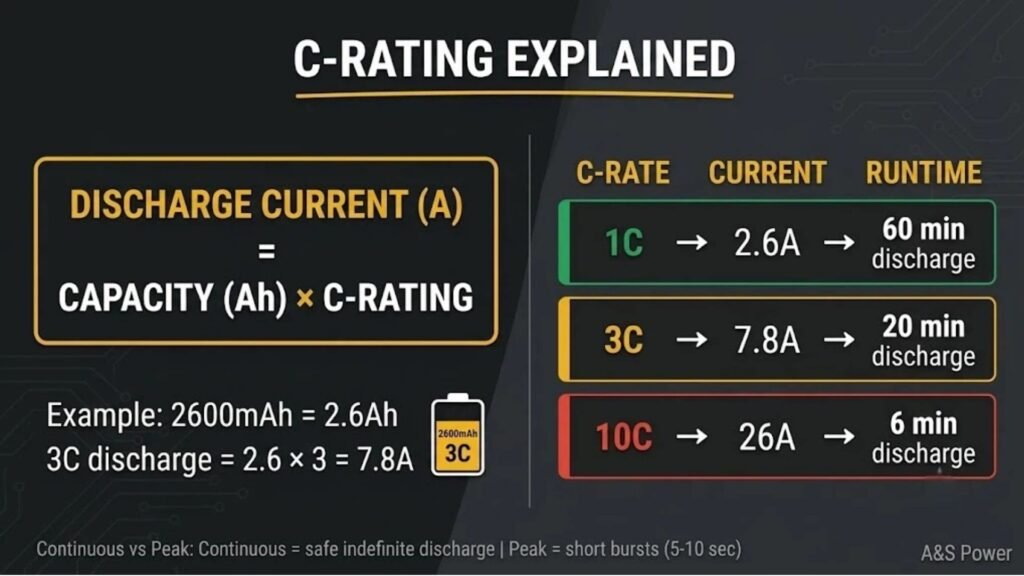
Battery packs use two connection methods: series (S) increases voltage, parallel (P) increases capacity. The notation 4S2P means 4 cells in series and 2 in parallel.
Series Connection (S) – Voltage Adds Up
When cells are connected in series, voltages add but capacity stays the same.
Pack Voltage = Number of Cells (S) × 3.7V (nominal)
Pack Capacity = Single Cell Capacity (unchanged)
Example: A 4S pack using 2600mAh cells = 4 × 3.7V = 14.8V nominal, capacity remains 2600mAh. Energy = 14.8V × 2.6Ah = 38.48Wh.
Parallel Connection (P) – Capacity Adds Up
When cells are connected in parallel, capacity adds but voltage stays the same.
Pack Voltage = Single Cell Voltage (unchanged)
Pack Capacity = Number of Cells (P) × Single Cell Capacity
Example: A 1S3P pack using 1000mAh cells = 3.7V nominal, capacity = 3 × 1000mAh = 3000mAh.
Combined: 3S2P Example
A 3S2P pack using 2600mAh 18650 cells:
- Voltage: 3S × 3.7V = 11.1V nominal (12.6V full charge)
- Capacity: 2P × 2600mAh = 5200mAh
- Energy: 11.1V × 5.2Ah = 57.72Wh
A&S Power offers a real-world example: the 11.1V 2600mAh 18650 battery pack (AS18650) delivers 28.86Wh with a DC 5.5×2.1 connector and integrated protection circuit.
C-Rating Explained: What It Means for Discharge Current
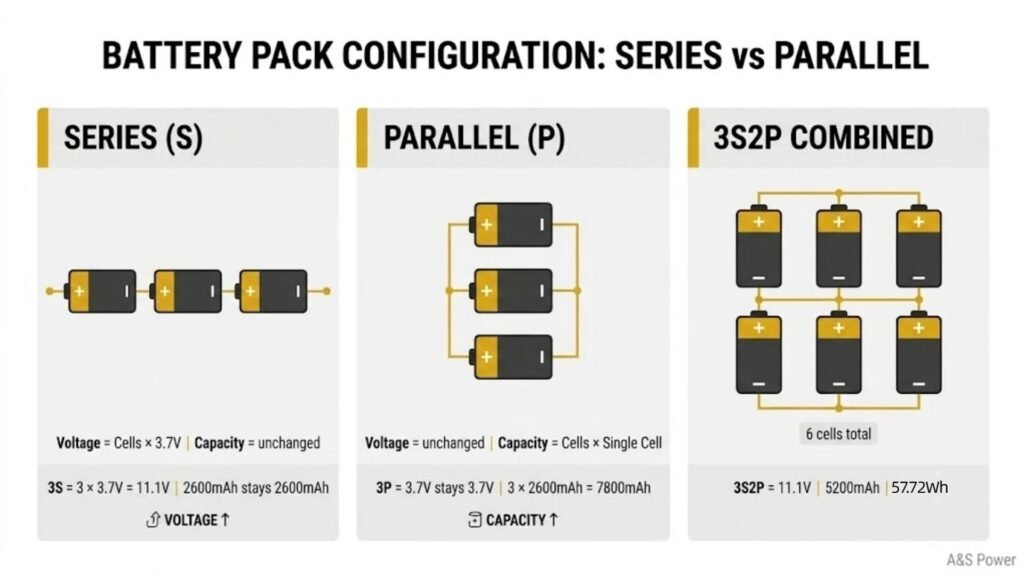
C-rating describes how fast a battery can safely discharge its stored energy. It is expressed as a multiple of the battery’s capacity. A 1C discharge means the battery empties in 1 hour; a 3C discharge means it empties in 20 minutes.
The Formula
Discharge Current (A) = Capacity (Ah) × C-Rating
Example: 2600mAh = 2.6Ah
3C discharge = 2.6Ah × 3 = 7.8A
Continuous vs Burst (Peak) C-Rating
Batteries often list two C-ratings:
- Continuous C-rating – The current the battery can deliver indefinitely without overheating or damage.
- Burst / Peak C-rating – A higher current the battery can deliver for short periods (typically 5-10 seconds), such as during motor startup or acceleration.
Common C-Rating Ranges by Battery Type
| Battery Type | Typical Continuous C-Rate | Typical Peak C-Rate | Best For |
|---|---|---|---|
| Standard LiPo Pouch | 0.5C – 2C | 2C – 5C | Wearables, IoT, medical devices, Bluetooth speakers |
| High-Drain LiPo Pouch | 5C – 15C | 15C – 30C+ | Drones, RC models, power tools |
| 18650 Li-Ion | 0.5C – 3C | 3C – 5C | Flashlights, laptops, e-bikes, power banks |
| LiFePO4 | 1C – 5C | 5C – 10C | E-bikes, solar storage, power tools, EVs |
Important: Operating a battery above its rated continuous C-rating causes overheating, accelerated degradation, and potential thermal runaway. Always verify that your device’s peak current draw does not exceed the battery’s burst C-rating.
C-Rate Calculations: Real-World Examples
Below are actual discharge current calculations using batteries from the A&S Power product lineup.
Example 1: AS18650-2600 (3.7V, 2600mAh, 3C)
| Parameter | Value |
|---|---|
| Capacity | 2600mAh = 2.6Ah |
| Continuous C-Rating | 3C |
| Continuous Discharge Current | 2.6Ah × 3 = 7.8A |
| Internal Resistance | ≤ 40mΩ |
| Typical Applications | High-performance flashlights, Bluetooth speakers, portable electronics |
Example 2: AS32700 LiFePO4 (3.2V, 6000mAh, 5C continuous / 10C peak)
| Parameter | Value |
|---|---|
| Capacity | 6000mAh = 6.0Ah |
| Continuous C-Rating | 5C |
| Continuous Discharge Current | 6.0Ah × 5 = 30A |
| Peak C-Rating | 10C |
| Peak Discharge Current | 6.0Ah × 10 = 60A |
| Internal Resistance | ≤ 3mΩ (ultra-low) |
| Typical Applications | Power tools, e-bikes, solar energy storage |
Example 3: Standard LiPo Pouch (3.7V, 1000mAh, 1C continuous)
| Parameter | Value |
|---|---|
| Capacity | 1000mAh = 1.0Ah |
| Continuous C-Rating | 1C (typical for standard LiPo pouch) |
| Continuous Discharge Current | 1.0Ah × 1 = 1.0A |
| Discharge Time at 1C | ~60 minutes |
| Typical Applications | IoT sensors, wearable devices, TWS charging cases, portable electronics |
Browse the full A&S Power product catalog for available capacities, voltages, and discharge ratings.
Voltage & C-Rate Selection Guide by Application
The table below matches common OEM application categories to typical LiPo voltage configurations and C-rating requirements.
| Application | Typical Voltage | Typical C-Rate | Key Considerations |
|---|---|---|---|
| TWS Earbuds / Smart Rings | 1S (3.7V) | 0.2C – 0.5C | Ultra-thin form factor, low self-discharge, PCM required |
| Wearables / Smartwatches | 1S (3.7V) | 0.5C – 1C | Custom shape, thin profile, lightweight |
| Medical Devices / Patches | 1S (3.7V) | 0.2C – 0.5C | ISO 13485, biocompatible materials, ultra-reliable |
| Bluetooth Speakers | 1S (3.7V) or 2S (7.4V) | 0.5C – 2C | High capacity for long playtime, BMS with low standby drain |
| Smartphones / Tablets | 1S (3.7V / HV 4.4V) | 1C – 2C | High-voltage cells, fast charging support, thin profile |
| Laptops | 2S – 4S (7.4V – 14.8V) | 0.5C – 1C | Smart BMS, fuel gauge, thermal management |
| RC Cars / Drones | 3S – 6S (11.1V – 22.2V) | 10C – 30C+ | High-drain LiPo, balance charging critical, low internal resistance |
| Power Tools | 5S – 10S (18.5V – 37V) | 5C – 15C | High peak current, rugged packaging, thermal protection |
| E-Bikes / E-Scooters | 10S – 13S (36V – 48V) | 1C – 3C | Large capacity packs, BMS with cell balancing, UN38.3 required |
| Solar Storage / Power Walls | LiFePO4 4S – 16S (12.8V – 51.2V) | 0.5C – 1C | Long cycle life (2000+), deep discharge tolerance, BMS with CAN bus |
For application-specific battery design, see our guides on custom medical batteries, Bluetooth speaker battery packs, and custom LiPo battery packs with BMS.
Common Mistakes OEMs Make with Voltage and C-Rating
Mistake 1: Selecting voltage based only on nominal rating
A 3S battery labeled “11.1V” actually ranges from 12.6V (full) to 9.0V (empty). Your device’s voltage regulator must handle this entire range. Designing for exactly 11.1V will cause shutdowns when the battery drops below that voltage.
Mistake 2: Ignoring C-rating and only looking at capacity
A 5000mAh battery rated at 0.5C can only deliver 2.5A continuously. If your device draws 5A, the battery will overheat and shut down even though it has high capacity. Always calculate required discharge current first, then match C-rating.
Mistake 3: Using the wrong charger cell count setting
Charging a 3S battery on a 4S setting delivers up to 16.8V to a pack rated for 12.6V max. This causes immediate overcharging, swelling, and fire risk. Always double-check the S number before connecting a charger.
Mistake 4: Skipping the balance lead on multi-cell packs
For 2S and higher packs, always connect the balance lead during charging. Without balancing, individual cells charge unevenly – one cell may overcharge while another remains undercharged. This reduces capacity and creates safety hazards over time.
Mistake 5: Storing batteries at full charge or empty
LiPo batteries degrade fastest when stored at 100% or 0% charge. For storage longer than 2 weeks, charge to approximately 3.8V per cell (40-60% capacity). For a 4S pack that is 15.2V; for a 6S pack that is 22.8V.
Frequently Asked Questions
What is the fully charged voltage of a 4S LiPo battery?
A 4S LiPo battery reaches full charge at 16.8V (4.2V per cell × 4 cells). The nominal voltage is 14.8V and the minimum cut-off voltage is 12.0V (3.0V per cell).
What is the minimum voltage of a 6S LiPo battery?
The minimum cut-off voltage for a 6S LiPo battery is 18.0V (3.0V per cell × 6 cells). Discharging below this voltage causes permanent cell damage. The nominal voltage is 22.2V and full charge is 25.2V.
What does 3S, 4S, or 6S mean on a LiPo battery?
The “S” number indicates how many cells are connected in series. A 3S battery has 3 cells in series (11.1V nominal), a 4S has 4 cells (14.8V nominal), and a 6S has 6 cells (22.2V nominal). More cells in series means higher voltage.
What is C-rating on a LiPo battery?
C-rating measures how fast a battery can safely discharge. A 1C rate means the battery discharges its full capacity in one hour. For example, a 2600mAh battery rated at 3C can deliver 7.8A continuously (2.6Ah × 3 = 7.8A). Higher C-rating means higher discharge current capability.
What voltage should I store my LiPo battery at?
LiPo batteries should be stored at approximately 3.8V per cell (about 40-60% charge). For a 4S pack that is 15.2V, for a 6S pack that is 22.8V. Storing at full charge or empty charge accelerates degradation.
Can I use a 4S LiPo charger on a 3S battery?
No. A 4S charger delivers up to 16.8V, which would overcharge a 3S battery (max 12.6V) and cause swelling, fire, or explosion. Always verify the cell count (S number) before charging.
How many volts is a 3S LiPo battery?
A 3S LiPo battery has a nominal voltage of 11.1V, a full charge voltage of 12.6V, and a minimum cut-off voltage of 9.0V. This is why 3S packs are often labeled “11.1V” – that is the nominal average voltage.
Need a Custom Voltage or C-Rating Battery Pack for Your Project?
A&S Power designs and manufactures custom lithium polymer and lithium-ion battery packs with precise voltage configurations and discharge ratings. From 1S wearables to 6S high-power packs, our engineering team delivers tailored solutions with built-in BMS, custom connectors, and full certification documentation.
All custom battery packs include PCM/BMS protection, UN38.3 transport certification, and full compliance documentation for global markets.