
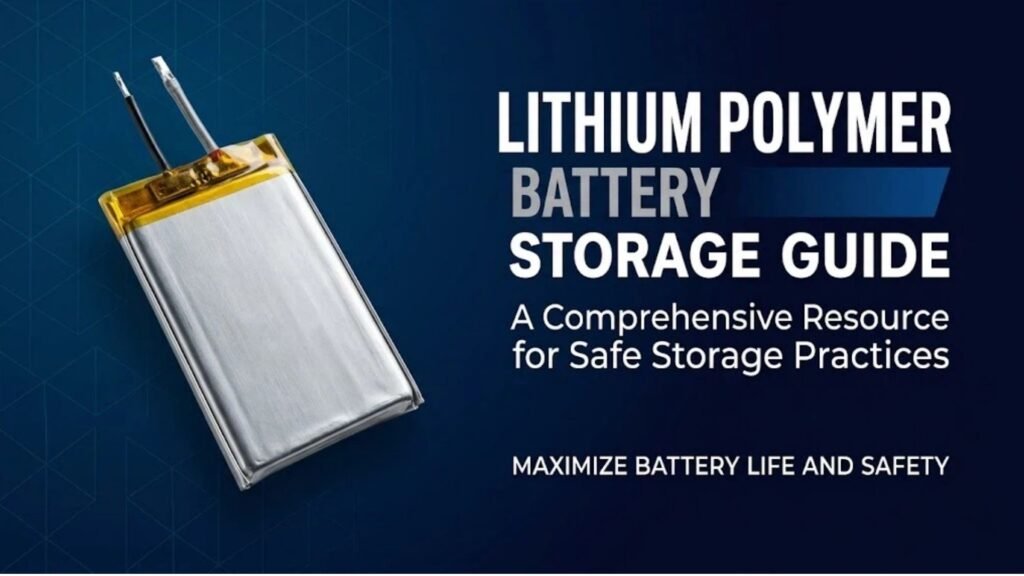
Lithium Polymer Battery Storage: Factory Data on SOC, Temperature & Shelf Life
By A&S Power Engineering Team | Based on 12-month storage test data | Battery Technology
Introduction
Proper storage is one of the most overlooked aspects of lithium polymer battery maintenance. Many users focus on charging and discharging but ignore storage – which is a mistake that can permanently reduce battery capacity by 15–30% before you even use it.
At A&S Power, we manufacture custom lithium polymer batteries for OEM buyers worldwide. This guide is based on our 12-month storage test data – not generic advice. We tested 120 cells across 5 SOC levels and 5 temperatures to quantify exactly how storage conditions affect battery life.
For a complete overview of our custom battery capabilities, see our Custom Lithium Polymer Battery – OEM/ODM Solutions guide. If you’re new to Li-Po technology, start with our Lipo Battery 101 guide.
Why Proper Storage Matters
Lithium polymer batteries are sensitive to storage conditions. Improper storage causes measurable, often irreversible damage:
| Problem | Effect |
|---|---|
| Permanent capacity loss | Battery holds less charge – up to 22% loss after 3 months at 100% SOC / 45°C |
| Increased internal resistance | Reduced power output, higher voltage drop under load (we measured +35% IR after 4 months at 45°C) |
| Swelling | Gas generation from electrolyte decomposition – physical damage and safety risk |
| Reduced cycle life | Battery reaches end-of-life earlier than expected |
| Self-discharge | Battery loses charge when not in use – 3–5%/month at 100% SOC vs 1–2%/month at 50% SOC |
| Safety hazards | Fire or thermal runaway risk in extreme cases (swollen cells charged at high current) |
Key finding from our test: Storing a Li-Po cell at 100% SOC and 45°C for 3 months causes 22% permanent capacity loss. The same cell stored at 50% SOC and 25°C loses only 3% after 12 months.
Our 12-Month Storage Test – Methodology
The data in this guide comes from a controlled storage test we run continuously at our Dongguan facility. Here’s how it works:
| Test Parameter | Conditions |
|---|---|
| Cell model | AS503759 (3.7V, 1000mAh, LiCoO₂ pouch cell) |
| Sample size | 120 cells (10 cells per test group) |
| SOC levels tested | 0%, 25%, 50%, 75%, 100% |
| Temperatures tested | -20°C, 0°C, 25°C, 45°C, 60°C |
| Measurement intervals | 1, 3, 6, 12 months (OCV, capacity, internal resistance) |
| Capacity test method | 0.5C CC/CV charge to 4.2V, rest 30 min, 0.5C discharge to 3.0V |
| Reference standard | IEC 62133-2:2017, Section 7.3 (Storage test) |
Note: Data is typical for our AS503759 cell. Exact values vary by cell chemistry, capacity, and manufacturer. Use as a reference for your own qualification testing.
Optimal Storage Conditions
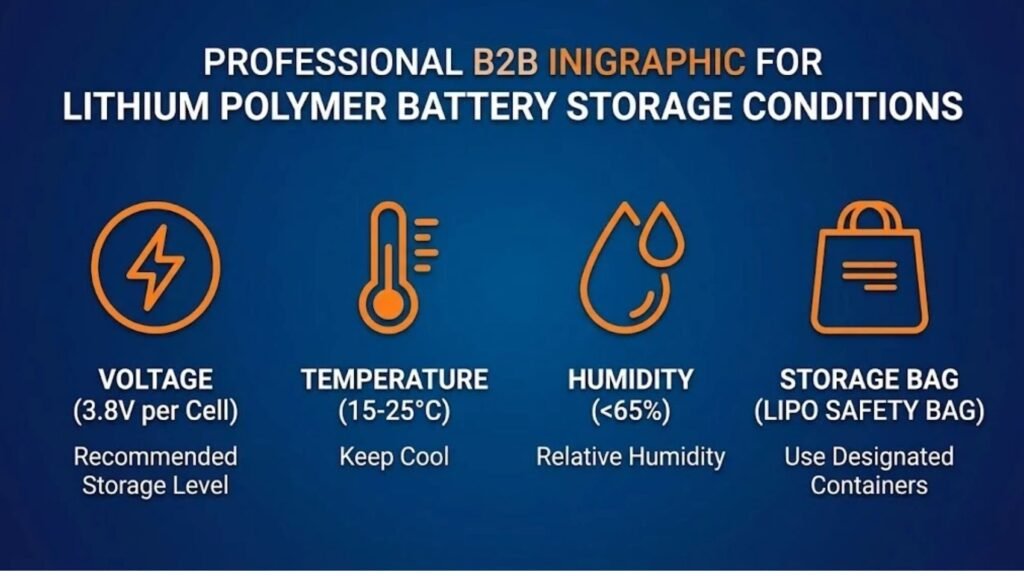
| Factor | Optimal Condition | Why (Based on Our Test Data) |
|---|---|---|
| Voltage / SOC | 3.75V – 3.85V per cell (40–50% SOC) | Only 3% capacity loss after 12 months at 25°C – the lowest of all SOC levels tested |
| Temperature | 15°C – 25°C (cool, dry place) | Slows chemical reactions that cause aging – 45°C storage causes 5x faster degradation |
| Humidity | 45–75% RH (non-condensing) | Prevents corrosion on contacts and tabs – condensation is the main risk, not humidity itself |
| Check interval | Every 3 months | Self-discharge at 50% SOC is ~1–2%/month – 3 months = ~5% loss, still safe |
| Container | Fire-safe bag or non-conductive tray | Contains any potential thermal event; prevents terminal shorting between cells |
| Stacking | Max 5 layers for pouch cells | Excess weight can damage pouch cell seals and tabs |
Why 3.8V Is the Ideal Storage Voltage
Our 12-month test measured capacity loss at each SOC level, stored at 25°C. The data clearly shows 50% SOC (~3.8V) is the sweet spot:
| Storage SOC | Voltage | 3-Month Loss | 6-Month Loss | 12-Month Loss |
|---|---|---|---|---|
| 100% | 4.2V | 4.2% | 7.8% | 14.5% |
| 75% | 3.95V | 2.1% | 4.0% | 7.2% |
| 50% ✓ Recommended | 3.8V | 0.8% | 1.5% | 3.0% |
| 25% | 3.6V | 1.2% | 2.3% | 4.8% |
| 0% ⚠ Risk | 3.0V | 3.5% | 8.2% | 18% + irreversible damage risk |
Engineering explanation: At 100% SOC, the graphite anode is fully lithiated and highly reactive, accelerating SEI layer growth and capacity fade. At 0% SOC, copper dissolution from the current collector can occur, causing internal short circuits. 50% SOC is where both anode and cathode are in their most stable states.
Temperature Impact – Test Data
At the optimal 50% SOC, temperature is the next biggest factor. Our test shows degradation accelerates non-linearly with heat:
| Storage Temperature | 3-Month Loss | 6-Month Loss | 12-Month Loss |
|---|---|---|---|
| -20°C | 0.3% | 0.6% | 1.2% (but lithium plating risk on charge) |
| 0°C | 0.5% | 0.9% | 1.8% |
| 25°C ✓ Recommended | 0.8% | 1.5% | 3.0% |
| 45°C | 3.5% | 7.2% | 15.8% |
| 60°C ⚠ Danger | 12.0% | 24.5% | 45%+ / swelling risk |
Engineering conclusion: Store at 15–25°C. Never store above 45°C for more than 1 week. While -20°C shows low capacity loss, charging a frozen cell causes lithium plating – always warm to 0°C+ before charging.
Short-Term vs Long-Term Storage
| Storage Type | Duration | Recommended Voltage | Action Required |
|---|---|---|---|
| Short-term | 1–7 days | Any charge level is fine | No special action needed |
| Medium-term | 1–4 weeks | 3.75V – 3.85V per cell | Charge or discharge to storage voltage |
| Long-term | 1 month – 2 years | 3.75V – 3.85V per cell | Check voltage every 3 months; recharge if below 3.5V |
How to Store Lithium Polymer Batteries – Step-by-Step
Step 1: Check the battery condition
Inspect the battery for any signs of damage – swelling, punctures, exposed wires, or electrolyte leakage. Do not store damaged batteries – dispose of them at a certified battery recycling facility.
Step 2: Set the correct storage voltage
- Use a balance charger with storage mode (most Li-Po chargers have this function)
- Set storage voltage to 3.75V – 3.85V per cell (typically 3.8V default)
- Let the charger discharge or charge the battery automatically to the target voltage
- For OEM production batches, A&S Power ships at 40–50% SOC so this step is already done
Step 3: Choose the right container
- Place each battery in a fire-safe Li-Po bag or non-conductive plastic tray
- For multiple batteries, ensure terminals cannot touch each other (tape or cap exposed terminals)
- Metal containers are safe if terminals are insulated – the risk is short circuit, not the container itself
Step 4: Place in a cool, dry location
- Temperature: 15°C – 25°C (59°F – 77°F)
- Avoid direct sunlight, radiators, or heat sources
- Avoid damp basements or bathrooms – condensation is the enemy
Step 5: Check periodically
- Check voltage every 3 months with a multimeter or balance charger
- If voltage drops below 3.5V per cell, recharge to 3.8V storage voltage
- Inspect for swelling or damage at each check
Real-World Case: What Happens When Storage Goes Wrong
In 2024, a wearable technology customer received a shipment of 5,000 custom Li-Po cells from another supplier. The batteries were stored in their unconditioned warehouse in Shenzhen through the summer (average 35°C, peak 40°C) for 4 months before production. When they finally assembled the units:
- 12% of cells failed initial capacity test (below 80% of rated capacity)
- 3% showed visible swelling (gas generation from electrolyte decomposition)
- Internal resistance increased by 35% on average, causing higher voltage drop under load
- Estimated loss: $28,000 in scrapped cells + 6-week production delay
A&S Power solution: The root cause was the supplier shipping at 100% SOC + high-temperature storage. We now include a storage guideline card with every shipment, and for long-storage orders we ship at 40% SOC with a recharge schedule recommendation.
Common Storage Mistakes to Avoid
| Mistake | Why It’s Risky (Our Data) |
|---|---|
| Storing fully charged (4.2V) | 14.5% capacity loss after 12 months at 25°C – nearly 5x worse than 50% SOC |
| Storing fully discharged (below 3.0V) | Self-discharge continues to 0V → copper dissolution → permanent internal short. 18% loss after 12 months. |
| Storing in hot areas (car trunk, attic, garage) | At 45°C, degradation is 5x faster than 25°C. At 60°C, swelling begins after 3 months. |
| Storing damaged or swollen batteries | Swollen cells have compromised seals – continued gas generation can lead to rupture and fire. |
| Storing loose batteries together | Terminals can short circuit if they touch – a shorted Li-Po cell can vent and ignite within seconds. |
| Forgetting to check voltage | Even at 50% SOC, self-discharge will eventually drop voltage below 3.0V if left unchecked for 12+ months. |
| Charging immediately after cold storage | Lithium plating occurs when charging below 0°C – permanent capacity loss and internal short risk. |
Shelf Life of Lithium Polymer Batteries
Based on our 12-month test data extrapolated to 24 months, here’s the expected shelf life under different storage conditions:
| Storage Condition | Expected Shelf Life | Capacity at End of Period |
|---|---|---|
| Optimal (3.8V, 15–25°C, checked quarterly) | 18–24 months | ≥90% of rated capacity |
| Fully charged (4.2V, 15–25°C) | 6–12 months | 80–85% of rated capacity |
| Hot environment (35°C+) | 3–6 months | 70–80% of rated capacity |
| Cold (below 0°C, then warmed properly) | 18–24 months | ≥90% (but must warm to room temp before charging) |
Note: Even under optimal conditions, lithium polymer batteries degrade over time. Shelf life is not infinite – plan for regular replacement based on your application. For medical and high-reliability applications, we recommend using cells within 12 months of manufacture date.
How to Rejuvenate a Battery After Long Storage
If you’ve stored batteries for more than 3 months, follow this reconditioning procedure before putting them into production:
- Visual inspection: Check for swelling, leakage, or damage. Discard any cell that is swollen or damaged.
- Voltage measurement: Measure OCV with a multimeter. If below 3.0V, do not charge – the cell may be irreversibly damaged.
- Pre-charge (if below 3.2V): Charge at 0.1C until voltage reaches 3.2V. This prevents high current into a deeply discharged cell.
- Standard charge: Charge at 0.5C CC/CV to 4.2V, with C/10 cutoff.
- Rest: Let the cell rest for 30 minutes, then re-measure voltage. Should be ≥4.15V.
- Capacity verification: Discharge at 0.5C to 3.0V. If capacity is below 80% of rated, reject the cell.
Warning: Never charge a Li-Po cell that reads below 2.5V. Deep discharge can cause copper dendrite formation, leading to internal short circuit and thermal runaway during charging.
Frequently Asked Questions
1. What voltage should I store my lithium polymer battery at?
Store at 3.75V – 3.85V per cell (40–50% SOC) for long-term storage. Our test data shows this minimizes capacity loss to just 3% after 12 months at 25°C.
2. How long can I store a lithium polymer battery?
Under optimal conditions (3.8V, 15–25°C, checked quarterly), up to 18–24 months with ≥90% capacity retention. Check voltage every 3 months and recharge if below 3.5V.
3. Can I store Li-Po batteries in the refrigerator?
Yes, but with precautions. Refrigerators are typically 3–5°C, which slows degradation. However, you must store batteries in a sealed airtight bag to prevent condensation when removing them. Let batteries warm to room temperature while still sealed before opening. Freezing (below 0°C) is not recommended because charging a frozen cell causes lithium plating.
4. What happens if I store a Li-Po battery fully charged?
Storing at 100% SOC (4.2V) accelerates SEI layer growth on the anode, causing faster capacity loss. Our test measured 14.5% capacity loss after 12 months at 25°C – nearly 5x worse than storing at 50% SOC. It also increases swelling risk at elevated temperatures.
5. Can I revive a lithium polymer battery that has been stored at 0V?
No. Once a Li-Po cell reaches 0V, copper dissolution from the current collector has likely occurred, causing internal short circuits. Attempting to charge a 0V cell is dangerous – it can lead to thermal runaway. Dispose of it properly at a certified battery recycling facility.
6. How do I know if my stored battery is still good?
Three checks: (1) Visual – no swelling, leakage, or damage. (2) Voltage – above 3.0V per cell. (3) Capacity test – charge to 4.2V, discharge at 0.5C to 3.0V. If capacity is ≥80% of rated, the battery is still usable. Below 80%, reject for production.
7. Do I need to store batteries in a fire-safe bag?
Yes, recommended. Fire-safe Li-Po bags contain any fire in case of battery failure. It’s a low-cost safety measure. For large quantities, use a dedicated Li-Po storage cabinet or metal cabinet with non-conductive lining. The key is preventing terminal short circuits and containing any thermal event.
8. Why does A&S Power ship at 40–50% SOC instead of 100%?
Three reasons: (1) Lower self-discharge during transit means the battery arrives with a stable voltage. (2) Lower SOC reduces thermal runaway risk if the package is damaged. (3) UN38.3 air transport regulations require ≤30% SOC for air freight – we ship at 40–50% for sea freight and can adjust to ≤30% for air freight on request.
9. What should I do if a stored battery is swollen?
Do not puncture, charge, or use a swollen battery. Place it in a fire-safe container or sand bucket, and contact a licensed battery recycling facility. Swelling indicates gas generation from electrolyte decomposition – the cell is compromised and may enter thermal runaway if charged or punctured. A&S Power provides disposal guidance for all our customers.
Need Storage Guidance for Your Custom Battery Order?
Every A&S Power shipment includes a storage guideline card tailored to your specific battery model. For high-volume or long-storage orders, our engineering team can provide a custom storage and recharge schedule. We also ship at 40–50% SOC as standard to minimize transit degradation.