Introduction
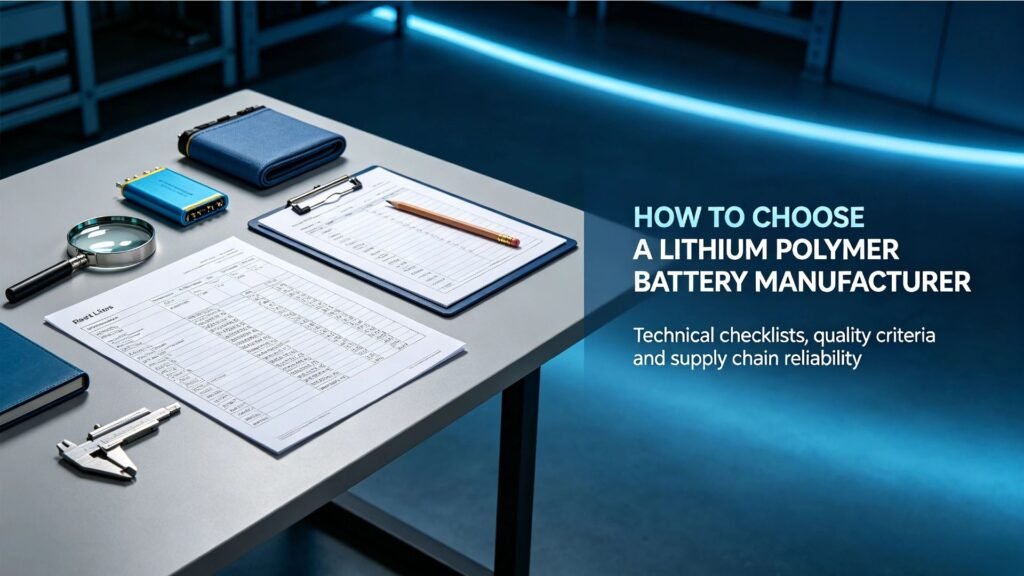
Selecting the right lithium polymer battery manufacturer is one of the most critical decisions in your product development cycle. The wrong choice can lead to quality issues, certification failures, supply chain disruptions, and costly delays. The right choice ensures reliable performance, regulatory compliance, and a long-term partnership that supports your business growth.
At A&S Power, we’ve worked with OEM buyers across wearables, medical devices, IoT, and consumer electronics for over a decade. We’ve seen the mistakes companies make when choosing a battery supplier – and we’ve helped many of them find the right path. Here’s what you need to know to make an informed decision.
For a complete overview of custom polymer battery solutions, check out our full guide: Custom Lithium Polymer Battery – OEM/ODM Solutions for IoT, Wearables & Medical Devices .
Why Choosing the Right Manufacturer Matters
Lithium polymer batteries are the heart of your portable product. They affect:
-
Product performance: Battery capacity, discharge rate, and cycle life directly impact user experience
-
Safety: Poorly manufactured cells can swell, leak, or catch fire
-
Compliance: Market access depends on certifications like UL, CE, RoHS, and UN38.3
-
Cost: Quality issues lead to returns, warranty claims, and brand damage
-
Time-to-market: Supplier delays can derail your entire product launch
A reliable lithium polymer battery manufacturer doesn’t just deliver cells – they provide engineering support, quality assurance, and compliance documentation that make your job easier.
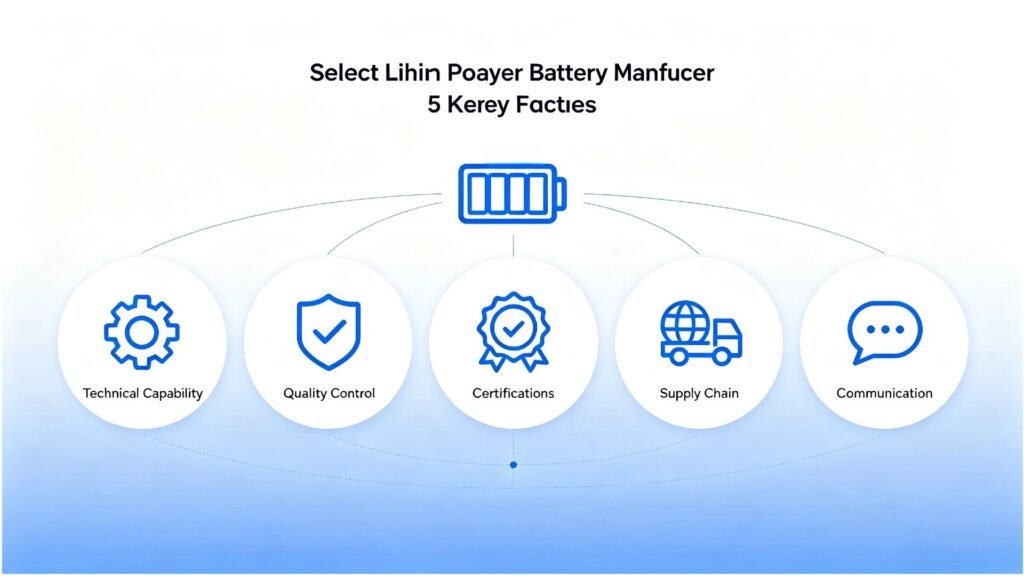
5 Key Factors to Evaluate When Choosing a Manufacturer
1. Technical Capability & Customization
Not all battery manufacturers offer true customization. Many simply resell standard cells with minimal modification.
| What to Look For | Red Flags |
|---|---|
| Custom dimensions (thickness, length, width) | “We only offer standard sizes” |
| Custom voltage and capacity | “Pick from our catalog” |
| BMS integration with specific communication protocols | “We don’t do BMS customization” |
| Custom connectors and wiring | “You can use our standard connector” |
| Engineering support for design reviews | “We’ll ship whatever you order” |
✅ What A&S Power Offers: We provide full customization – from cell dimensions and BMS integration to connectors, labeling, and packaging. Our engineering team works with you from concept to production.
2. Quality Control & Testing
Quality consistency is non-negotiable in B2B battery supply. A single defective batch can cost you thousands in returns and damage your brand reputation.
| What to Look For | Red Flags |
|---|---|
| 100% final functional testing on every cell | “We do random sampling” |
| Batch-level traceability | “We don’t track batch data” |
| In-process quality control checks | “We test at the end only” |
| ISO9001 certification | “We follow our own standards” |
| Clear quality documentation | “We don’t provide test reports” |
✅ What A&S Power Offers: Every cell undergoes 100% testing before shipment. We provide batch-level traceability and comprehensive test reports with every order. Our facility is ISO9001 and ISO14001 certified.
3. Certifications & Regulatory Compliance
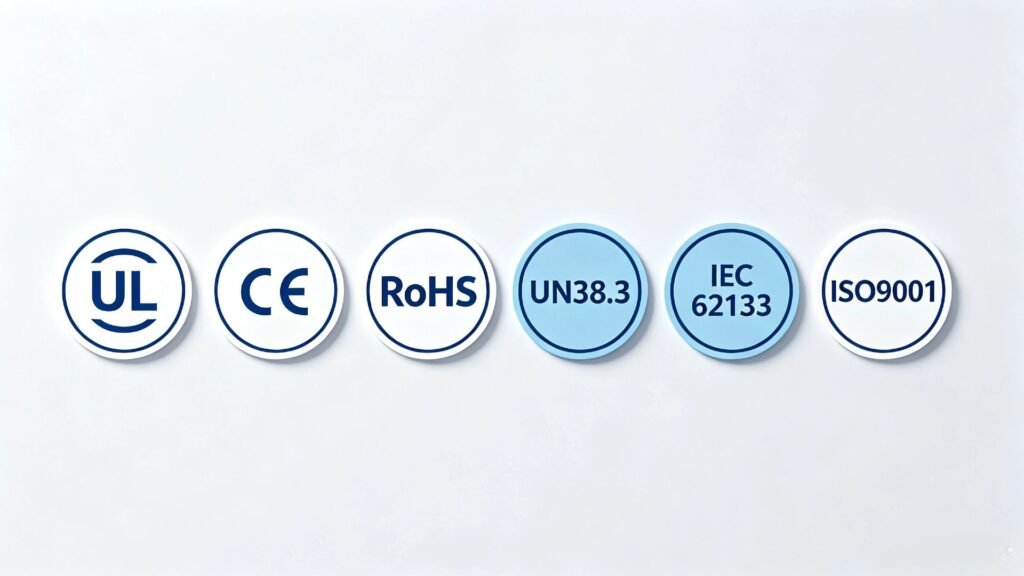
Without proper certifications, your products may be blocked at customs or rejected by retailers. This is one area where cutting corners is never worth it.
| Certification | Why It Matters |
|---|---|
| UN38.3 | Mandatory for air and sea transport of lithium batteries |
| UL 1642 / 2054 | Safety certification required for North American markets |
| CE | Required for products sold in the EU |
| RoHS | Restriction of hazardous substances – mandatory in many regions |
| IEC62133 | International safety standard for portable batteries |
✅ What A&S Power Offers: We provide full compliance documentation – UN38.3 test summaries, UL/CE/RoHS certificates, and MSDS – with every order.
4. Supply Chain Reliability & Capacity
Your manufacturer’s production capacity directly affects your ability to scale. A supplier with limited capacity can become a bottleneck when you need to ramp up.
| What to Look For | Red Flags |
|---|---|
| Scalable production capacity | “We’re running at full capacity already” |
| Stable raw material sourcing | “We buy materials when we get orders” |
| Clear lead times | “We’ll let you know when it’s ready” |
| Backup supply chain options | “We have only one supplier for materials” |
| Proven track record with similar projects | “This is our first time doing something like this” |
✅ What A&S Power Offers: With stable raw material sourcing and scalable production lines, we support both prototyping and high-volume mass production. We provide clear lead times and keep you informed throughout the process.
5. Communication & Support
B2B battery projects require ongoing communication. A manufacturer that’s hard to reach or slow to respond will cause frustration and delays.
| What to Look For | Red Flags |
|---|---|
| Responsive pre-sales support | “We’ll get back to you next week” |
| Technical expertise in your application | “I’ll need to check with someone else” |
| Transparent pricing and timelines | “We’ll figure it out later” |
| Post-delivery support | “Once it ships, it’s your problem” |
✅ What A&S Power Offers: We provide responsive communication from initial inquiry to post-delivery support. Our technical team understands your industry and provides clear answers – not vague promises.
Common Mistakes OEM Buyers Make When Choosing a Battery Manufacturer
❌ Mistake 1: Choosing Based on Price Alone
The cheapest quote often comes with hidden costs – poor quality, delayed shipments, or missing certifications. Battery quality directly affects your product’s safety and reputation.
How to avoid it: Evaluate total cost of ownership, not just unit price. Consider quality, reliability, and support.
❌ Mistake 2: Not Verifying Certifications
Some suppliers claim to have certifications but don’t actually hold valid ones. Fake or expired certificates can cause customs holds and market access issues.
How to avoid it: Request copies of actual certificates and verify them with the issuing bodies when possible.
❌ Mistake 3: Skipping Sample Testing
Approving a supplier without testing samples is a gamble. The final production batch may not match your specifications.
How to avoid it: Always request engineering samples. Test them thoroughly in your actual product before approving mass production.
❌ Mistake 4: Not Understanding Minimum Order Quantities (MOQ)
Unexpectedly high MOQs can tie up your capital and increase inventory risk.
How to avoid it: Clarify MOQs upfront. Look for manufacturers that offer flexible quantities for prototyping and scale-up.
❌ Mistake 5: Ignoring Supply Chain Risks
Relying on a single supplier with limited capacity or material sourcing exposes you to disruption risk.
How to avoid it: Assess your manufacturer’s supply chain stability. Ask about their material sourcing and backup options.
Red Flags to Watch Out For
When evaluating a lithium polymer battery manufacturer, be cautious if you encounter:
| Red Flag | What It Could Mean |
|---|---|
| “We can’t provide samples” | They may not have actual production capability |
| “Our prices are half of everyone else’s” | Quality is likely compromised |
| “We don’t have certificates right now” | They may not actually hold valid certifications |
| “We don’t do engineering support” | They are likely just a reseller, not a manufacturer |
| “We don’t provide test reports” | Quality control may be non-existent |
| “Lead time? Maybe 30-60 days” | They may not have a clear production plan |
Why A&S Power Is the Right Choice for Your OEM Battery Project
At A&S Power, we understand that choosing a lithium polymer battery manufacturer is a significant decision. That’s why we make it easy for you:
✅ True Customization
We design and manufacture cells and packs to your exact dimensions, capacity, voltage, and connector requirements. No off-the-shelf compromises.
✅ Comprehensive Certifications
UL, CE, RoHS, UN38.3, IEC62133 – we hold the certifications you need for global market access. Full documentation included with every order.
✅ Rigorous Quality Control
100% final testing on every cell. Batch-level traceability. ISO9001 and ISO14001 certified facilities.
✅ Engineering Support
Our team provides design reviews, thermal modeling, BMS customization, and integration support – from concept to production.
✅ Direct Factory Pricing
As a factory-direct manufacturer, we offer competitive pricing without compromising quality or service.
✅ Global Shipping
UN38.3 certified for air and sea transport. We ship to customers worldwide – North America, Europe, Asia, and beyond.
Frequently Asked Questions (FAQ)
1. What is the difference between a battery manufacturer and a battery assembler?
A manufacturer produces the cells themselves. An assembler buys cells from other manufacturers and assembles them into packs. A&S Power is a true manufacturer – we control cell quality from the source.
2. How long does it take to get engineering samples?
Typical sample lead time is 2-4 weeks from specification finalization. This includes cell fabrication, assembly, and testing.
3. What certifications should a reputable manufacturer have?
At minimum: UN38.3 (transport), UL/CE (safety), RoHS (materials), and ISO9001 (quality management). A&S Power holds all of these.
4. Can you provide references from similar customers?
Yes. We can share case studies and references from clients in your industry upon request.
5. How do I verify a manufacturer’s certifications?
Ask for copies of current certificates. For UL and CE, you can often verify through the issuing body’s online databases.
6. What happens if my battery project changes after production starts?
We work with you to accommodate changes whenever possible. Clear communication throughout the project ensures we can adapt to your needs.
7. Do you support small-batch prototyping?
Yes. We support projects at any stage – from prototype quantities to full-scale production.
Get a Quote for Your Custom Lithium Polymer Battery Project
Ready to choose the right lithium polymer battery manufacturer for your project? Contact A&S Power today.
📄 Request a Technical Datasheet – Contact Us
📞 Speak with Our Engineering Team – Get In Touch
🔗 Browse Our Custom Battery Solutions – View Products
We provide full compliance documentation and engineering support with every order – so you can focus on your product, not supplier headaches.
Dongguan A&S Power Technology Co., Limited.
Building 1, No. 2, Keji 9th Road, Songshan Lake, Dongguan, Guangdong, China
📞 +86 137 1383 1631 | ✉ info@enerbe.net