
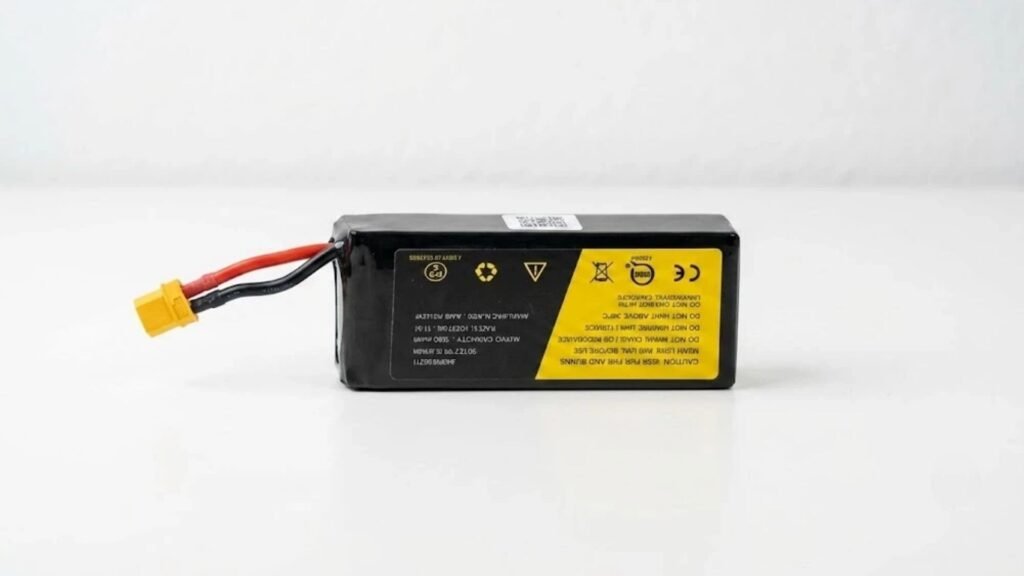
11.1V Lipo Battery (3S) – Complete Guide to Voltage, Uses & Safe Charging
Published by A&S Power | Battery Technology
Introduction
If you’ve been researching lipo batteries for your RC car, drone, or portable device, you’ve likely come across the 11.1 volt lipo battery – also known as a 3S battery. But what exactly does 11.1V mean, and why is it so popular?
At A&S Power, we manufacture custom lithium polymer batteries for OEM buyers worldwide. In this guide, we cover everything you need to know about the 11.1 volt lipo battery – from voltage and capacity to common uses and charging tips.
For a complete overview of our custom battery capabilities, check out our full guide: Custom Lithium Polymer Battery – OEM/ODM Solutions for IoT, Wearables & Medical Devices.
If you‘re new to lipo batteries, start with our Lipo Battery 101 guide for the basics.
What is an 11.1V Lipo Battery?
An 11.1V lipo battery is a lithium polymer battery pack that contains three cells connected in series. This is why it’s also called a 3S battery – three cells in series.
Key specifications:
| Specification | Value |
|---|---|
| Number of cells | 3 cells (3S) |
| Nominal voltage | 11.1V (3 × 3.7V) |
| Full charge voltage | 12.6V (3 × 4.2V) |
| Cutoff voltage | 9.0V (3 × 3.0V) |
| Common capacities | 800mAh – 5,000mAh |
| Common configurations | 3S1P (3 cells in series, 1 in parallel) |
In simple terms: An 11.1V lipo battery delivers more power than a 2S (7.4V) but is lighter and more manageable than a 4S (14.8V) or 6S (22.2V) battery.
Common Uses of 11.1V Lipo Batteries
11.1V lipo batteries are widely used in mid-range applications requiring balanced power and weight:
| Application | Why 11.1V Lipo Battery |
|---|---|
| RC cars and trucks | Balanced speed and torque for mid-sized models |
| Mid-sized drones | Extended flight time with good power output |
| FPV racing drones | Agility and acceleration for freestyle flying |
| Airsoft guns | Reliable power for consistent firing |
| Portable electronics | Devices requiring 11.1V input |
| DIY projects | Custom robots, gadgets, and electronics |
For more information on different cell counts, check out our guides on 2S Lipo Battery, 3S Lipo Battery, 4S Lipo Battery, and 6S Lipo Battery.
11.1V Lipo Battery vs 7.4V vs 14.8V – What‘s the Difference?
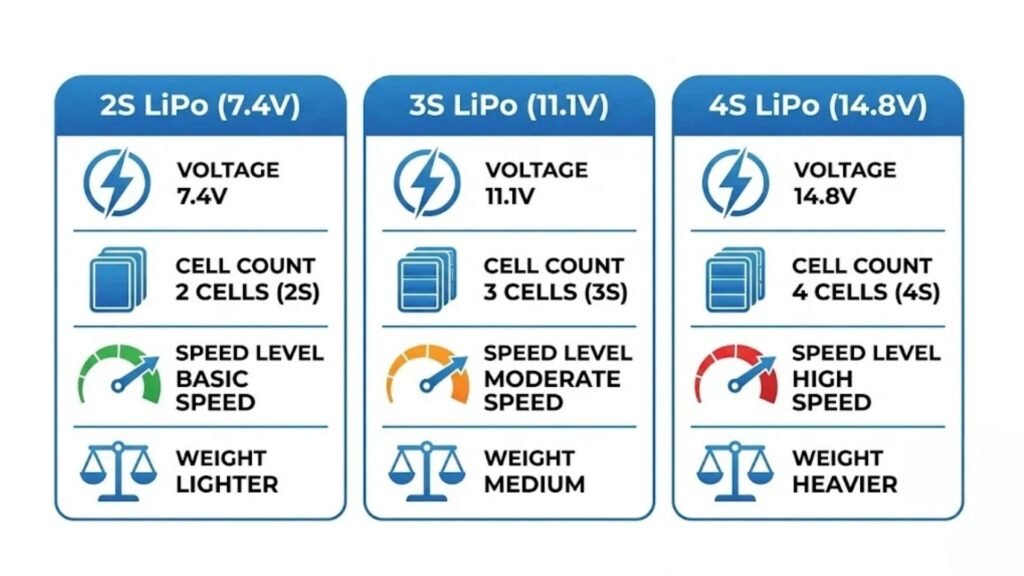
| Feature | 7.4V (2S) | 11.1V (3S) | 14.8V (4S) |
|---|---|---|---|
| Voltage | 7.4V | 11.1V | 14.8V |
| Speed/Power | Moderate | Higher | Very high |
| Weight | Lighter | Medium | Heavier |
| Runtime | Longer | Medium | Shorter |
| Best for | Entry-level RC, small drones | Mid-sized RC, drones | Racing, larger RC |
| Skill level | Beginner | Intermediate | Advanced |
How to Choose the Right 11.1V Lipo Battery
1. Capacity (mAh)
Higher capacity = longer runtime. For RC cars, 2,000-5,000mAh is common. For drones, 1,000-2,200mAh is typical for balanced weight and flight time.
2. Discharge rate (C-rating)
For casual RC cars, 30C-50C is sufficient. For racing drones, 70C-100C is recommended.
3. Connector type
Most 11.1V lipo batteries come with XT60, Deans (T-Plug), EC3, or JST connectors. Check your device compatibility.
4. Physical dimensions
Ensure the battery fits your device‘s battery compartment – especially important for drones with tight space constraints.
Important Considerations for 11.1V Lipo Batteries
- Voltage compatibility: Always check your device’s input voltage range. Most devices designed for 12V will accept 11.1V, but verify the tolerance to avoid damage.
- Charger selection: Never use a charger that isn’t designed for 3S lipo batteries. The correct charging voltage is 12.6V – if your charger doesn’t support this, you’ll undercharge or overcharge the battery.
- Temperature sensitivity: Lipo batteries perform best at 15°C to 25°C. Extreme heat or cold will reduce capacity and lifespan.
- Physical inspection: Always inspect for swelling or damage before each use. A swollen battery is unsafe and should be replaced immediately.
How to Charge an 11.1V Lipo Battery Safely
What you need:
- Lipo balance charger (supports 3S)
- 3S balance lead connection
- Fire-safe charging bag
Step-by-step:
- Connect the main power leads to the charger
- Connect the balance lead to the charger’s balance port
- Set charger to 3S (11.1V) – do not select 2S or 4S
- Set charging current to 1C – e.g., 2.2A for a 2,200mAh battery
- Start charging and monitor the process
- Disconnect when the charger shows “Complete”
⚠️ Never charge an 11.1V lipo battery without balance charging – uneven cell charging creates fire hazards.
For detailed charging instructions, see our How to Charge Lipo Batteries guide.
Frequently Asked Questions
1. Can I use an 11.1V lipo battery in a 7.4V device?
No. 11.1V batteries deliver higher voltage (11.1V vs 7.4V) and will damage 7.4V-compatible devices.
2. What is the voltage of a fully charged 11.1V lipo battery?
A fully charged 11.1V lipo battery reads 12.6V (4.2V per cell).
3. What is the lowest voltage for an 11.1V lipo battery?
The minimum voltage is 9.0V (3.0V per cell). Discharging below this causes permanent capacity loss.
4. How long does an 11.1V lipo battery last?
Under normal use, an 11.1V lipo battery lasts 300-500 cycles (3-5 years).
5. What is the difference between 11.1V and 12V batteries?
11.1V is the nominal voltage of a 3S lipo battery. 12V is a different standard used in some devices – always check your device specifications.
6. Can I use an 11.1V battery in a 12V device?
Most 12V devices can accept an 11.1V battery, but check your device’s voltage tolerance before use. Some devices require a regulated 12V input and may not work properly with 11.1V.
7. What is the difference between 11.1V and 12V batteries?
11.1V is the nominal voltage of a 3S lipo battery (3 × 3.7V). 12V is a different standard used in some devices – always check your device specifications.
Custom Lipo Battery Solutions from A&S Power
At A&S Power, we manufacture custom lithium polymer batteries for OEM buyers across multiple industries. From RC cars and drones to medical devices and wearables, we deliver tailored solutions with safety and performance in mind.
- ✅ Custom dimensions and capacities
- ✅ OEM labeling and packaging
- ✅ UL, CE, RoHS, and UN38.3 certification
- ✅ Engineering support from concept to production