
Swollen LiPo Battery: Why It Puffs and What to Do Safely
Published by A&S Power | Battery Safety & Quality
Introduction
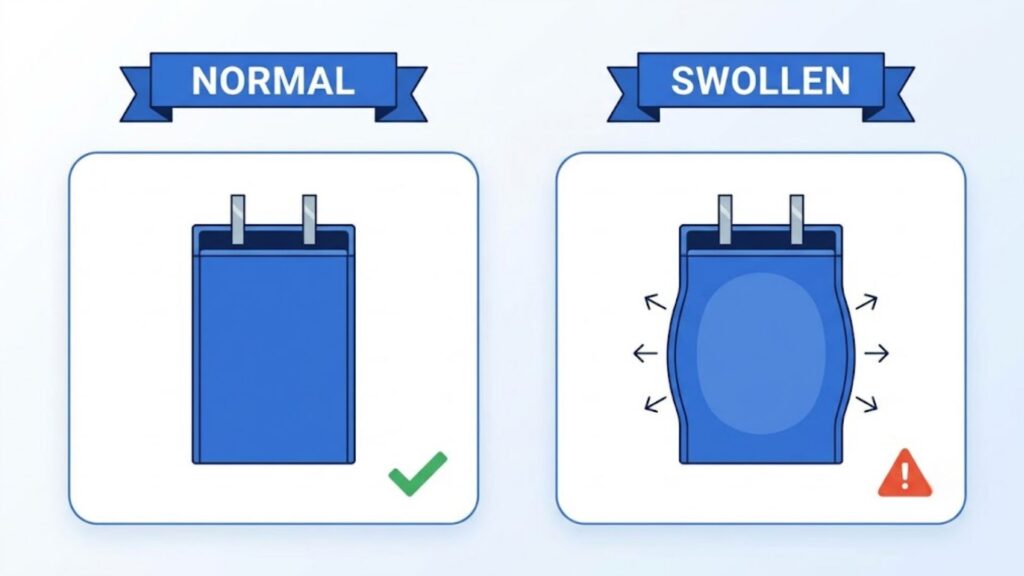
If you fly drones, run RC cars, or design portable products, you have likely seen one: a lithium polymer battery that should sit flat now bulges like a small pillow, at one corner or across the whole pack. The words people use for it are swollen, puffed, bloated, or bulging. They all describe the same failure.
The short answer: a swollen LiPo battery has produced gas inside its soft foil pouch. Stop using it, do not puncture it, discharge it safely, and recycle it. A puffy cell is a damaged cell, not a tired one that will recover.
At A&S Power, we make lithium polymer pouch cells and custom packs for OEM buyers. A swollen LiPo is one of the questions that comes back most often after a product has been in the field. This guide explains what the gas is, where it comes from, whether a puffy cell is dangerous, and how to dispose of a swollen lithium battery without starting a fire. The last two sections cover what we do on the production line so a cell leaves the factory stable, and what an OEM should specify to keep failures out of the field.
If you are new to the chemistry, our introduction to lithium polymer batteries covers the basics. For day-to-day handling, the LiPo voltage and C-rating chart gives the safe voltage window per cell.
Why a LiPo Pouch Puffs
A lithium polymer cell is not held inside a rigid metal can. The electrodes, stacked or wound into a compact core, are sealed inside a soft aluminum-laminated film pouch with the liquid electrolyte soaking the separator and electrodes. When the cell is healthy, the inside stays near normal air pressure and the two flat faces stay flat.
A lithium cell is a chemical reactor in a bag. During the first charge, a thin protective layer called the SEI (solid electrolyte interphase) forms on the negative electrode. That layer is supposed to stay stable. Small amounts of gas are produced in the early cycles and are mostly absorbed. When the chemistry is pushed outside its normal window by overcharge, heat, damage, or age, side reactions run faster than the cell can absorb the gas they make. The gas has nowhere to go in a sealed pouch, so it pushes the flexible foil outward. The bulge you see is that trapped gas.
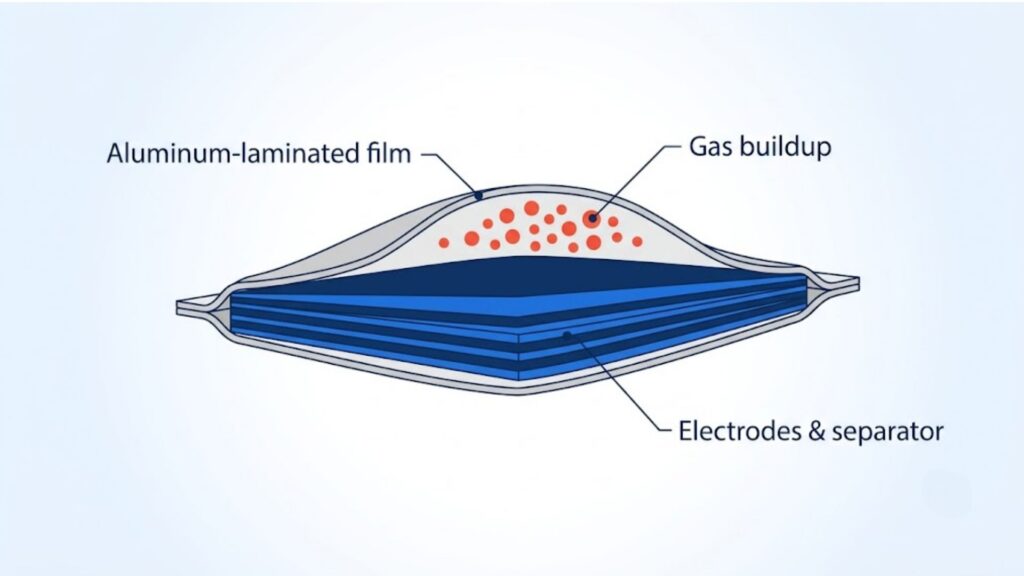
The gas is only the symptom. By the time a pouch is visibly puffy, the electrodes and electrolyte have already been through reactions that raise internal resistance and take capacity away. The cell is not warning you before the damage; it is showing the damage after it has happened.
What Causes a Swollen LiPo Battery
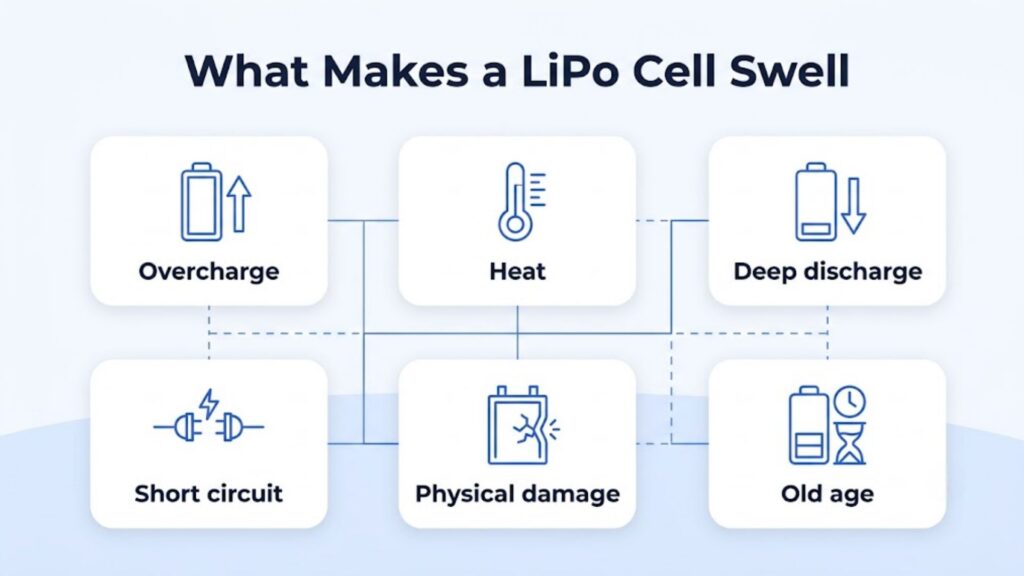
Gas comes from a handful of well-understood triggers. In the field, more than one is usually present at once, for example an overcharged pack left in a hot car.
| Cause | What happens inside the cell | How it usually happens |
|---|---|---|
| Overcharge | Charging past 4.2V per cell over-extracts lithium from the positive electrode and oxidizes the electrolyte, breaking down the SEI and producing gas in volume. | Wrong cell count on the charger, charging unattended, or a pack with no protection circuit. |
| Deep discharge | Below about 3.0V per cell the copper current collector can dissolve and the SEI breaks down. The next charge then gases heavily. | Running a pack until the device cuts hard, or storing a pack that was already nearly empty. |
| Heat | High temperature speeds up side reactions and makes the SEI unstable, so gas forms faster even without a charger connected. | Pack left in a vehicle, in direct sun, near a heat source, or run hard in a sealed enclosure. |
| Internal short circuit | A torn separator, a speck of metal, or a lithium dendrite bridges the electrodes, causing local self-heating that can cascade into swelling or a thermal event. | A manufacturing defect, a puncture, a crush, or poor charging that grows metal spikes. |
| Physical damage and moisture | A puncture or a weak seal lets water in. Water reacts with the lithium salt to form acid and gas, and damage can also set off an internal short. | A crash, a squeezed pack, a bad crimp, or a seal that failed. |
| Old age and cycling | Over hundreds of cycles the SEI thickens, internal resistance climbs, and a small amount of gas builds up until the pouch loses its flat shape. | A pack near or past the end of its 300–500 cycle service life. |
A manufacturing defect such as excess moisture, misaligned electrodes, or a weak heat seal can produce gas on its own. That is the main reason unbranded, untested cells have a higher swelling rate than cells that have been through a proper formation and aging process. The signs of a bad cell and the signs of a badly treated cell can look identical on the outside.
Why Pouch Cells Swell but Most Cylindrical Cells Do Not
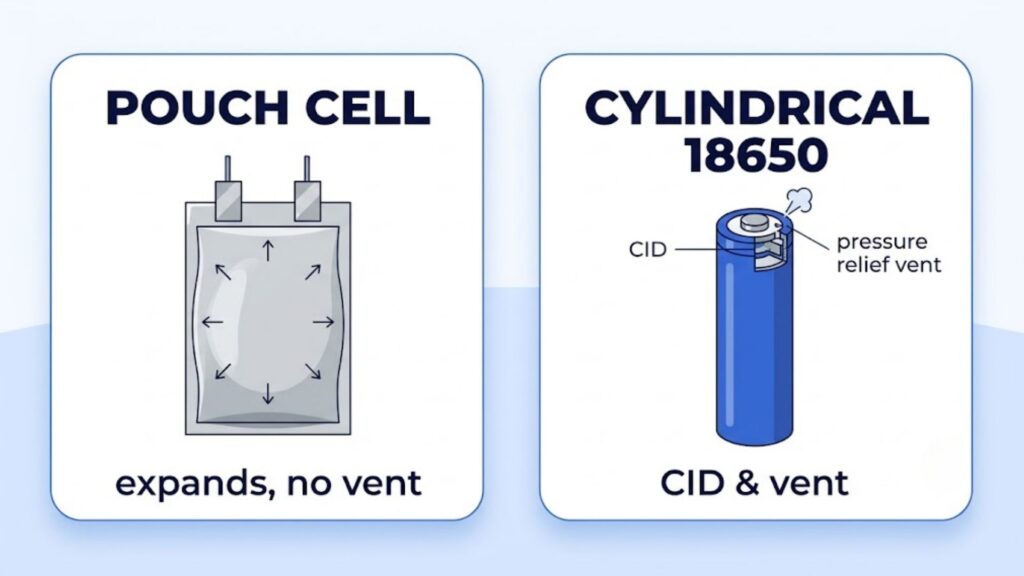
A steel-cased 18650 or 21700 cell behaves differently under internal pressure. The can is rigid, and the top carries a CID (current interrupt device) and a pressure relief vent. When pressure rises past the set point, the CID disconnects the cell and the vent opens to release gas. The can stays cylindrical; it does not balloon.
| Feature | Pouch LiPo | Cylindrical 18650 / 21700 |
|---|---|---|
| Outer case | Flexible aluminum-laminated film | Rigid steel can |
| Pressure release | The pouch expands first; in a severe case the seal tears open | CID disconnects and the vent opens by design |
| Early warning | Visible swelling, easy to spot | Usually no bulge; it vents directly |
| Shape | Thin and customizable, made to fit an enclosure | Fixed round format |
This does not make pouch cells less safe. The same soft package that puffs is what lets a pouch cell be thin, light, and shaped to fit a wearable, a medical sensor, or a tight drone frame. The difference is in how the two formats ask for help: a pouch shows swelling, while a cylindrical cell vents through a mechanical part. Either way, swelling or venting means the cell is finished.
How to Check a Battery for Swelling
A small bulge is easy to miss inside a pack, especially under heat-shrink wrap. Work with the pack disconnected from the load and on a flat, clean surface.
- Disconnect the pack and set it on a flat table. A flat pack sits still; a puffy pack rocks when you nudge a corner because the swollen face no longer touches the table.
- Look at the edges and corners. Gas often collects at one end first, lifting the label or opening a gap where the foil layers meet.
- Press gently on the faces with a flat hand. A healthy cell is firm and flat. A gassy cell feels soft or springy, like a sealed air packet. Do not press hard.
- On a multi-cell pack, check each cell through the balance lead. A cell that reads well below the others, or that keeps dropping, is the one to suspect even if the pack looks even.
| Condition | What you see | What to do |
|---|---|---|
| Light swelling | Slight lift at an edge, a faint rock on the table, still charges and discharges | Retire it from service and recycle it at the next opportunity. Do not keep it in a flying or safety-critical device. |
| Heavy swelling | Pillow-shaped pack, hot to the touch, a sweet solvent smell, leakage, a torn seal, or a cell below its cutoff voltage | Isolate it now, do not charge it, and move to disposal steps immediately. |
Can You Still Use a Puffy LiPo?
No. A swollen pack is not a tired pack you can nurse through a few more runs. It is a cell that has already gassed, which means an internal short or a side reaction is underway and the internal resistance is already higher than it should be. Every charge and discharge adds more stress to a cell that is no longer in the condition it was designed for. The bulge can stay stable for months, or it can progress to smoke and fire the next time you charge it. There is no way to know which from the outside.
Do not put it in the freezer, do not flatten it under a weight, and do not swap the one bad cell out of a multi-cell pack and rebuild it unless you build packs for a living. The other cells in that pack have been through the same heat and cycles and are usually close behind.
Never puncture, crush, or squeeze a swollen pouch, and never charge it. The gas inside is flammable. A needle, a knife, or hard pressure can create an internal short and turn a slow gas leak into an immediate fire or venting event. Letting the gas out is the most dangerous thing you can do to a puffy cell.
Most LiPo safety incidents reported in the RC and drone community trace back to a known damaged or puffy cell being charged one more time, not to a healthy cell failing out of nowhere. The steps in our LiPo charging guide assume a sound, undamaged pack.
How to Dispose of a Swollen LiPo Battery Safely
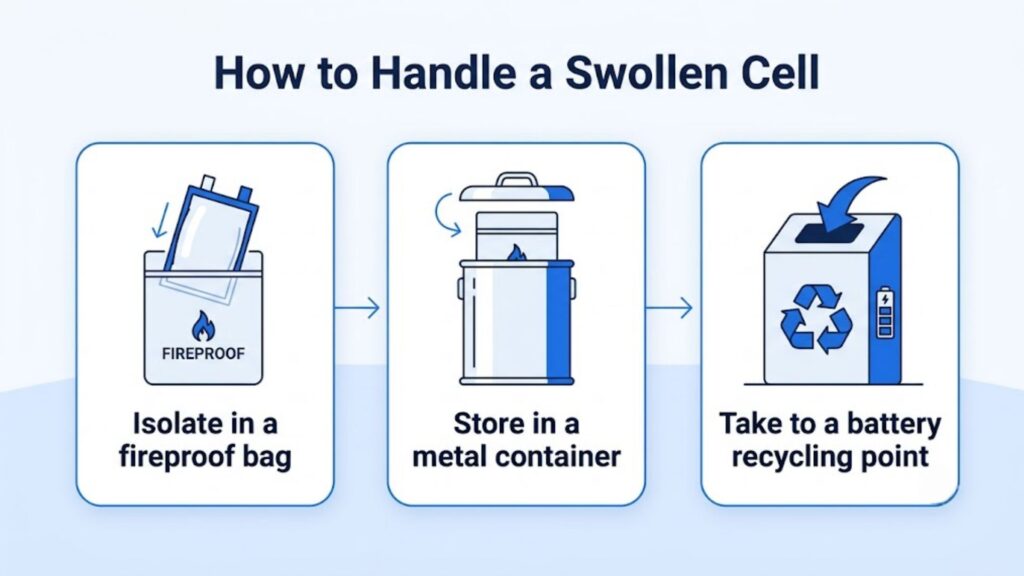
Step by step:
- Stop using the pack and do not charge it again.
- Isolate it. Put it in a LiPo fireproof bag, a metal container, or a bucket of sand, away from fuel, wood, paper, people, and pets. Keep it in a shaded, ventilated spot, not in a hot car.
- Discharge it to a safe voltage using a LiPo discharger, a resistor bank, a power resistor with a bulb, or the discharge function on a balance charger, down to about 3.0V per cell or the level your local recycler asks for. Never discharge by shorting the leads.
- Take it to a battery recycling point: a Call2Recycle drop-off in North America, a local household hazardous waste facility, a battery or hardware store that accepts LiPo, or a hobby shop collection box.
- Do not put it in the household trash or a curbside recycling bin. Unprotected lithium cells are a known cause of fires in garbage trucks and sorting facilities.
Some RC pilots use a saltwater bath to fully discharge a dead pack when recycling is not available: submerge the whole pack in a plastic container of roughly 30–40 grams of salt per liter of water, leave the lid loose, and keep it outdoors for a week or two until the voltage reads near zero and stays there. This is a hobbyist method, not an official recycling procedure, and it is corrosive and conductive. The recommended route is still a proper recycling point. Follow the rules in your region; the EU, the UK, and most Asian markets run dedicated lithium battery collection.
A cell that is only being stored for a while, not retired, should sit at about 50–60% charge (roughly 3.8–3.85V per cell) in a cool, dry place. Storing LiPo fully charged, especially in heat, ages it quickly and is a common cause of late swelling. The LiPo storage guide covers the details.
How We Prevent Swelling at the Factory
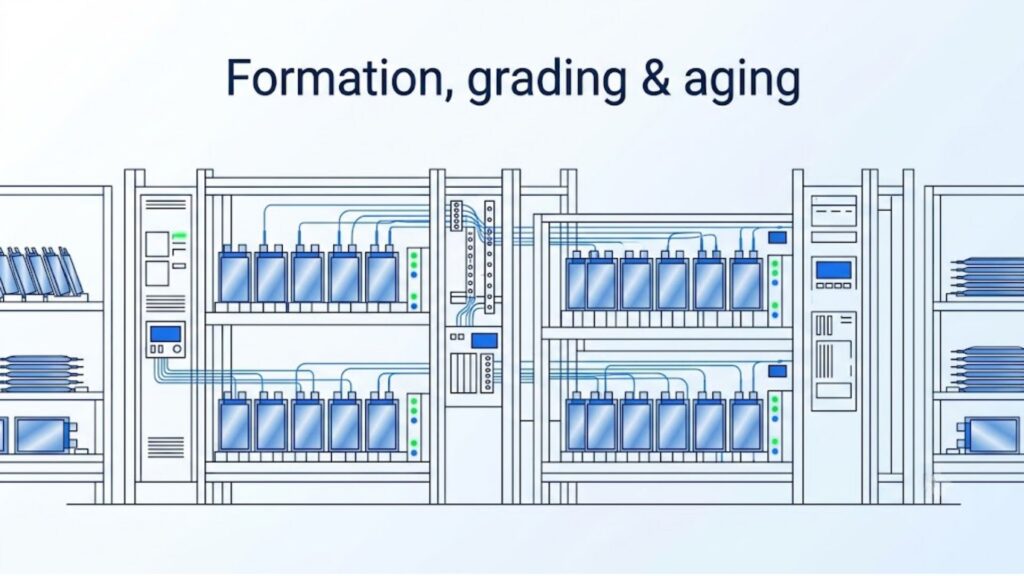
Most cells that would puff in the field can be caught before they leave a factory, as long as the line controls moisture, builds the SEI correctly, and screens out micro-shorts. These are the steps that matter on our line.
| Process step | What it does for swelling |
|---|---|
| Incoming and moisture control | Raw materials are inspected and the electrodes are vacuum-baked; assembly runs in a dry room with a controlled dew point. Water is the enemy of the electrolyte, and trapped water is a direct source of gas and acid. |
| Formation (first charge) | A controlled low-current first charge builds a dense, stable SEI on the negative electrode. A rushed or too-hot formation leaves a porous layer that keeps reacting and gassing through the cell’s life. |
| Capacity grading | A standard charge-discharge cycle measures real capacity and internal resistance so weak and out-of-spec cells are removed. |
| OCV and ACIR testing | Open-circuit voltage and internal resistance are measured. A cell with a developing internal short self-discharges fast and shows an abnormal voltage drop. |
| Aging and voltage hold | Cells are rested, sometimes at elevated temperature, and measured again for voltage retention and thickness change. Early gassing and micro-shorts surface here rather than in a customer’s product. |
| Seal and thickness checks | The top and side heat seals are inspected for leaks, and thickness is spot-checked before and after cycling to catch any cell that has expanded. |
| Protection in the pack | Finished packs add a PCM or BMS to cut overcharge, over-discharge, overcurrent, and short circuits, with an NTC thermistor for temperature and cell balancing on multi-cell builds. |
No process catches every future failure, and a cell that is abused after it ships can still swell. But a cell that has passed formation, grading, and aging with a stable voltage and a stable thickness is much less likely to puff than one sealed and shipped the same week.
What OEM Buyers Should Specify to Keep Packs From Puffing
Cell quality sets the baseline, but the pack design and the information given to the end user decide how often a swollen battery comes back under warranty. These are the points we put in every custom pack spec.
| Check point | Why it matters |
|---|---|
| Protection hardware | Specify a PCM/BMS with overcharge, over-discharge, overcurrent, and short-circuit cutoffs, plus an NTC and cell balancing for high-rate, high-temperature, or multi-cell packs. |
| Correct cell sizing | Choose the C-rating and cell size around the continuous current, not the peak. A cell run at its limit every day runs hot and ages fast. |
| Matched charger | Ship or specify a charger that matches the cell count and voltage, with balance charging on multi-cell packs, so the end user cannot overcharge. |
| Factory quality records | Ask for formation, grading, and aging data and valid UN38.3 and IEC62133 documentation. A supplier that cannot show these has no real way to prove the cells were screened. |
| Storage instructions | Give the end user clear storage guidance: about 50% charge, cool and dry, away from heat, with a periodic check. Fully charged, hot storage is a leading cause of swelling in products that sit on a shelf. |
Our custom pack assembly and BMS guide shows how protection is built into a pack, and the manufacturer selection guide lists the quality questions to ask a supplier before a project starts.
Frequently Asked Questions
1. Is a swollen LiPo battery dangerous?
A puffy cell does not always burst, but it is a damaged cell that has already gassed and can heat up, vent, or catch fire if charged, discharged hard, punctured, or crushed. Treat it as a safety item: stop using it, isolate it, and recycle it. That is the answer to whether LiPo batteries are dangerous in this state, yes, a damaged one is.
2. What causes a LiPo battery to swell?
The usual causes are overcharging, over-discharging, heat, an internal short circuit, physical damage or moisture, and old age. A manufacturing defect with excess moisture or a weak seal can also cause gas. Often several causes overlap.
3. Can I still use a puffy LiPo battery?
No. Swelling is irreversible, and the cell’s internal resistance and chemistry have already changed. Running or charging it adds stress to an unstable cell. Retire it and replace it.
4. Will a swollen LiPo battery explode?
A bulge on its own does not mean an explosion, and many puffy packs sit stable for weeks. But there is no reliable way to tell a stable one from one that will vent on the next charge. Charging, puncturing, or crushing it can lead to smoke, flame, or a thermal event, which is why it must be retired.
5. Can I puncture it to let the gas out?
No. Puncturing a swollen pouch is the most dangerous option: it releases flammable gas and can create an internal short that ignites the cell. Leave the seal intact and discharge or recycle the cell as a whole.
6. Can a swollen LiPo be fixed?
No. The reactions that produce gas and the SEI damage behind them cannot be reversed, and the foil pouch stays stretched. There is no safe repair, only safe disposal.
7. Why do cylindrical 18650 cells not swell?
They are in a rigid steel can fitted with a CID and a pressure relief vent. When internal pressure rises, the CID opens the circuit and the vent releases gas, so the can keeps its shape. Pouch cells instead expand their flexible foil.
8. How do I dispose of a swollen lithium battery?
Stop using it, isolate it in a fireproof bag or a metal container, discharge it to a safe voltage with a proper discharger, and take it to a LiPo recycling point such as Call2Recycle or a household hazardous waste facility. Do not put it in the normal trash.
9. Can a LiPo swell from sitting unused?
Yes. A pack stored fully charged, in heat, or already nearly empty ages faster and can gas over time. Store unused packs at roughly 50–60% charge in a cool, dry place and check them periodically.
10. Is a slightly puffy cell still OK to use?
A faint bulge is still a sign of internal damage and higher resistance, even if the pack works. It is best retired from a flying, medical, or safety-critical device and recycled rather than pushed until it fails hard.
Custom LiPo Packs Built to Avoid Field Failures
We manufacture pouch cells and custom packs with PCM/BMS and NTC protection, formation, grading and aging data, and full transport and safety documentation. Tell us the device, the current it draws, and the space it has to fit, and we size the cells and protection so the pack that arrives is ready to go into the product.
- Custom dimensions, capacity and voltage
- PCM/BMS protection and NTC thermal monitoring fitted to the pack
- UL, CE, RoHS, UN38.3 and IEC62133 certification
- Engineering support from the first spec to mass production