
Introduction
Choosing the right lipo battery charger can be confusing. With so many options – balance chargers, fast chargers, chargers with LCD screens, chargers with storage mode – it’s easy to get overwhelmed.
At A&S Power, we manufacture custom lithium polymer batteries for OEM buyers worldwide. This guide breaks down everything you need to know about lipo battery chargers so you can make the right choice.
For a complete overview of our custom battery capabilities, check out our full guide: [Custom Lithium Polymer Battery – OEM/ODM Solutions for IoT, Wearables & Medical Devices] .
What is a Lipo Battery Charger?
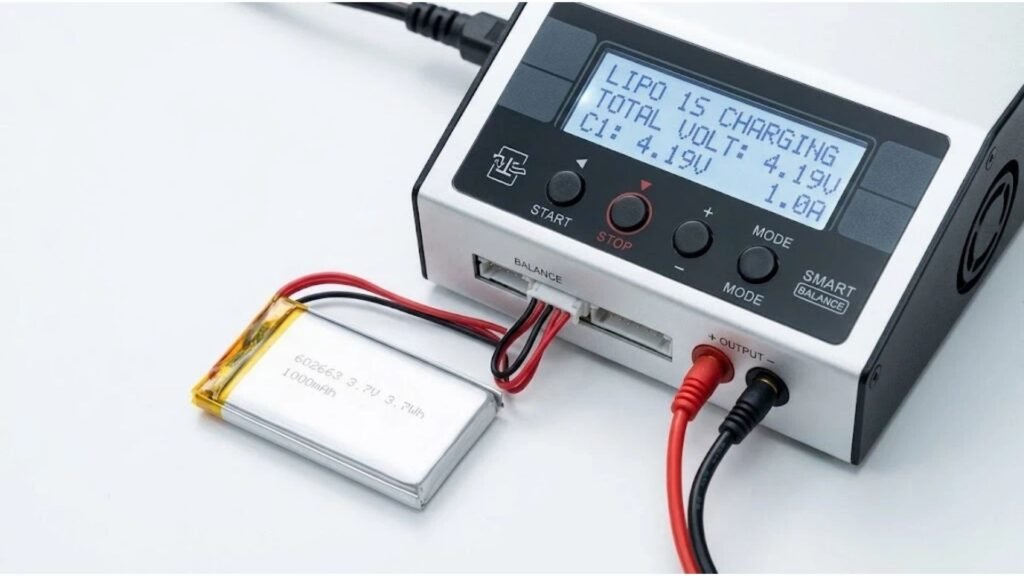
A lipo battery charger is a specialized charger designed specifically for lithium polymer batteries. Unlike regular battery chargers, lipo chargers:
-
Balance each cell in a multi-cell pack
-
Prevent overcharging (stop at 4.2V per cell)
-
Monitor temperature and current
-
Provide storage mode for battery preservation
-
Detect faulty or damaged cells
Regular chargers – like those used for NiMH or alkaline batteries – do not have these safety features and can damage lipo batteries or create fire risks.
Types of Lipo Battery Chargers
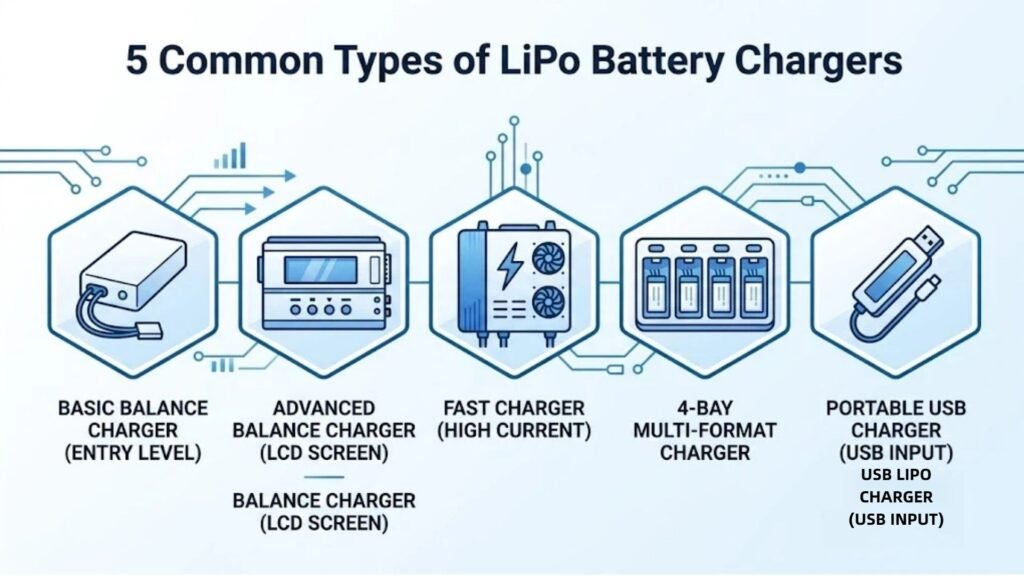
| Type | Best For | Features |
|---|---|---|
| Basic balance charger | Beginners, casual users | Simple operation, balance charging, 2-4S support |
| Advanced balance charger | Regular users, drone pilots | Multiple battery types, storage mode, LCD display |
| Fast charger | Professionals, racing | Higher charging current (2C-5C), shorter charge times |
| 4-bay multi-format charger | Multiple batteries | Can charge different battery types simultaneously |
| USB lipo charger | Small batteries, travel | Portable, powered by USB, low current (0.5A-1A) |
Key Features to Look For
When buying a lipo battery charger, pay attention to these features:
1. Balance charging
This ensures each cell in a multi-cell pack charges evenly – critical for battery life and safety.
2. Auto cutoff
The charger should automatically stop charging when the battery reaches 4.2V per cell.
3. Storage mode
This charges or discharges the battery to 40-60% for long-term storage – essential for battery longevity.
4. LCD display
Shows voltage, current, capacity, and time – helps you monitor the charging process.
5. Multi-cell support
Check what cell count the charger supports (2S, 3S, 4S, etc.). Make sure it matches your batteries.
6. Safety certifications
Look for UL, CE, or RoHS certification – these indicate the charger meets safety standards.
7. Overheat protection
The charger should shut down automatically if it gets too hot during charging.
How to Charge a Lipo Battery with a Charger
-
Connect the battery‘s balance lead to the charger’s balance port
-
Set the correct cell count (2S, 3S, etc.)
-
Set charging current (typically 1C – e.g., 1A for a 1000mAh battery)
-
Press start – monitor the voltage on the LCD screen
-
When the charger shows “Complete,” disconnect immediately
⚠️ Never leave a charging battery unattended. Always use a fire-safe charging bag.
Common Mistakes When Choosing a Lipo Battery Charger
| Mistake | Why It’s Risky |
|---|---|
| Buying a charger without balance function | Uneven cell charging reduces lifespan and creates safety risks |
| Using a charger with incorrect voltage | Overcharges or undercharges cells, damaging the battery |
| Not using a fire-safe bag | In case of battery failure, the bag contains the fire |
| Buying cheap unbranded chargers | No safety certifications, unknown quality |
Frequently Asked Questions
1. What is the difference between a lipo charger and a regular charger?
A lipo charger balances cells, stops at correct voltage, and has storage mode. Regular chargers lack these features and can damage lipo batteries.
2. Can I charge a lipo battery without a balance charger?
No. Charging without balance leads creates uneven cell voltages and is dangerous.
3. How long does a lipo battery take to charge?
Typically 1-2 hours at 1C charging rate. Fast chargers can reduce this but require batteries rated for higher C rates.
4. What does 1C mean in charging?
1C means charging at the battery‘s rated capacity – 1A for a 1000mAh battery, 2A for a 2000mAh battery, and so on.
5. How do I know when my lipo battery is fully charged?
The charger will show “Full” or “Complete” and display 4.2V per cell. Always disconnect immediately when done.
Custom Lipo Battery Solutions from A&S Power
At A&S Power, we manufacture custom lipo batteries for OEM buyers across multiple industries. From wearables and medical devices to drones and portable speakers, we deliver tailored solutions with safety and performance in mind.
✅ Custom dimensions and capacities
✅ OEM labeling and packaging
✅ UL, CE, RoHS, and UN38.3 certification
✅ Engineering support from concept to production
📄 Request a Technical Datasheet – Contact Us
📞 Speak with Our Engineering Team – Get In Touch
🔗 Browse Our Custom Battery Solutions – View Products
Dongguan A&S Power Technology Co., Limited.
Building 1, No. 2, Keji 9th Road, Songshan Lake, Dongguan, Guangdong, China
📞 +86 137 1383 1631 | ✉ info@enerbe.net