
Introduction
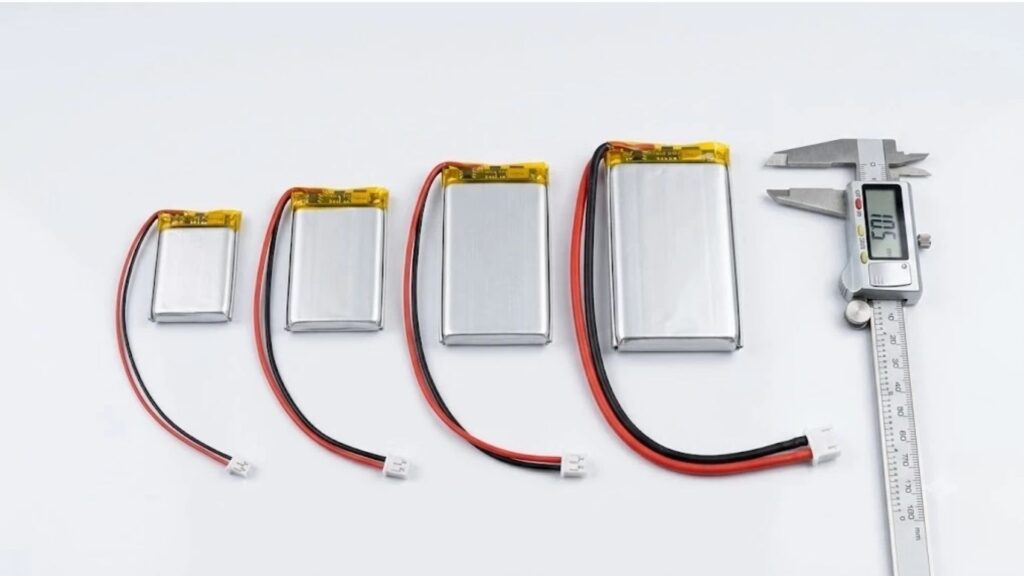
Every lithium polymer pack leaves our factory with two leads and a connector on the end. Those leads look like a small detail, and on the bill of materials they are. But pick the wrong wire gauge and the pack runs warm, the voltage sags before it reaches the board, and the connector becomes the first thing to fail.
We build custom lithium polymer battery packs for OEM buyers, and two numbers decide the wire: how much current the device draws, and how long the cable is. This guide shows how we get from those two numbers to a finished lead, with the reference table we actually use.
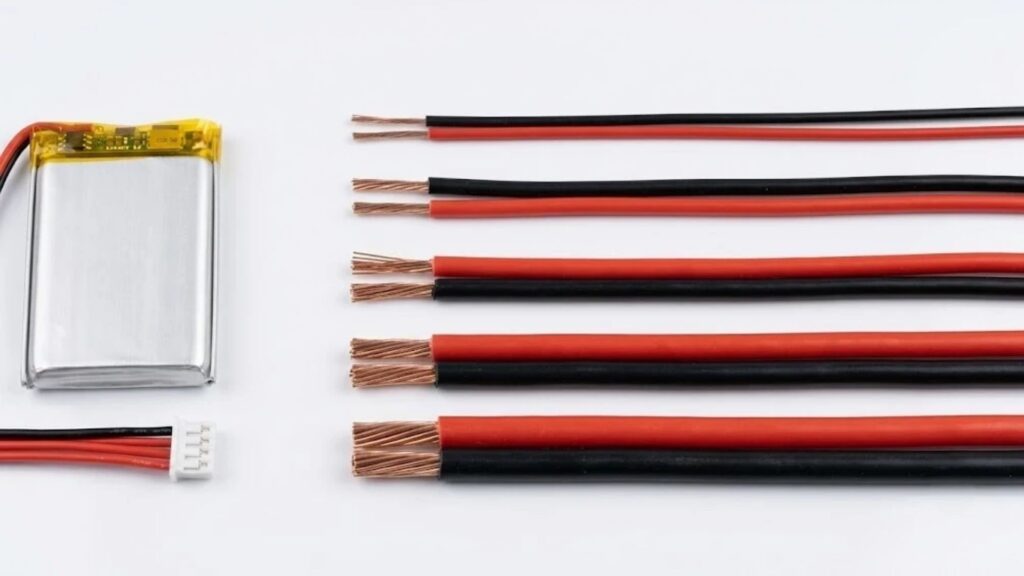
Most of the packs we make for medical, IoT and portable devices sit in the 18 to 26 AWG range. The full table runs all the way up to the thick aught sizes, so if your product pulls more current, the same method applies. For our broader capabilities, see the custom lithium polymer battery overview.
Why Wire Gauge Matters
A copper wire has resistance. When current runs through it, two things happen, and both are easy to predict:
- The wire heats up. The heat is I²R, the current squared times the resistance. Double the current and you get four times the heat.
- Voltage drops across the wire. That drop is I×R, so the device at the far end sees a lower voltage than the pack is putting out.
A wire that is too thin runs hot, softens its own insulation, and heats the connector contacts along with it. A wire that is too thick does not damage anything, because the load draws the current it needs regardless of wire size. It just wastes copper, it is stiff in a small enclosure, and it costs more. We aim for the middle with some headroom.
Size the wire for the continuous current, not the peak number on a datasheet. A short peak can ride close to the rating. The current held for minutes is what heats the lead.
How AWG Works
AWG stands for American Wire Gauge. It began in North America, but it is the common way to size copper wire in products sold around the world, including the packs we ship to Europe and Asia.
The scale runs backwards, which catches people out. A smaller number is a thicker wire. 26 AWG is thin, 18 AWG is much thicker, and past 1 AWG the sizes go 1/0, 2/0, 3/0 and 4/0, where the zero is read as “aught.”
- Drop three gauge numbers and the cross-section roughly doubles.
- Drop ten gauge numbers and the cross-section is about ten times larger and the resistance about one tenth.
Cross-section decides how much current the wire can carry. Length decides the total resistance, so a 10 cm lead and a 3 meter cable of the same gauge behave very differently.
You will see two common jackets. Soft silicone wire bends easily and tolerates heat, so it shows up on high-rate and RC packs. PVC and XLPE wire are used on fixed installs in industrial and medical products. The copper inside follows the same AWG dimensions either way, so the table applies to both.
AWG Cable Size & Ampacity Chart
The cross-section and resistance columns are fixed AWG values for copper. A wire does not have one true current rating, because the number depends on how hot the insulation can get, whether the wire sits in open air or inside a bundle, and the ambient temperature.
| AWG | Cross-section (mm²) | Resistance (mΩ/m) | Ampacity, free air (A) | Bundled / conservative (A) |
|---|---|---|---|---|
| 26 | 0.13 | 134.5 | 2.5 | 1.5 |
| 24 | 0.20 | 84.2 | 3.5 | 2 |
| 22 | 0.33 | 52.7 | 7 | 3.5 |
| 20 | 0.52 | 33.3 | 11 | 5 |
| 18 | 0.82 | 21.0 | 16 | 7.5 |
| 16 | 1.31 | 13.2 | 22 | 10 |
| 14 | 2.08 | 8.29 | 32 | 15 |
| 12 | 3.31 | 5.21 | 41 | 20 |
| 10 | 5.26 | 3.28 | 55 | 30 |
| 8 | 8.37 | 2.06 | 73 | 45 |
| 6 | 13.3 | 1.30 | 101 | 60 |
| 4 | 21.2 | 0.82 | 135 | 80 |
| 2 | 33.6 | 0.52 | 180 | 100 |
| 1/0 | 53.5 | 0.33 | 245 | 135 |
| 2/0 | 67.4 | 0.26 | 302 | 170 |
| 4/0 | 107.2 | 0.16 | 405 | 230 |
“Free air” is a single lead in the open with roughly a 30°C temperature rise. “Bundled / conservative” covers leads run together in a harness or in warm enclosures, and it is the column we size most packs against, then add headroom. These are not NEC building-wiring figures or the rating of any specific connector. Check the insulation rating and the bundling in your own product.
How to Choose a Battery Cable by Current
If you know the continuous current and the lead is short, which most battery leads are, this table takes you straight to a gauge. It is built from the conservative column, so it is safe to use on a short, open lead without adding anything.
| Continuous current | Suggested AWG |
|---|---|
| up to 1.5 A | 26 |
| up to 2 A | 24 |
| up to 3.5 A | 22 |
| up to 5 A | 20 |
| up to 7.5 A | 18 |
| up to 10 A | 16 |
| up to 15 A | 14 |
| up to 20 A | 12 |
| up to 30 A | 10 |
| up to 45 A | 8 |
| up to 60 A | 6 |
| up to 80 A | 4 |
| up to 100 A | 2 |
| up to 135 A | 1/0 |
| up to 170 A | 2/0 |
| up to 230 A | 4/0 |
To get the continuous current of a pack, multiply the capacity in Ah by its continuous C-rate. A 1 Ah cell at a 1C continuous rating gives 1A. The device’s rated draw is a good cross-check, and we use the lower of the two.
Distance and Voltage Drop
Short leads, soldered straight onto a board, rarely have a drop worth worrying about. Long cables are different. In RVs, boats and fixed installs a cable can run a few meters, and then the gauge is decided by voltage drop rather than by heat.
The drop on the full circuit, counting both the positive and negative runs, is:
Vdrop = I × (resistance per meter × one-way length × 2)
On a 12V system we keep the drop under about 0.3V, under 3%. Here is a worked case at 20A with a 3 meter one-way run, so 6 meters in the full circuit:
| AWG | Resistance over 6 m | Voltage drop at 20 A |
|---|---|---|
| 12 | 31.3 mΩ | 0.63 V (too much) |
| 10 | 19.7 mΩ | 0.39 V (borderline) |
| 8 | 12.4 mΩ | 0.25 V (good) |
This is why a cable that looks oversized for the current can still be the right choice once it is long. The heat table says 12 AWG handles 20A. The voltage-drop math says 8 AWG is the answer at 3 meters.
Matching the Connector
The connector sits in the same circuit as the wire, and it has its own current rating and contact resistance. A thick lead on a small plug gains nothing, and a thin lead on a large plug just moves the heating problem to the wire. We size both to the same current.
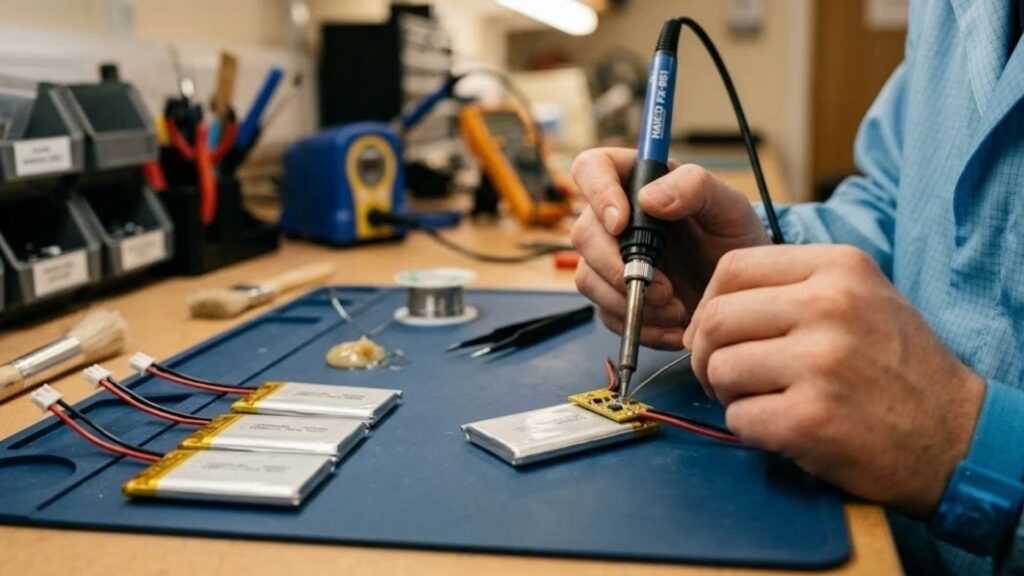
These are the connector families that show up on LiPo and lithium packs, roughly from smallest to largest current:
| Connector | Typical use |
|---|---|
| Molex PicoBlade / JST SH | Sub-1A leads on tiny cells and sensors |
| JST RCY / PH | 1–5A leads on small LiPo packs, easy to unplug |
| JST-XH balance plug | Balance lead on multi-cell packs, one pin per cell plus common |
| XT30 | Small high-rate packs, roughly 15–30A peak |
| Deans (T-Plug) / EC3 | Mid-size RC, roughly 40–60A peak |
| XT60 / EC5 | High-rate RC and drones, roughly 60–90A peak |
| XT90 | Large packs, roughly 90–120A peak |
The peak figures are rough guides, not rated values, and the real rating varies by version and wire size. Most packs we make for medical and portable devices use the JST and small Molex families. We fit whichever plug your device already uses, or leave bare leads if you prefer to terminate them in-house.
Real Pack Examples From Our Line
These are packs we actually make. The point they make together is that capacity alone does not set the wire. The designed discharge rate and the device current do.
| Pack | Current it is built for | Lead and connector |
|---|---|---|
| 3.7V 1,000 mAh LiPo AS602663 | ~0.5–1 A in a small portable device | 24–26 AWG red/black, white JST |
| 3.7V 10,400 mAh AS18650 pack | ~2–3 A for medical / backup use | 24 AWG, ZHR-3P, NTC thermistor |
| 7.4V 1,800 mAh AS18650 2S pack | ~2–4 A in a 7.4V instrument | 20–22 AWG, matched plug |
| 11.1V 1,500 mAh AS583573 3S pack | ~3–6 A in an 11.1V device | 18–20 AWG, JST-XH balance lead |
Notice the pattern. The 10,400 mAh pack holds the most energy, yet it ships with 24 AWG wire, the same size as the 1,000 mAh cell. Both are built for low-rate discharge. The 3S pack that steps the voltage up to 11.1V carries less current for the same power, so its lead does not need to be thick either.
Frequently Asked Questions
1. What gauge wire comes on a LiPo battery pack?
It follows the current. The small medical and IoT packs we make usually ship with 18 to 26 AWG leads and a JST or small Molex plug. High-rate RC and drone packs use thicker silicone leads, roughly 10 to 14 AWG with an XT or Deans connector. Find the continuous current first and the gauge is then fixed.
2. What gauge wire do I use for a 12V battery?
Voltage alone does not set the wire, the current and the length do. Under 5A on a short lead, 20 AWG is fine. At 50A you would use 8 to 4 AWG, and at 100A or more you move into the aught sizes. Run the numbers for your own current and distance.
3. What are the types of LiPo battery connectors?
From small to large, the common families are JST and Molex for low-current leads, the JST-XH balance plug on multi-cell packs, then XT30, Deans and EC3, XT60 and EC5, and XT90 for the highest currents. Most of the packs we build use the smaller JST and Molex families because the device current is low.
4. Can the wire be too thick?
It cannot damage anything. The load draws the current it needs regardless of wire size, so an oversized lead will not push extra current into the device. It just wastes copper and is stiff in a small enclosure. Oversize on purpose for long voltage-drop runs, not on short leads.
5. Does a higher C-rating mean I need thicker wire?
A higher C-rate means the pack can supply more current. If the device actually draws that current, size the wire for it. If it draws less, the extra C-rating is headroom and the lead follows the real draw, not the battery’s capability.
6. Stranded or solid, silicone or PVC?
Battery work uses stranded wire, which handles vibration and bending far better than solid. Silicone is softer and takes higher heat, so it suits high-rate packs. PVC and XLPE are stiffer and are used on fixed industrial and medical installs. Pick the jacket for the environment, then the gauge from the current.
7. What happens if the wire is too thin?
It heats up and the voltage sags at the device. In a mild case you lose some performance and the insulation ages early. In a bad case the wire or connector melts, and it can start a fire. Going one gauge thicker is cheap insurance compared with that.
Custom LiPo Packs With the Right Leads Fitted
Tell us the current your device draws, the space the pack has to fit in, and the connector it already uses. We size the cells, the wire and the plug together, so the pack that arrives is ready to drop into your product instead of needing rework.
- Custom dimensions, capacity and voltage
- Matched wire gauge, connectors and OEM labeling
- UL, CE, RoHS, UN38.3 and IEC62133 certification
- Engineering support from the first spec to mass production