
Introduction
A rechargeable lipo battery is one of the most common power sources in modern electronics – from smartphones and wireless earbuds to medical devices and IoT sensors. But what makes them different from other rechargeable batteries, and why are they so widely used?
At A&S Power, we manufacture custom lithium polymer batteries for OEM buyers worldwide. This guide covers everything you need to know about rechargeable lipo batteries – from how they work to their advantages and common applications.
For a complete overview of our custom battery capabilities, check out our full guide: [Custom Lithium Polymer Battery – OEM/ODM Solutions for IoT, Wearables & Medical Devices] .
If you’re new to lipo batteries, start with our [Lipo Battery 101] guide for the basics.
What is a Rechargeable Lipo Battery?
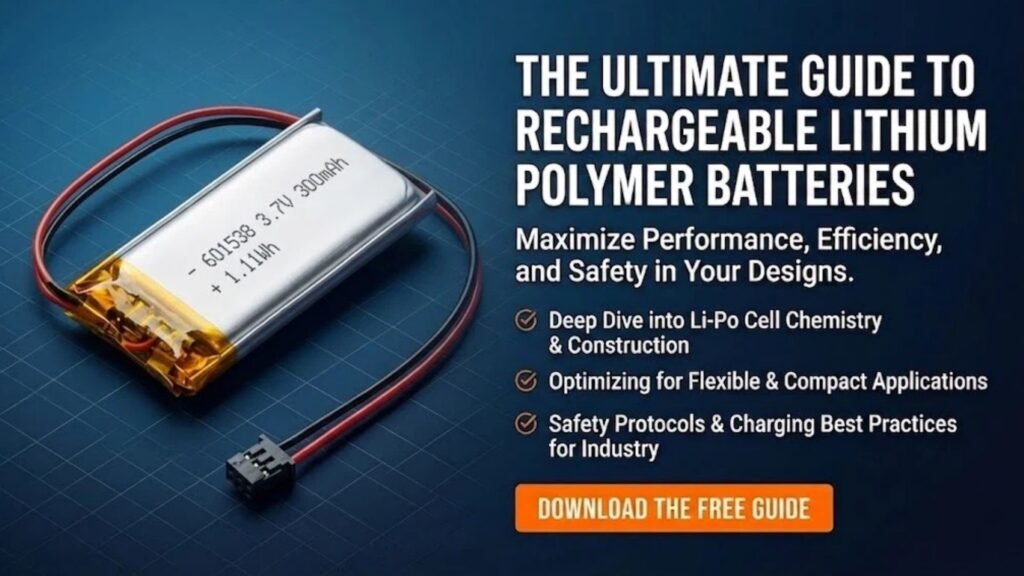
A rechargeable lipo battery (lithium polymer battery) is a type of rechargeable battery that uses a gel-like polymer electrolyte instead of the liquid electrolyte found in traditional lithium-ion batteries. This design allows for:
-
Flexible shapes and sizes – can be as thin as 3.0mm
-
Lightweight construction – no heavy metal casing
-
High energy density – more power in less space
-
Customizable form factors – fits any device design
-
Rechargeable – can be used hundreds of times
Unlike disposable batteries, rechargeable lipo batteries can be charged and discharged 300-500+ times, making them cost-effective and environmentally friendly.
Key Specifications to Understand
| Specification | What It Means |
|---|---|
| Nominal Voltage | Typically 3.7V per cell – the standard voltage for most portable devices |
| Capacity (mAh) | Higher = longer runtime. Ranges from 20mAh to 10,000mAh+ |
| Charge Cycles | Number of times the battery can be charged and discharged before capacity drops below 80% |
| Discharge Rate (C-rating) | How quickly the battery can deliver power – higher C-rating for high-power devices |
| Operating Temperature | The temperature range the battery can safely operate in |
| Cycle Life | 300-500+ cycles to 80% capacity |
Advantages of Rechargeable Lipo Batteries
1. High Energy Density
More power in a smaller, lighter package – ideal for compact portable devices.
2. Customizable Shapes
Can be manufactured in almost any shape or size to fit specific device designs.
3. Long Cycle Life
300-500+ charge cycles – 2-3 times longer than standard rechargeable batteries.
4. Low Self-Discharge
Retains charge when not in use – ready to use when you need it.
5. No Memory Effect
Can be recharged anytime without performance loss – no need to fully discharge before charging.
6. Wide Operating Temperature
Performs well in various environments.
Common Applications of Rechargeable Lipo Batteries
| Industry | Applications |
|---|---|
| Wearable Devices | Smartwatches, fitness trackers, smart glasses, smart rings |
| Consumer Electronics | Smartphones, tablets, TWS earbuds, Bluetooth speakers |
| Medical Devices | CGM monitors, ECG patches, portable diagnostic equipment |
| IoT Sensors | Smart home sensors, environmental monitors, asset trackers |
| Portable Power | Power banks, portable speakers, camping lights |
| Industrial Equipment | Handheld scanners, test equipment, portable tools |
How to Choose the Right Rechargeable Lipo Battery
Step 1: Determine your voltage requirement
Most portable devices operate on 3.7V single-cell configurations. Check your device specifications.
Step 2: Choose the right capacity
Higher mAh = longer runtime, but also larger size. Balance runtime with space constraints.
| Capacity | Typical Runtime | Best For |
|---|---|---|
| 20-100mAh | 1-4 hours | Small earbuds, sensors |
| 100-500mAh | 4-12 hours | Fitness trackers, small wearables |
| 500-2,000mAh | 12-24 hours | Smartwatches, portable speakers |
| 2,000-5,000mAh | 24-48+ hours | Tablets, power banks |
Step 3: Check physical dimensions
Ensure the battery fits your device enclosure. Lithium polymer batteries can be customized to fit any space.
Step 4: Consider protection features
Look for built-in PCM (Protection Circuit Module) that provides overcharge, over-discharge, and short-circuit protection.
How to Charge Rechargeable Lipo Batteries
What you need:
-
Lipo balance charger (supports your battery’s cell count)
-
Correct balance lead connection
-
Fire-safe charging bag
Step-by-step:
-
Connect the main power leads to the charger
-
Connect the balance lead to the charger’s balance port
-
Set charger to the correct cell count (1S for 3.7V)
-
Set charging current to 1C (e.g., 0.5A for a 500mAh battery)
-
Start charging and monitor the process
-
Disconnect when the charger shows “Complete”
For detailed charging instructions, see our [How to Charge Lipo Batteries] guide.
Rechargeable Lipo Battery vs Li-Ion – What’s the Difference?
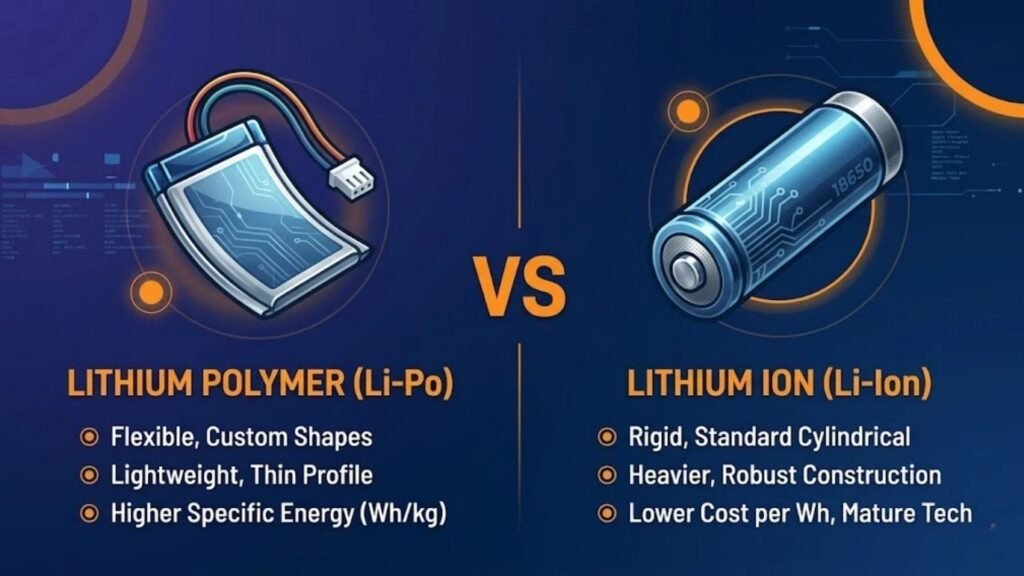
| Feature | Lipo Battery | Li-Ion Battery |
|---|---|---|
| Electrolyte | Gel-like polymer | Liquid |
| Shape | Flexible, customizable | Rigid cylindrical or prismatic |
| Weight | Lighter | Heavier |
| Energy Density | High | Comparable |
| Safety | Less prone to leakage | Can vent if punctured |
| Cost | Higher | Lower |
| Best for | Compact, custom designs | Standard applications |
Frequently Asked Questions
1. How long does a rechargeable lipo battery last?
Under normal use, a lipo battery lasts 300-500 charge cycles (3-5 years of regular use).
2. Can I leave my rechargeable lipo battery on the charger overnight?
No. Leaving a lipo battery on the charger overnight carries safety risks. Always monitor the charging process.
3. Why is my rechargeable lipo battery swelling?
Swelling indicates internal damage, overcharging, or overheating. Stop using it immediately and dispose of it properly.
4. How should I store rechargeable lipo batteries?
Store at 40-60% charge in a cool, dry place (15°C – 25°C). Check voltage every 1-2 months.
5. Can I use a regular charger for rechargeable lipo batteries?
No. Only use chargers specifically designed for lipo batteries. Regular chargers can provide incorrect voltage and create safety risks.
6. What is the difference between 3.7V and 7.4V batteries?
3.7V is a single-cell configuration. 7.4V is a two-cell configuration (2S) that delivers more power.
Custom Rechargeable Lipo Batteries from A&S Power
At A&S Power, we manufacture custom rechargeable lipo batteries for OEM buyers across multiple industries. From wearables and medical devices to IoT sensors and portable electronics, we deliver tailored solutions with safety and performance in mind.
✅ Custom dimensions and capacities
✅ OEM labeling and packaging
✅ UL, CE, RoHS, and UN38.3 certification
✅ Engineering support from concept to production
📄 Request a Technical Datasheet – Contact Us
📞 Speak with Our Engineering Team – Get In Touch
🔗 Browse Our Custom Battery Solutions – View Products
Dongguan A&S Power Technology Co., Limited.
Building 1, No. 2, Keji 9th Road, Songshan Lake, Dongguan, Guangdong, China
📞 +86 137 1383 1631 | ✉ info@enerbe.net